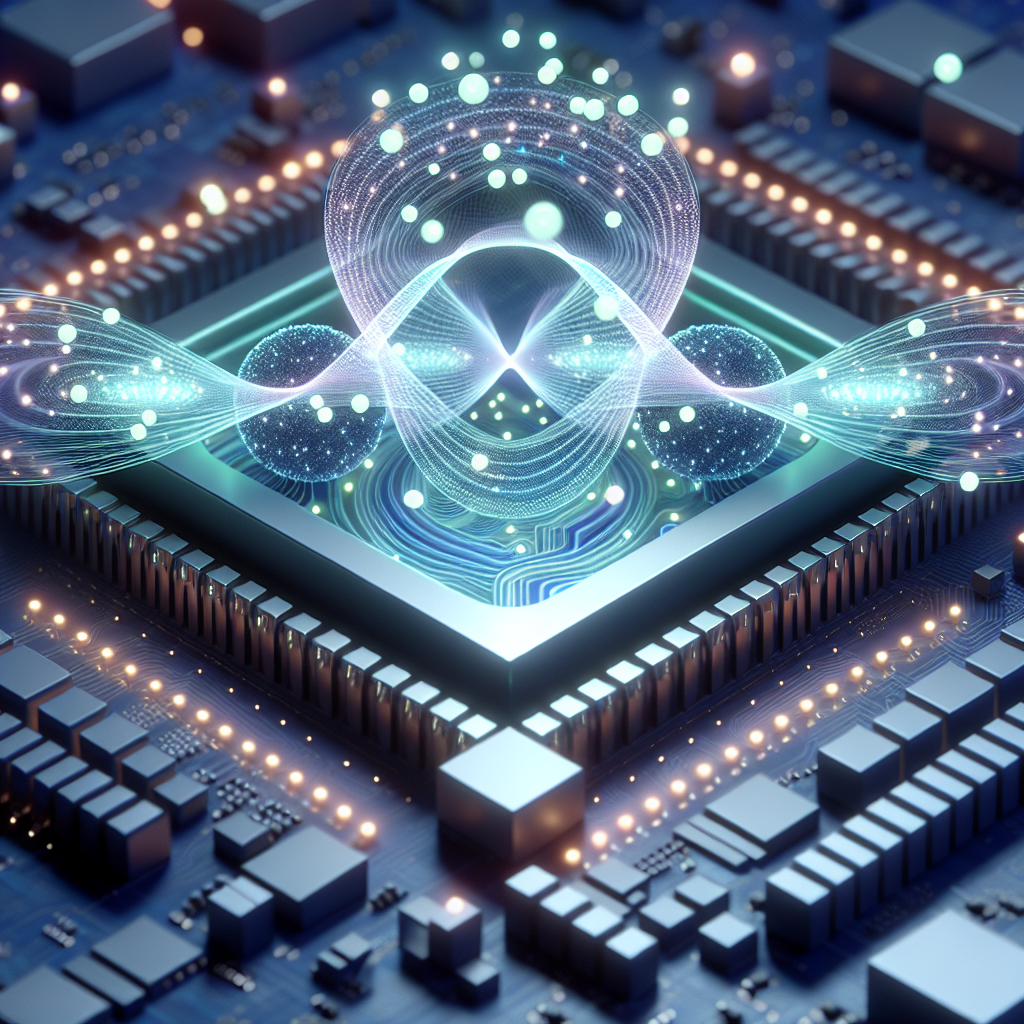
In the first part, we explored Digital Quantum Coprocessors and the fundamentals of digital qubits. This article will cover:
- The architecture of digital quantum coprocessors
- Performance characteristics
- The future potential of this technology
For a better understanding, it is recommended to review the key concepts from the first part.
Homogeneous vs Heterogeneous
There are two types of digital quantum coprocessors:
Homogeneous Coprocessor
- Uses a single pseudo-random number generator (PRNG) and a comparator shared among all qubits
- It is more resource-efficient and simpler to implement
Heterogeneous Coprocessor
- Each qubit has its own PRNG and comparator
- Provides greater flexibility but increases hardware complexity
Homogeneous coprocessors are more scalable for quantum simulations without the complexity of individual control systems for each qubit. In this article, we focus on the homogeneous coprocessor.
Architecture of Digital Quantum Coprocessors
The coprocessor consists of three main layers:
1. Digital Qubit Layer – Manages state representation and probabilistic behavior.
2. Quantum Gate Layer – Simulates quantum logic operations.
3. FPGA Processing Layer – Handles execution and parallelism.
Digital Qubit Layer
- Multi-Bit Registers – Store digital qubits as a series of bits representing probabilistic states.
- Wave Function Calculator – Determines the probability of a qubit being in state |0? or |1?.
- Pseudo-Random Number Generators – Introduce randomness to simulate quantum behavior.
Quantum Gate Layer
- Quantum Logic Gates – Classical implementations of gates such as Hadamard, CNOT, and Phase.
- Lookup Tables – Precomputation of probabilistic results from gate applications.
- Conditional Operations – Modification of qubit states based on predefined rules.
FPGA Processing Layer
- Arithmetic Units – Calculate necessary updates to qubit states after applying quantum gates.
- Registers and Flip-Flops – Store and update digital qubit states.
- Multiplexers and Logic Circuits – Data processing across multiple qubits.
- Parallel Processing – Executes multiple qubits simultaneously for better performance.
Digital Quantum Coprocessors vs Real Quantum Computers
| Feature | Real Quantum Computers | Digital Quantum Coprocessors |
|----|----|----|
| Memory and State Retention | They have no classical memory | Use registers for state storage |
| Error Correction | Need quantum error correction | Use traditional verification methods |
| Decoherence | Affected by quantum noise | Do not suffer decoherence |
Conclusion
FPGA-based digital quantum coprocessors represent an intermediate point between classical and quantum computing. By simulating quantum behavior in a digital environment, these systems allow experimenting with quantum algorithms and moving closer to practical solutions in quantum computing.
At Q2BStudio, we specialize in developing advanced technological solutions, including hardware and software integration to optimize the performance of digital quantum simulations. With our expertise in development and innovation, we help companies adopt new technologies and improve their infrastructure with customized solutions.