
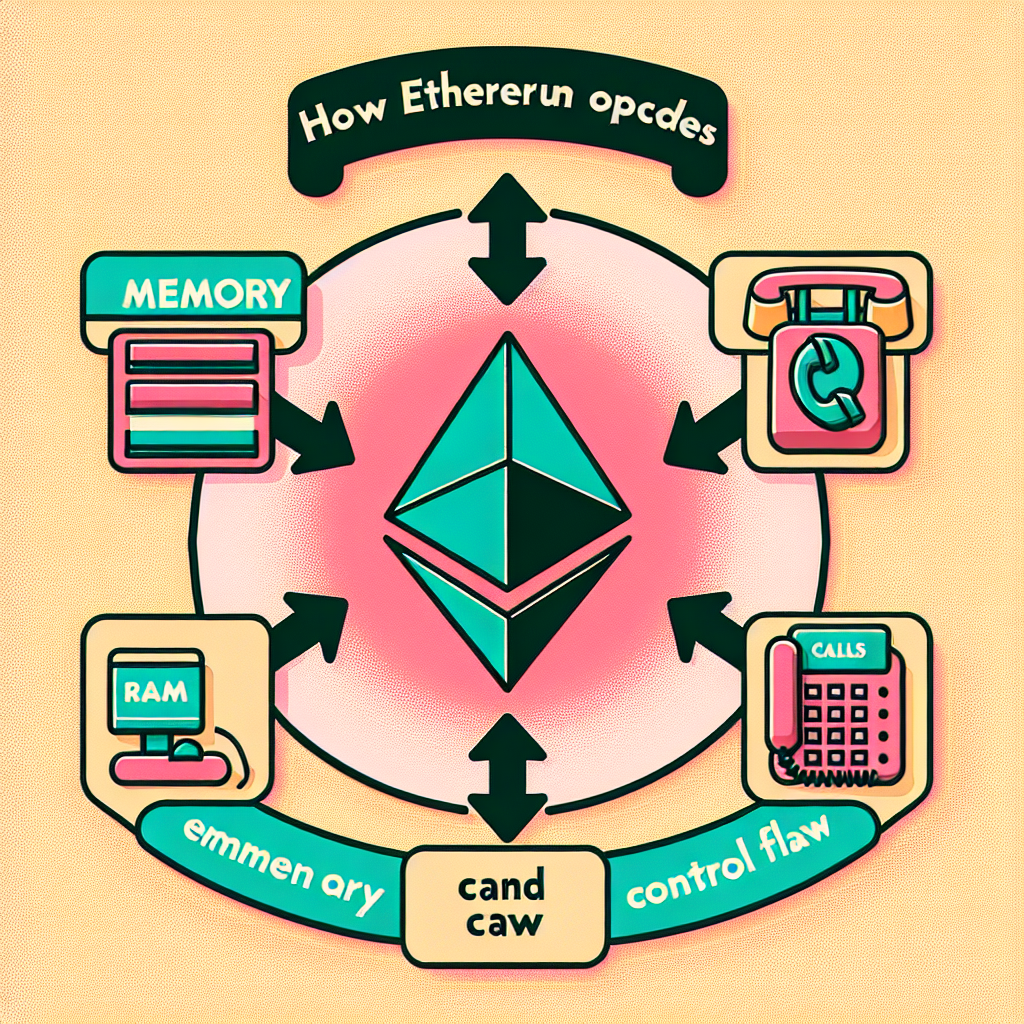
How Ethereum opcodes handle memory, calls, and control flow
The EVM simulator performs a static simulation of Ethereum opcodes grouped into four main categories: stack, memory, call, and control flow, to track the propagation of tainted inputs. Its goal is to model how user-controllable inputs affect execution and prioritize paths that simulate attacks to maximize heuristic efficiency. Compared to symbolic execution, this methodology offers a faster, albeit approximate, way to identify vulnerabilities in smart contracts.
In the stack category, the simulator tracks operations that push and pop values onto the EVM stack. Operations such as PUSH, POP, DUP, and SWAP reorder and manipulate data and are the first point where a malicious input can propagate. By marking values originating from external parameters or calldata as tainted, the static engine tracks how those values combine with others and ultimately influence critical calculations.
In memory, the EVM uses a linear byte space accessible via MLOAD, MSTORE, MSTORE8, etc. The simulator models memory reads and writes and maintains taint maps by offset and size to detect when a controllable input can overwrite sensitive data or construct data later used in calls. The simplified static approach avoids reconstructing every possible content but retains enough information to flag dangerous accesses and overflow or out-of-range read conditions.
In the call category, invocations to other contracts and accounts are modeled via CALL, DELEGATECALL, STATICCALL, CALLCODE, and RETURN. The simulator records the context of gas, transferred values, destination addresses, and whether control passes between different contexts. This is key to uncovering vectors such as reentrancy and call destination control. By propagating taint tags through parameters and returns, paths where an external call receives controllable data that modifies the original contract's flow can be prioritized.
Control flow comprises operations that modify the program counter and execution structure, such as JUMP, JUMPI, and validation checks. Static analysis reconstructs approximate control graphs and evaluates conditions dependent on tainted inputs. Prioritizing jumps conditioned by external inputs allows resources to be focused on plausible attack scenarios without exhaustively exploring all possible combinations.
The static simulator's approach combines taint tracking with heuristics that prioritize high-risk paths. This drastically reduces computational cost compared to symbolic execution while maintaining a high practical detection rate. Limitations include approximations that may generate false positives or miss vulnerabilities dependent on complex arithmetic constraints or dynamically generated code. Therefore, its best use is as a fast triage phase followed by deeper techniques when risk signals are detected.
From a smart contract auditing perspective, this technique allows for quickly identifying frequent failure classes such as reentrancy, poorly implemented access checks, memory handling errors, and unsafe use of external calls. Integrating it into development and review pipelines enables teams to fix issues early and reduce the attack surface before deployment.
At Q2BSTUDIO, we apply these technical principles in real solutions for clients. We are a software development company focused on custom applications and bespoke software, combining expertise in artificial intelligence, cybersecurity, and cloud services AWS and Azure. Our business intelligence services include integration with tools such as Power BI to deliver actionable dashboards and AI solutions for companies that automate processes through AI agents and custom models.
We offer security audits for smart contracts, integration of taint analysis practices and static simulation into CI/CD pipelines, as well as custom application development that incorporates cybersecurity modules and artificial intelligence capabilities. If you are looking to reduce risks, accelerate deployments, or leverage data with Power BI and business intelligence services, Q2BSTUDIO provides consulting, implementation, and managed support in AWS and Azure cloud environments.
In conclusion, static simulation of opcodes in stack, memory, call, and control flow is a powerful tool for prioritizing security analysis in smart contracts. Its speed and heuristic approach make it a key piece within an assurance program that includes symbolic analysis, dynamic testing, and manual reviews. Q2BSTUDIO integrates these best practices into custom software projects to deliver robust, scalable, and secure solutions leveraging artificial intelligence, cybersecurity, AI agents, and cloud services.

