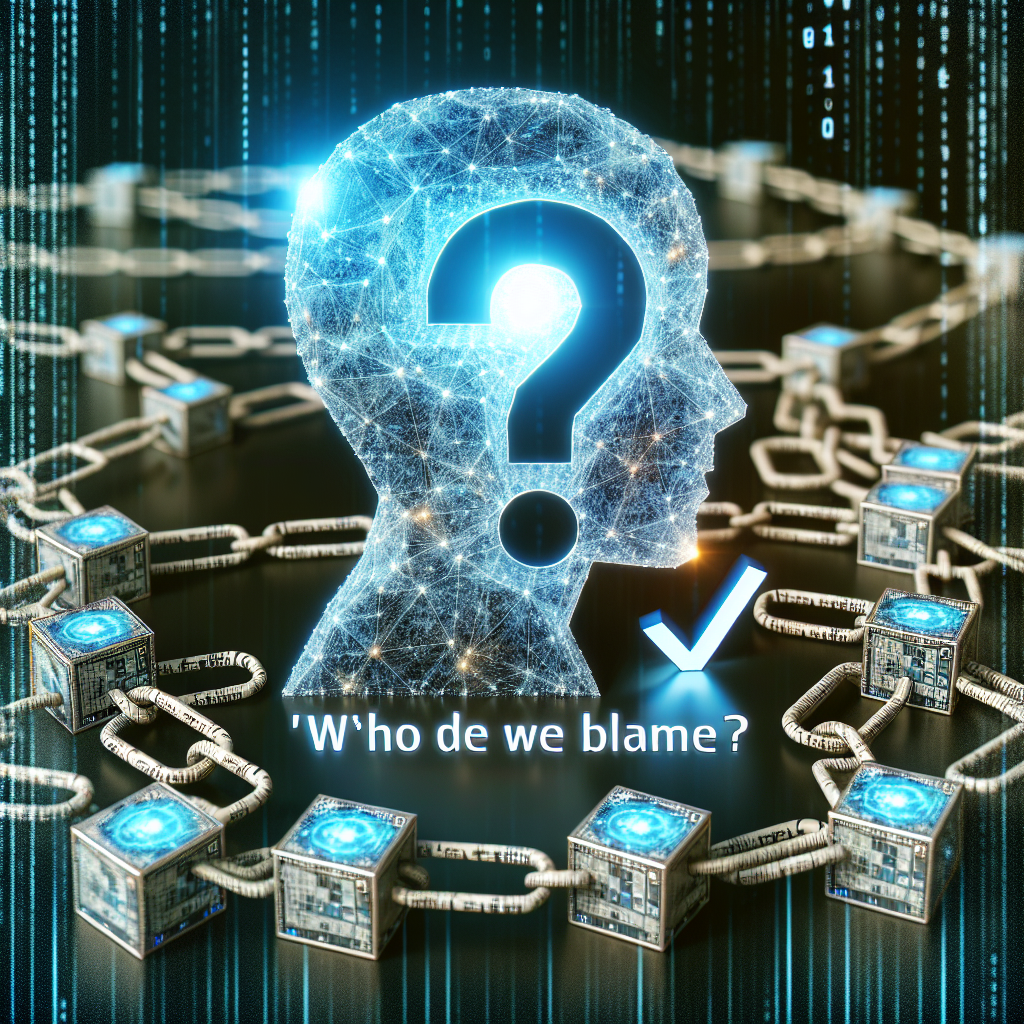
Let's be honest: the combination of AI and blockchain has been promoted as the ultimate solution for the future. AI brings intelligence, blockchain ensures trust. Together, they seem to create a decentralized and intelligent system that no one can corrupt and everyone can trust.
Until it fails.
When that happens, the big question arises: Who is responsible? And instead of clear answers, what we get is a game of finger-pointing. It's time to talk about what happens when AI fails within blockchain. We're not talking about simple server errors or wrong chatbot responses, but critical failures in a system that was supposed to be unbreakable.
And most importantly: who takes responsibility?
The idea of combining AI with blockchain was born from good intentions. AI processes and acts on large amounts of data, while blockchain provides transparency and decentralization. In theory, we get systems that can think and adapt without needing a central authority, with smart contracts that not only execute orders but also analyze data, make predictions, and make decisions.
In practice, reality is more complex.
Let's take a decentralized lending application that uses AI to evaluate applicants. It not only analyzes the digital wallet history but also trading behavior, previous interactions in financial protocols, and even social media presence. It then assigns a credit score based on that data.
What if the AI marks someone as high risk simply because they once invested in a cryptocurrency that dropped in value? That person won't be able to access a loan, even if they have never defaulted on payments.
So, whose fault is it? The developer? The data? The AI model? The blockchain?
The smart contract executed its logic correctly, but the logic was wrong. Or the data was flawed. Or the model training had biases.
In traditional systems, if something fails, the company takes responsibility, issues apologies, or implements fixes. But in decentralized environments, the lack of a central control point means there is no one specific to blame. This can be an advantage in terms of security and censorship resistance, but it is also a problem when failures occur.
Recent studies show that less than 30% of users fully trust AI systems, especially in financial applications. When they are also told that these AIs operate in a decentralized environment without customer service, trust is even lower.
The real problem is not AI or blockchain, but the system design. AI works with probabilities: it learns, estimates, and improves. Blockchain is rigid and deterministic: it executes instructions exactly. To combine them effectively, mature and well-thought-out design is needed, something often sacrificed in the rush to launch products.
Another major challenge is legal and ethical aspects. If an AI system discriminates in a traditional bank, the institution is legally responsible. But if an automated system operated by a DAO unfairly denies a loan, who can be held accountable? Can decisions be reversed when they are recorded on the blockchain?
We have created systems with real impact, but without a clear responsibility structure. This is not innovation; it is a legal problem waiting to happen.
But there are solutions to improve the integration of AI and blockchain:
1. Transparent models – Use open-source AI models or at least ensure visibility into how decisions are made.
2. Human oversight – Allow human review for critical decisions instead of leaving everything to smart contracts.
3. Model versioning and rollback – Implement ways to update or revert faulty AI models used in smart contracts.
4. Off-chain computation and on-chain validation – Run AI models off the blockchain, using oracles to verify and record results without compromising network integrity.
Ultimately, the question is not just who to blame when AI on blockchain fails, but how we design systems that avoid these problems from the start.
At Q2BSTUDIO, as specialists in development and technological services, we understand the challenges of artificial intelligence and blockchain technology. We focus on developing innovative solutions that balance transparency, control, and efficiency, ensuring that digital transformation is safe and reliable for businesses and users.
It's not just about avoiding technological failures. It's about building solutions that protect those who use them. At Q2BSTUDIO, we believe the true success of AI and blockchain lies not in their potential, but in how they are implemented responsibly.