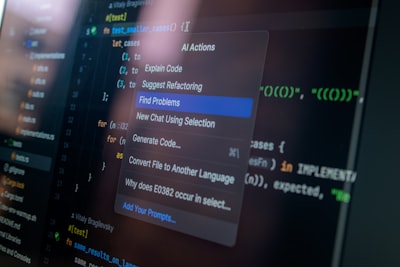
Automatic code generation using large language models (LLMs) has gone from being a technical curiosity to becoming an indispensable tool in modern software development. However, despite their ability to produce functional building blocks quickly, these models carry a critical problem: the inherent lack of security. It's not uncommon for a code wizard to generate an unparameterized SQL query or a function that allows injections, leaving the door open to cyberattacks. For companies looking to build robust custom applications, this fragility is unacceptable. This is where an innovative technique that combines artificial intelligence and model alignment comes into play: task vectors, capable of correcting the course of LLMs without the need for massive retraining or subsequent adjustments.
Until now, most efforts have focused on separately evaluating the functionality and security of the generated code, or applying patches after generation. But this approach is reactive and costly. The proposal to use task vectors – linear operations on the weights of the model – allows the behavior of the LLM to be modified in a precise and efficient way. In essence, it's about adding or subtracting addresses in the model's weight space to power desired attributes, such as functional and secure code generation, without losing performance. This is achieved through an alignment process that does not require specialized decoding, which reduces latency to practically imperceptible values (below 1% compared to the base model).
One of the most promising applications of this technique is the creation of systems capable of generating code that simultaneously meets two requirements: that it compiles and executes correctly (functional) and that it does not present known vulnerabilities (secure). This is especially relevant in environments where custom software must be deployed on critical infrastructures, such as those offered by AWS and Azure cloud services. By integrating this type of alignment into the training or fine-tuning phase, companies can dramatically reduce the need for manual security reviews, speeding up development cycles without sacrificing cybersecurity.
The concept of task vectors is not new in the realm of natural language processing, but its application to code represents a quantum leap. While in text they are used to balance utility and toxicity, in code generation they are applied to balance syntactic correctness and the absence of exploits. For example, a model trained with task vectors can learn to avoid insecure patterns such as using eval() in Python or string concatenation in SQL, without the need for explicit rules. This is possible because vectors capture the 'direction' of the desired behavior from contrasting examples.
For organizations that rely on artificial intelligence to optimize their development processes, this technique represents a golden opportunity. Instead of relying on external filters or post-build static analysis tools, security can be built directly into the model that produces the code. This aligns perfectly with Q2BSTUDIO's vision, where we offer cybersecurity and pentesting solutions that cover the entire software lifecycle, from design to production. Combining task vectors with a comprehensive security strategy allows companies to reduce risks and comply with regulations such as GDPR or ISO 27001 without slowing down innovation.
In addition, the versatility of task vectors makes them compatible with other modern approaches, such as AI agents that automate repetitive tasks in the development chain. An agent that generates code can be tuned with security vectors, while another specialized in testing can apply robustness vectors. In this way, an assisted generation ecosystem is built that not only accelerates the creation of custom applications, but also guarantees levels of quality and security that are impossible to achieve with traditional methods. Companies that already use business intelligence services such as Power BI can benefit equally, as the generation of DAX queries or data transformation scripts can also be protected against injections or malpractices.
From a business perspective, implementing task vectors does not require an exorbitant investment in infrastructure. As these are operations on the weights of existing models, they can be applied on pre-trained LLMs and adjusted with relatively small datasets. This democratizes access to secure code generation, allowing even SMEs to adopt AI for business without relying on large research teams. At Q2BSTUDIO, as a software and technology development company, we accompany our clients in the integration of these capabilities, offering everything from artificial intelligence consulting to the creation of turnkey solutions ranging from process automation to cloud migration.
However, it is important to note that task vectors are not a silver bullet. They work best when you have a representative dataset of functional, secure code versus insecure code. The quality of the vector depends directly on the quality of the examples. That's why we recommend combining them with good cybersecurity practices, such as regular audits and penetration testing. In this sense, the AWS and Azure cloud services offer native security tools that can complement the alignment of the model, but the code generation layer is the ideal starting point to prevent vulnerabilities at the source.
Looking ahead, it is foreseeable that AI code generation will reach maturity levels where security is an implicit attribute, not an added feature. Task vectors are a firm step in that direction. Companies that adopt these techniques will soon gain a competitive advantage, developing custom software faster, cheaper, and, above all, more reliable. At Q2BSTUDIO, we are ready to help organizations navigate this transition, offering artificial intelligence services, cross-platform application development, and Business Intelligence solutions with Power BI that directly benefit from these innovations. The key is to understand that security and functionality are not competing goals, but two sides of the same coin, and that with the right tools, both can be achieved simultaneously and efficiently.
.jpg)