
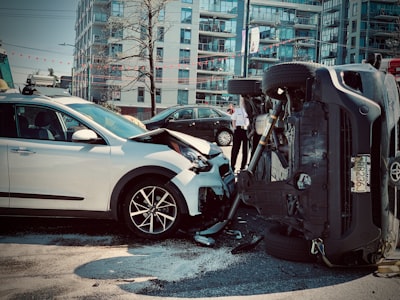
Autonomous driving has ceased to be a futuristic concept and has become a technological reality that is advancing by leaps and bounds. However, one of the biggest challenges remains ensuring that AI systems that make decisions behind the wheel are able to react correctly to critical incidents. Traditional computer vision models have evolved into multimodal architectures that integrate language and vision, but evaluating their performance in situations of real danger remains a complex task. This is where AUTOPILOT VQA comes into play, a benchmark specifically designed to measure the reasoning capacity of these models in the face of road incidents recorded by dashcams.
Unlike generic datasets that focus on object recognition or scene description, AUTOPILOT VQA proposes questions structured around real events and near misses. The benchmark covers categories such as weather and lighting conditions, type of road environment, surface condition, signage, types of entities involved, location of the impact and even reasoning about the avoidability of the accident. This approach forces models to go beyond simple visual detection and understand temporal and causal relationships between elements in the scene. For companies developing driver assistance systems or autonomous vehicles, having a standard like this is critical to validating the robustness and safety of their solutions.
From a technical perspective, the evaluation of vision-language models (VLM) in this context involves challenges such as temporal reasoning, attention to peripheral details, and interpretation of ambiguous language. A model that correctly answers 'Was the traffic light red before impact?' needs to not only see the traffic light, but remember its status at an earlier instant. This demands architectures with memory and sequential reasoning capacity. Companies that integrate AI into their products, such as Q2BSTUDIO, which offers AI solutions for enterprises, can leverage this benchmark to fine-tune their models before deploying them in real-world environments. Validation using specific benchmarks reduces risks and accelerates the adoption of safer technologies.
The value of AUTOPILOT VQA also lies in its ability to detect biases and weaknesses in models. For example, a system trained mostly in daytime conditions might fail when analyzing nighttime or foggy incidents. By categorizing questions by environmental conditions, benchmarking allows you to identify specific areas for improvement. This is especially relevant for companies looking to offer bespoke applications in the automotive sector, where customisation and adaptation to different geographical and climatic scenarios are key. In addition, the integration of cloud services such as AWS or Azure allows you to scale the processing of large volumes of dashcam video to train and evaluate these models efficiently.
In the business arena, the adoption of secure autonomous systems depends not only on the underlying technology, but also on the trust they generate in users and regulators. A benchmark such as AUTOPILOT VQA provides objective metrics that can be used in safety audits and compliance reports. Companies that develop software for connected vehicles or commercial fleets can benefit from having a technology partner that offers both consulting and implementation. Q2BSTUDIO, with its expertise in AWS and Azure cloud services, helps deploy robust infrastructures to handle real-time analysis of sensor and dashcam data, ensuring low latencies and high availability.
Another relevant aspect is cybersecurity. Self-driving systems are potential attack vectors, from manipulating camera images to injecting malicious commands. Assessing the robustness of models to incidents also includes testing their resilience to adversarial inputs. Companies looking to protect their solutions should consider specialized cybersecurity services. Q2BSTUDIO offers pentesting and cybersecurity to identify vulnerabilities in AI systems, ensuring that models are not only accurate, but also safe from attacks.
Data analytics also plays a crucial role. The huge volumes of data generated by dashcams require business intelligence tools to extract patterns and optimize performance. Power BI and other business intelligence solutions allow you to visualize evaluation metrics, compare results between different models, and make informed decisions about improvements. Companies that integrate these capabilities can accelerate their development cycles and reduce costs.
Finally, the trend towards autonomous AI agents that interact with the environment in real time makes benchmarks such as AUTOPILOT VQA even more necessary. AI agents for business, whether in logistics, distribution, or mobility, must demonstrate reliable reasoning in the face of unforeseen situations. Q2BSTUDIO develops custom software that incorporates these intelligent agents, ensuring that they meet safety and efficiency standards. The combination of vision, language and temporal reasoning is the current frontier of applied artificial intelligence, and having references such as this benchmark is the first step towards truly autonomous and responsible systems.
