
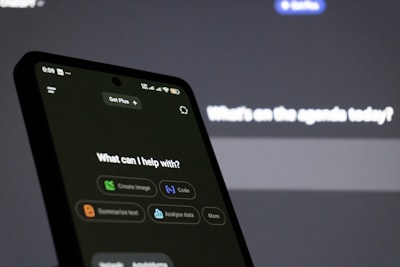
When we talk about artificial intelligence applied to the business environment, we tend to imagine complex systems with a deep mathematical understanding or technicians in white coats fine-tuning algorithms. However, the day-to-day of an AI that truly delivers value to organizations is more like the experience of a versatile assistant, solving everyday tasks – from debugging a Python script to advising on cybersecurity strategy – without needing to be "rocket science." This article offers a practical guide, from a technical and business perspective, on how AI can be efficiently integrated into a company's daily processes, and how companies that bet on tailor-made applications manage to turn that capability into a real competitive advantage.
The concept of "a useful day" for an AI is completely different from that of a human. While an employee can manage a dozen complex tasks in a day, an AI-based system can process hundreds or thousands of requests in the same amount of time. But beyond speed, what is truly transformative is their ability to learn and adapt to specific contexts. Let's imagine a sales team using an AI agent to analyze customer conversations, extract patterns, and suggest personalized responses. That's not science fiction, it's the reality offered by solutions like the ones we developed at Q2BSTUDIO, integrating AWS and Azure cloud services to ensure scalability and global availability.
One of the most amazing aspects of working with an AI in a professional setting is its ability to handle ambiguity. For example, when a user asks "what is the meaning of life?", most attendees respond with a joke (the famous "42"), but a well-trained AI can take advantage of that interaction to detect the user's emotional state and redirect the conversation towards a productive goal. That contextual intelligence is the result of years of development in custom software and language models trained on domain data. Companies that invest in AI for business not only automate tasks, but build an intelligence layer that understands the business and anticipates needs.
But an AI assistant does not operate in a vacuum. To be truly useful, it needs to be backed by a robust architecture. This is where AWS and Azure cloud services come into play, providing the computing power needed to run language models, store conversation data, and handle demand spikes without interruption. For example, a company deploying a customer service chatbot can benefit from the elasticity of Azure to automatically scale during marketing campaigns, without incurring excessive fixed costs. At Q2BSTUDIO we design these solutions with a modular approach, combining business intelligence services such as Power BI to extract real-time metrics on the effectiveness of interactions.
Cybersecurity is another fundamental pillar. When an AI manages sensitive data—customer conversations, financial information, or internal processes—protection must be built in by design. The cybersecurity policies we apply in our projects include end-to-end encryption, multi-factor authentication, and continuous audits. It is not enough for AI to be intelligent; it must also be reliable. That's why, when deploying AI agents that interact directly with corporate systems, it's crucial to perform penetration testing (pentesting) and comply with regulations such as GDPR. In fact, in every artificial intelligence project for companies that we carry out, security is a non-negotiable requirement from the prototyping phase.
Beyond technical capabilities, the real magic happens when AI becomes another member of the team. It does not replace employees, but rather amplifies their productivity. A data analyst can spend hours cleaning spreadsheets, while an AI trained on business rules is able to generate reports in Power BI in seconds, detecting anomalies that would go unnoticed. That's the value of well-implemented business intelligence services: turning data into decisions. And when combined with custom application development, the result is a digital ecosystem where each piece communicates seamlessly.
From Q2BSTUDIO's perspective, the key is to understand that there is no universal AI. Every company has different workflows, culture, and goals. That is why we are committed to custom software design, where artificial intelligence is trained with proprietary data and integrated into existing systems (CRM, ERP or cloud platforms). A practical example: a customer in the logistics sector needed an assistant that would manage delivery incidents in real time. We created an AI agent that, connected to AWS services, processed alerts, prioritized urgent ones, and suggested alternative routes based on traffic. The result: a 30% reduction in response times.
For an AI to have a truly productive "useful day", it is also necessary to design the user experience. Most failed interactions happen because the system doesn't understand the context or the user doesn't know how to communicate. That's why we incorporate conversational design principles and train the models with real examples from the company. A well-calibrated AI not only answers questions, but knows when to refer a human or when to delve into a topic. That's the line between a mediocre assistant and one that actually adds value.
Finally, we cannot forget the human part. Although AI does not have emotions (as we mentioned at the beginning), the perception that users have of it depends largely on how it is presented. A friendly tone, quick responses, and the ability to apologize when you fail (yes, AIs get it wrong, too) build trust. At Q2BSTUDIO we have seen how companies that adopt these technologies achieve greater satisfaction from both customers and employees. Technology, in the end, is a means. The aim is to make work more efficient, safer and, why not, more humane.
In short, a guide to an AI useful day should not focus on complex algorithms, but on how that AI is integrated into an organization's daily operations. From automating repetitive tasks to advanced analytics with Power BI, to cloud security and custom application development, each component plays a role. If your company is considering making the leap to artificial intelligence, remember that it is not rocket science, but about understanding your processes well and having a technological ally as Q2BSTUDIO to transform them. After all, the most useful days are those when technology quietly works so that people can focus on what really matters.
.jpg)
.jpg)
.jpg)
.jpg)