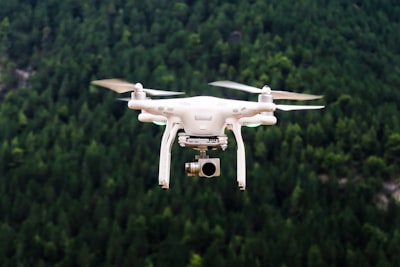
Unmanned aerial vehicle (UAV) control is one of the most dynamic fields of modern robotics, where accuracy and adaptability are critical. Traditional methods such as nonlinear dynamic inversion (INDI) have proven effective, but face limitations when systems operate in highly nonlinear regimes or with unpredictable perturbations. In this context, conditional invertible neural networks (cINNs) represent a significant advance, as they allow modeling complete probability distributions associated with control actions, offering a probabilistic alternative that captures inherent uncertainty. This article explores how these architectures can transform UAV control, and how companies like Q2BSTUDIO are applying AI for enterprises to develop robust and scalable solutions.
cINNs are based on bijective transformations that learn an invertible correspondence between the input variables and a simple latent distribution, usually a Gaussian. In the context of drone control, the network conditions the prediction of control commands (e.g., angular accelerations or thrust) based on the current state and trajectory references. This allows you to generate not only point value, but a complete distribution, which is especially valuable for movement planning tasks under uncertainty or for integrating safety constraints. A recent study with an X8 coaxial drone showed that training a cINN from an INDI controller as the master achieves open-loop reproduction with a coefficient of determination greater than 0.94 and good probabilistic calibration, suggesting that the network can approximate classical controller policy with high fidelity.
However, the real challenge appears in closed-loop scenarios, where the drone must react in real time to disturbances and modeling errors. In the same study, performance in 15 trajectories showed that cINN equals INDI in terms of mean square error of position, but with an acceptance rate of 47% at follow-up. This reveals two main failure modes: attitude divergence to sudden changes in reference and phase delay to high-frequency commands. These failures are not random; indicate limitations in model bandwidth and training data coverage. To overcome them, a comprehensive strategy is required that combines tailor-made applications with data augmentation techniques, regularization, and possibly integration with other robust control approaches.
From a business perspective, the implementation of these models in production environments demands much more than sophisticated algorithms. You need a robust infrastructure that supports distributed training, real-time inference, and deployment on embedded hardware. This is where AWS and Azure cloud services play a crucial role, offering scalable resources to process large volumes of flight data and run parallel simulations. In addition, cybersecurity becomes paramount when drones operate in critical environments or with sensitive data; Therefore, cybersecurity solutions must be integrated by design to protect communications and models against adversarial attacks.
Another innovative aspect is the incorporation of AI agents that act as assistants in the tuning of the controllers. These agents can monitor the performance of the cINN in real time, detect deviations and propose updates to weights or even switch to a rule-based backup controller. To do this, it is essential to have visualization panels that allow engineers to interpret the probability distributions generated. Business intelligence tools such as Power BI, integrated with inference APIs, make it easy to create dashboards that show uncertainty in predictions, the evolution of log-probability-error correlation, and other key indicators. At Q2BSTUDIO, we develop business intelligence services solutions that allow control teams to visualize and analyze the behavior of these complex models.
The future of UAV control using investable neural networks lies in hybridization with reinforcement learning techniques and model-based predictive control. cINNs can act as low-dimensional generative models that feed a path optimizer, reducing computation time without sacrificing accuracy. Recurrent versions that capture temporal dynamics more explicitly are also explored. For companies looking to adopt these methodologies, the recommended path is to start with a pilot that uses synthetic data generated by an expert controller, validate the model in simulation, and then migrate to real hardware with supervision. At Q2BSTUDIO, we offer process automation services that accelerate this development cycle, from data collection to deployment in edge computing.
In conclusion, conditional invertible neural networks represent a powerful tool for probabilistic UAV control, with clear advantages in terms of uncertainty modeling and generalizability. However, its successful implementation requires a multidisciplinary approach that combines advanced algorithms, cloud infrastructure, cybersecurity and business intelligence tools. Companies like Q2BSTUDIO are at the forefront of this transformation, offering AI for businesses and bespoke applications that enable organizations to take full advantage of these technologies. The challenge is not only technical, but also strategic: to invest in the right capabilities to achieve reliable, safe and efficient autonomous control.