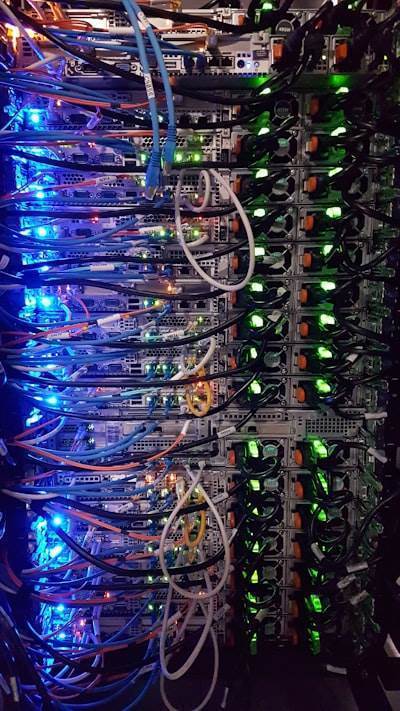
Imagine that a cloud tenant, without needing to compromise any system or use hacking techniques, can cause sharp oscillations in a data center's power consumption to the point of threatening the stability of the electrical grid that feeds it. That is precisely what Bit2Watt proposes, a conceptual attack presented by three researchers from Zhejiang University at the CHES 2026 conference, the IACR's hardware security conference. The mechanism is surprisingly simple: by leveraging ordinary GPU access in the cloud, an attacker or even a legitimate client can force spikes and valleys in energy demand with a speed that electrical infrastructures are not designed to manage. This article analyzes in depth the technical, business and security implications of this new class of threat, and explores how companies can protect themselves through advanced custom software, artificial intelligence and cybersecurity solutions.
Bit2Watt is not a classic exploit. It does not require injecting malicious code, escalating privileges or bypassing authentication mechanisms. Its power lies in the very architecture of cloud services. Modern data centers house thousands of GPUs that consume enormous amounts of energy. When a tenant launches an intensive parallel computing workload (for example, training AI models, rendering or scientific calculations), the consumption of the GPU node skyrockets in seconds. If that user coordinates multiple instances across different regions or even within the same cluster, they can generate synchronized fluctuations that exceed the response capacity of the data center's energy management systems. The researchers demonstrated that these variations can destabilize the local electrical grid, causing voltage drops or, in the worst case, outages due to overload.
The relevance of this finding goes beyond theory. Public cloud operators like AWS, Azure or Google Cloud have invested in load balancing and peak reduction systems, but Bit2Watt exploits a different vector: speed. While traditional mechanisms assume that load changes are gradual or predictable, an attacker can orchestrate abrupt transitions using simple scripts or even legitimate API requests. The potential impact is enormous: if a data center consumes tens of megawatts, a 20-30% spike in a few seconds can force the grid to activate emergency reserves or, worse, cause cascading blackouts.
From a business perspective, this risk highlights the need for intelligent cloud infrastructure management. This is where companies like Q2BSTUDIO offer critical solutions. Developing custom software that monitors in real time the energy consumption of cloud workloads makes it possible to detect anomalous patterns before they become threats. For example, an AI system trained to recognize suspicious GPU behaviors (such as massive start-ups and stops) can alert the operations team and even activate automatic mitigation mechanisms. Traditional cybersecurity focuses on protecting data and preventing intrusions, but Bit2Watt shows that the physical energy layer also needs protection. Therefore, Q2BSTUDIO integrates pentesting and vulnerability analysis practices specific to cloud environments, assessing not only logical security but also energy resilience.
The public cloud, especially AWS and Azure, offers native tools to limit consumption, such as AWS Compute Optimizer or Azure Autoscale, but these tools are designed for efficiency, not security. A more robust approach is to implement access control policies based on the energy behavior of tenants. This is where Business Intelligence (BI) with Power BI comes into play: by collecting GPU consumption metrics and correlating them with activity logs, organizations can create dashboards that visualize the risk of destabilization in real time. Q2BSTUDIO helps design these dashboards, enabling administrators to make informed decisions about resource allocation and prioritization of critical workloads.
Another mitigation vector is AI agents. An autonomous agent deployed in the cloud orchestration layer can monitor energy demand and, upon detecting a pattern similar to Bit2Watt, reassign loads, pause non-essential instances, or even negotiate with the electrical grid to compensate for fluctuations. These agents are trained with historical data and simulation models, and integrate with cloud provider APIs. Q2BSTUDIO develops these custom agents, adapting them to the specific needs of each client, whether it is a startup deploying AI models or a corporation with critical applications in the cloud.
The Bit2Watt case also opens a regulatory debate. Governments and power utilities will need to collaborate with cloud providers to establish maximum load variation limits per tenant, similar to electrical service quality regulations. In the meantime, organizations that rely on the cloud must take proactive measures. Process automation is key: scripts that monitor consumption and execute corrective actions in milliseconds can turn a potential catastrophe into a minor incident. Q2BSTUDIO offers automation solutions that integrate container orchestration, energy management and real-time alerts.
In summary, Bit2Watt reminds us that cloud security is no longer limited to protecting data; it now encompasses the physical infrastructure itself. Companies that adopt a holistic approach —combining artificial intelligence, cybersecurity, BI and automation— will be better prepared to face this new generation of threats. Q2BSTUDIO, as a software and technology development company, accompanies its clients on this path, offering custom solutions ranging from consulting to the implementation of intelligent agents. The lesson is clear: in a world where a cloud tenant can destabilize an electrical grid without a single exploit, prevention and intelligent monitoring are the best defense.