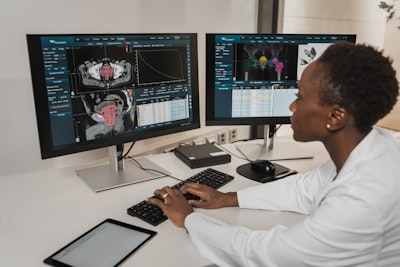
The emergence of artificial intelligence in healthcare has transformed how diseases are diagnosed, clinical histories are managed, and personalized treatments are designed. However, the evaluation of these systems remains anchored in traditional methodologies based on standardized questions, which do not reflect the complexity of a real medical consultation. This gap is filled by Doctorina MedBench-ICD10, a next-generation benchmark that places simulated clinical dialogue at the center of evaluation, enabling measurement not only of diagnostic correctness but also of conversational efficiency and sequential reasoning capability. The proposal moves away from multiple-choice tests and builds scenarios where an agent —whether a human physician or an AI system— must collect medical history, analyze lab reports, images and medical documents, formulate differential diagnoses, and provide personalized recommendations. All this is under the umbrella of the ICD-10 coding system, ensuring precise clinical traceability.
At the core of Doctorina MedBench-ICD10 is the D.O.T.S. metric, which breaks down performance into four dimensions: Diagnosis (accuracy of the clinical conclusion), Observations/Investigations (ability to request and interpret complementary tests), Treatment (appropriateness of proposed interventions), and Step Count (number of exchanges needed to reach an outcome). This structure penalizes both clinical errors and unnecessarily long conversations, incentivizing efficient and accurate interactions. Additionally, the framework incorporates a multi-level quality control architecture, with full regression testing and trap cases designed to detect model degradation in both development and production. The current dataset exceeds 1,000 clinical cases and covers more than 750 diagnoses, providing broad coverage of common and rare pathologies.
From a business perspective, adopting benchmarks like Doctorina MedBench-ICD10 represents a paradigm shift. Organizations developing medical software can no longer settle for validating their models through static exams; they need simulation environments that reflect the uncertainty and dynamism of a real consultation. This is where companies like Q2BSTUDIO bring differential value. Our expertise in developing custom applications allows us to build platforms that natively integrate these benchmarks, personalizing dialogue flows according to client needs. Whether for a hospital wanting to evaluate its virtual assistants or a startup launching a triage chatbot, the ability to adapt the benchmark to specific scenarios is key.
The technological infrastructure supporting these systems must be robust and scalable. Therefore, cloud solutions from AWS or Azure become indispensable allies. At Q2BSTUDIO we offer comprehensive cloud AWS/Azure services, ensuring that evaluation pipelines —from storing thousands of clinical cases to running parallel simulations— execute with high availability and optimized cost. Cybersecurity is an inalienable pillar when handling sensitive health data. Our teams implement advanced protection measures, including encryption, access control, and penetration testing, aligned with regulations like HIPAA or GDPR. In fact, we offer specialized cybersecurity services that shield benchmark environments from data leaks and adversarial attacks.
Another relevant front is results analytics. Data generated by Doctorina MedBench-ICD10 —diagnosis accuracy metrics, response times, error patterns— can be exploited through Business Intelligence tools. With our experience in BI / Power BI, we help organizations build dashboards that monitor model evolution, detect clinical biases, and ground strategic decisions. These dashboards allow, for example, comparing performance across different versions of an AI agent or identifying medical specialties where the system needs improvement.
The concept of AI agents is central to Doctorina MedBench-ICD10. The benchmark not only evaluates language models but requires the agent to maintain a coherent dialogue, remember prior information, and decide when to ask for more data or when to issue a diagnosis. This fits perfectly with Q2BSTUDIO's line of work in developing intelligent agents for clinical process automation. From appointment scheduling to post-discharge monitoring, AI-based agents can integrate with hospital legacy systems, reducing administrative burden and improving patient experience. The combination of a rigorous benchmark with well-trained agents paves the way toward more precise and accessible medicine.
The evaluation methodology of Doctorina MedBench-ICD10 also allows measuring healthcare professionals themselves, offering an objective mirror of their clinical reasoning skills. This opens the door to simulation-based continuous education programs, where physicians can practice with varied cases and receive structured feedback. Institutions adopting this approach —whether through web platforms or mobile apps— require a technology partner capable of orchestrating the entire infrastructure. Q2BSTUDIO, with its track record in healthcare digital transformation projects, is in a privileged position to undertake these developments.
In summary, Doctorina MedBench-ICD10 represents a significant advance in medical AI evaluation, overcoming the limitations of traditional benchmarks by focusing on realistic dialogue and sequential clinical reasoning. But a benchmark, however sophisticated, is only useful if deployed correctly. That is where the value of having a team that understands both technology and the healthcare context comes in. At Q2BSTUDIO we combine custom application development, cloud power, data security, and business intelligence to bring these benchmarks into production. The future of AI-assisted medicine is not only played out in research labs, but in the ability to integrate these tools into daily clinical practice, with benchmarks that guarantee their reliability and efficiency. Doctorina MedBench-ICD10 is a firm step in that direction, and from Q2BSTUDIO we are ready to accompany organizations on this path toward a more realistic, secure, and scalable clinical evaluation.