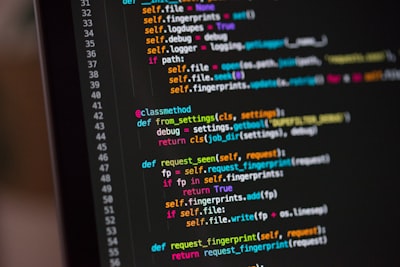
Large language model code generation has reached unprecedented adoption in modern software development. However, its use in production environments, especially when integrated into autonomous agents and compilation systems without line-by-line supervision, reveals a critical fragility: the inability to guarantee that the generated code is semantically correct in the actual execution context. Models can produce references to undeclared variables, missing columns in a database schema, nonexistent library functions, or unsupported command-line options. To address this challenge, an innovative approach known as decode-time grammars has emerged, combining grammar fragments instantiated during generation with runtime environment information. This article explores this technique in depth, its formal foundations, and the practical implications for companies developing custom applications, cloud services, and artificial intelligence solutions.
The core idea of decode-time grammars is simple yet powerful: instead of using a fixed, universal grammar to constrain the model output, grammar fragments are employed that depend on the current environment state. Each 'hole' in generation is associated with a specific policy that selects the appropriate fragment, and a tightening operator replaces open reference positions with typed slots containing the identifiers available at that point (variable names, schema fields, APIs, command-line options). This process ensures not only syntactic correctness but also semantic correctness by preventing references to undefined symbols. Formally, grammar fragments are modeled as environment-indexed grammars ordered by refinement, and it is proven that once the Gamma slot is applied, ghost references are eliminated by construction. Practical implementations, as demonstrated in projects covering languages such as TileLang, SQL, and P4 with models from 0.6B to 236B parameters, eliminate these errors with moderate overhead over standard constrained decoding.
For technology companies, the impact is significant. In custom software development, where integration with proprietary APIs and domain-specific languages is common, the ability to generate ghost-reference-free code drastically reduces debugging time and increases product reliability. Q2BSTUDIO, as a software and technology company, has observed how adopting advanced code generation techniques can transform engineering team productivity. By incorporating semantic constraints derived from the runtime environment, developers can delegate repetitive tasks to AI agents without compromising quality. For example, in projects using custom software for cloud platforms, generating deployment scripts or SQL queries directly benefits from these dynamic grammars, avoiding errors that could lead to costly service disruptions.
The relationship with cybersecurity is also relevant. Generated code containing invalid references can open attack vectors, such as SQL injection or unwanted command execution. Eliminating these ghost references reduces the attack surface. Companies investing in cybersecurity services, like those offered by Q2BSTUDIO in their pentesting offering, can integrate these techniques to automatically verify that AI-generated code does not introduce vulnerabilities. Additionally, in cloud AWS/Azure environments, where resource orchestration is managed through templates and scripts, semantic accuracy is critical. An error referencing a nonexistent resource can trigger cascading failures. Decode-time grammars provide a validation layer that complements infrastructure-as-code policies.
Another area where this technology shines is Business Intelligence (BI) and Power BI. Automatic generation of DAX queries or M expressions for data transformation requires precise knowledge of the underlying schema. With grammar fragments instantiated from the actual data model, AI agents can produce correct and efficient formulas. Q2BSTUDIO, through its BI / Power BI solutions, leverages these techniques to offer intelligent assistants that accelerate report and dashboard creation, reducing manual effort and minimizing interpretation errors. Similarly, in process automation using AI agents, the ability to generate integration code between heterogeneous systems becomes reliable, as the agent knows exactly which functions and APIs are available at generation time.
From a technical perspective, implementing decode-time grammars requires two key components: offline grammar induction and online policy resolution. Offline induction analyzes the runtime environment (e.g., a database schema or an API) and extracts all valid identifiers, building parameterized grammar fragments. During generation, the decoder queries the policy system to determine which fragment to apply at each point, and the tightening operator replaces placeholders with actual candidates. This process is efficient because constraint application occurs at the token level without requiring a second verification step. Experiments with models up to 236B parameters show minimal overhead compared to grammar-constrained decoding, making it viable for real-time applications.
The implications for the future of software development are profound. As LLMs become more deeply integrated into CI/CD pipelines and integrated development environments (IDEs), having formal guarantees of semantic correctness will be a competitive differentiator. Companies that adopt these techniques early will be able to offer safer and more efficient code generation tools. Q2BSTUDIO stands at the forefront, combining its expertise in artificial intelligence with deep enterprise environment knowledge. Whether in custom application projects, cloud migrations, or BI system implementations, the ability to generate error-free semantic code accelerates development cycles and reduces operational risks.
In conclusion, decode-time grammars represent a significant advancement in LLM-based code generation, overcoming the limitations of approaches based solely on syntactic grammars. By linking generation to the actual environment, semantic correctness is achieved that was previously difficult to attain. For companies seeking to maximize return on investment in AI and automation, integrating these techniques into their workflows is a natural step. Q2BSTUDIO offers consulting and development services to implement these solutions, ensuring that AI-generated code is as reliable as that written by human experts.