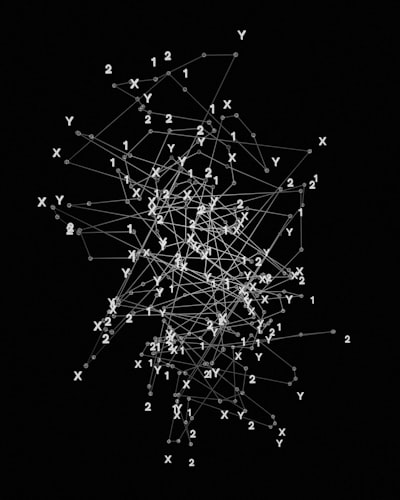
The cops and robbers problem in graph theory is a classic that has fascinated mathematicians and computer scientists for decades. It is a pursuit-evasion game where a group of cops tries to capture a robber moving along the edges of a graph. The fundamental question is whether a strategy exists that guarantees capture for a given number of cops. Beyond its theoretical interest, this problem has deep implications in fields such as artificial intelligence, automated planning, and cybersecurity. In this article, we explore how domain design for this game can be modeled as a non-deterministic planning problem, and how companies like Q2BSTUDIO can leverage these concepts to develop innovative technological solutions.
To understand domain design, we must first grasp the dynamics of the game. In an undirected graph, cops and the robber occupy vertices. The cops move coordinately, while the robber responds to their movements. The cops' goal is to occupy the same vertex as the robber at some turn. Determining whether a graph is 'k-copwin' (i.e., k cops can guarantee capture) is a classic game theory problem. However, from a computational perspective, we can model this scenario as a non-deterministic planning problem, where the cops' actions are controlled by the planner and the robber's actions are unpredictable but bounded by graph rules.
This approach allows using state-of-the-art planners to determine the existence of a winning strategy. The cops' action is modeled as non-deterministic because they must consider all possible robber responses. The robber, in turn, moves deterministically within its legal set of moves. This asymmetry is key to domain design: the planner must anticipate all opponent moves and generate a policy that, regardless of the robber's decisions, leads to capture. In practice, this means defining a state space that includes all agent positions, possible actions, and transitions. Planners such as PDDL (Planning Domain Definition Language) can be extended to handle non-deterministic actions, turning the search for solutions into a perfect-information game theory problem.
In the business realm, this kind of modeling has direct applications. For example, in cybersecurity, incident response teams can be seen as cops chasing an attacker (robber) within a corporate network. Modeling the network as a graph allows planning containment and eradication strategies. Q2BSTUDIO develops custom applications that integrate AI to simulate these scenarios, helping companies strengthen their security posture. For instance, a system can be designed that, upon detecting an intrusion, automatically executes a plan to isolate the compromised node and deploy response agents (cops) to neutralize the threat.
Another application area is collaborative robotics, where multiple autonomous agents (cops) must coordinate their movements to capture a target in a dynamic environment. Domain design here involves not only the base graph but also real-world constraints such as obstacles, sensors, and communication limitations. The AI agents developed by Q2BSTUDIO can be trained using planning and reinforcement learning techniques to efficiently solve these tasks. For example, in a logistics warehouse, mobile robots can act as cops to intercept misplaced goods or detect unauthorized intrusions.
One of the most interesting extensions of the basic model is the inclusion of different movement rules. For instance, cops might move faster than the robber, or have limited vision. These variations turn the problem into a planning challenge with partial information, where agents must infer the robber's position from observations. Q2BSTUDIO has developed AI solutions that integrate state estimation algorithms and planning under uncertainty, applicable to environments such as smart surveillance or fleet management.
Another relevant aspect is the possibility that the robber is also an intelligent agent capable of anticipating the cops' strategies. In that case, domain design becomes a zero-sum game requiring game theory and multi-agent reinforcement learning techniques. Our team at Q2BSTUDIO has experience implementing these systems using modern AI agent frameworks, and deploys them on cloud infrastructure to ensure scalability.
The cloud plays a fundamental role in executing these simulations. Using cloud AWS or Azure, it is possible to scale computations to graphs with millions of nodes, analyzing capture strategies in real time. Q2BSTUDIO offers cloud services to deploy planning and simulation applications, guaranteeing high availability and performance. Additionally, cloud architecture allows integrating these systems with other enterprise platforms, such as ERPs or CRMs, facilitating automated decision-making.
Furthermore, data generation from these models enables applying Business Intelligence (BI) and Power BI to visualize movement patterns, capture times, and strategy efficiency. Companies can thus make informed decisions about resource allocation in their security or logistics operations. For instance, through interactive dashboards, a security manager can see which network nodes are most vulnerable and how to improve response team distribution.
The use of Business Intelligence in this context allows organizations to measure the performance of their capture strategies. Using Power BI dashboards, metrics such as average capture time, number of required moves, or graph coverage can be analyzed. These data feed back into domain design, enabling real-time adjustments.
Finally, it is worth noting that the underlying graph theory is also useful for modeling communication networks, transportation routes, or even social interactions. Any situation where entities pursue or evade others can be approached with this methodology. Q2BSTUDIO, as a leading company in custom software development, offers consulting and development to transform these concepts into practical solutions, whether to improve cybersecurity, optimize logistics, or create interactive video game experiences.
In summary, domain design for the cops and robbers problem in graphs is not just an academic exercise. It is a powerful tool that, implemented through custom software, can solve complex pursuit-evasion problems in various sectors. At Q2BSTUDIO, we combine expertise in graph theory, artificial intelligence, and software development to create innovative solutions that help our clients optimize their processes and protect against threats.
If your company faces coordination, security, or planning challenges, do not hesitate to contact us. Our team of experts can design and implement a customized domain tailored to your specific needs, leveraging the latest technologies in AI, cybersecurity, and cloud. From graph conceptualization to production deployment, we offer a comprehensive service that turns theory into tangible value.