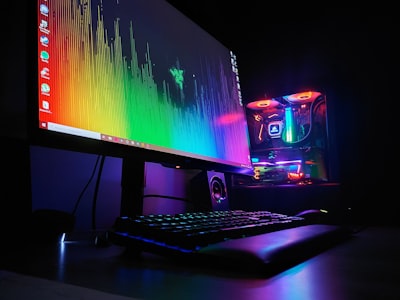
The PC gaming market has undergone a remarkable transformation in recent years, and the democratization of cutting-edge hardware is allowing players to access powerful setups at prices that previously seemed impossible. A paradigmatic case is the possibility of building a gaming PC for $850 that includes components whose individual value exceeds $1,200, thanks to intelligent selection strategies, deals, and resource optimization. In this article, we explore how to achieve that build, which key parts to choose, and how the integration of technology services —such as those offered by Q2BSTUDIO— can further enhance the gaming experience and system management.
The key is to prioritize performance without overspending. One of the smartest decisions today is to opt for DDR5 memory, which offers superior bandwidth and higher speeds than DDR4, improving performance in titles that benefit from reduced latency and data transfer. For an $850 budget, it is feasible to combine a mid-range processor like the Ryzen 5 7600 or Intel Core i5-13400F with a B660 or B650 motherboard that supports DDR5, along with a GPU such as the Radeon RX 6600 or a used/on-sale GeForce RTX 3060. The result is a system capable of running AAA games at 1080p with high FPS rates and room for future upgrades.
The price difference compared to a $1,200 build lies in the brand selection, purchasing refurbished or clearance parts, and choosing a quality but not oversized power supply. For example, a $200 CPU, a $300 GPU, 16GB of DDR5 for $70, a 1TB NVMe SSD for $60, a $120 motherboard, a 650W power supply for $70, and a budget case total around $850. Meanwhile, a $1,200 build would include a more powerful GPU, liquid cooling, more storage, or RGB lighting — elements that enhance the experience but are not essential for good gaming.
Beyond hardware, the true potential of a budget gaming PC lies in the software that accompanies it. Q2BSTUDIO, as a software and technology development company, understands that every user has unique needs. That's why it offers custom software that can personalize interaction with the operating system, driver configuration, or automation of maintenance tasks. Imagine a tool that automatically adjusts DDR5 RAM frequency based on game workload, or frees up system resources when running a demanding title. That is possible through custom software development.
Artificial intelligence (AI) also plays a growing role in gaming. AI agents can analyze player behavior and recommend optimal graphics settings, predict bottlenecks, and suggest component upgrades. Q2BSTUDIO implements AI solutions that integrate directly with the operating system, offering a smoother and more efficient gaming experience. For instance, an AI agent could monitor temperature and GPU usage, dynamically adjusting fan speed or reducing resolution in heavy scenes to maintain fluidity.
Cybersecurity is another fundamental pillar. A cheap gaming PC should not be vulnerable to malware or attacks that steal game accounts or personal data. Q2BSTUDIO provides cybersecurity services including vulnerability audits, advanced endpoint protection, and pentesting to identify flaws. Additionally, their cloud solutions (cloud AWS/Azure) allow storing saves, configurations, and profiles securely, accessing them from any device. This is especially useful for gamers who switch between desktop and laptop PCs.
Data analysis also has a place. With BI/Power BI tools, players can visualize performance metrics —FPS, temperature, RAM usage— over time, identifying patterns and optimizing their system. Q2BSTUDIO develops custom dashboards that integrate with platforms like Steam or Epic Games, providing valuable insights to decide if it's time to upgrade DDR5 memory or the GPU. They can even correlate data from multiple games to recommend specific adjustments.
Finally, process automation through software allows the budget gaming PC to run at its peak without manual intervention. For example, scripts that perform disk cleanup, driver updates, and game save backups periodically. Q2BSTUDIO offers automation services that free the user from repetitive tasks, improving the system's longevity and gaming experience.
In conclusion, building a budget gaming PC for $850 with parts valued at $1,200 and DDR5 memory is an achievable challenge if an intelligent strategy is applied. But the real added value comes from the software ecosystem around it. Companies like Q2BSTUDIO demonstrate that the combination of optimized hardware, custom applications, artificial intelligence, cybersecurity, cloud, BI, and automation can transform a modest system into a high-performance, sustainable gaming platform.