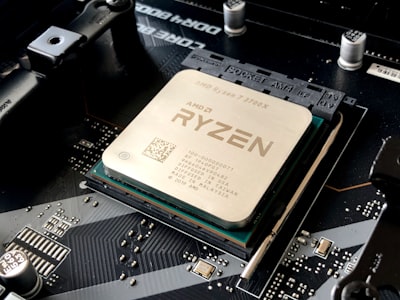
AMD has once again shaken up the enterprise processor market with the announcement of its new Epyc 9996 Venice series, a 256-core beast that promises to deliver 3.4x the performance of the latest Intel Xeon processors. This figure is not just marketing hype; it stems from a completely redesigned architecture combining a 3nm manufacturing process with an enhanced Infinity Architecture interconnect. The 256 cores are organized into 32 chiplets of 8 cores each, all connected via a high-speed bus that eliminates traditional bottlenecks. For companies dealing with intensive workloads such as scientific simulations, 3D rendering, or training artificial intelligence models, this leap drastically reduces processing times.
The comparison with Intel Xeon is significant: while top-end Xeons offer around 56 cores and consume up to 350 watts, the Epyc 9996 Venice maintains a 400W TDP thanks to intelligent thermal management that dynamically scales frequency. In preliminary benchmarks, single-core performance is only about 15% better than its predecessor, but multi-core performance skyrockets to 340% in parallelizable workloads. This makes it the ideal platform for virtualized environments, massive databases, and Big Data analytics. Additionally, it supports up to 12 channels of DDR5-6400 memory and 160 PCIe 5.0 lanes, allowing multiple GPUs and ultra-fast storage devices to be connected without bus saturation.
For companies looking to harness this power, the key lies in having the right custom software. It is not enough to simply mount a server with the new Epyc; applications must be designed to efficiently parallelize tasks, manage cache memory, and minimize latency. This is where Q2BSTUDIO, as a software development and technology company, brings its expertise. Their engineers work side by side with clients to migrate legacy workloads to modern architectures, optimizing algorithms to squeeze every available core. Whether on-premise or in the cloud, the goal is to reduce operational costs and accelerate time-to-market.
Artificial intelligence is one of the fields that benefits most from this hardware. Large language models (LLMs) and computer vision systems require enormous parallel computing capabilities. With the Epyc 9996 Venice, companies can train neural networks in a fraction of the previous time, or even deploy AI agents in real time without relying exclusively on specialized GPUs. Q2BSTUDIO integrates these processors into custom AI solutions, from conversational chatbots to demand prediction systems. Furthermore, cybersecurity is strengthened by the ability to run encryption and threat analysis without affecting overall performance, a critical aspect for sectors such as finance or healthcare.
The cloud also plays a fundamental role. Companies migrating their infrastructures to cloud AWS or Azure can provision instances based on Epyc Venice to reduce cost per compute hour. The price-to-performance ratio is unbeatable compared to equivalent Intel instances, and thanks to cloud elasticity, it can scale on demand. Q2BSTUDIO offers cloud AWS/Azure services to help organizations design hybrid architectures, optimizing workload placement based on criticality. They also deploy Business Intelligence dashboards (Power BI) that monitor real-time usage of these processors, allowing resource adjustments and demand peak prediction.
In the automation domain, these 256 cores allow thousands of concurrent processes to run without degradation. For example, in inventory management or financial transaction processing, the Epyc 9996 Venice can handle peaks of 10,000 operations per second with latencies under 1 millisecond. Companies using custom applications developed by Q2BSTUDIO are already seeing throughput improvements of up to 400%, thanks to a combination of powerful hardware and optimized software. Process automation also benefits: software robots (RPA) can run in parallel without interference, reducing labor costs and human errors.
We cannot forget cybersecurity. With the increase in cores, potential attack vectors also grow. AMD has incorporated silicon-level security technologies such as Secure Encrypted Virtualization and Secure Memory Encryption. However, the software layer is equally critical. Q2BSTUDIO offers cybersecurity audits and pentesting to validate that applications deployed on Epyc Venice have no vulnerabilities. They also integrate intrusion detection and ransomware protection solutions tailored to the multi-core architecture.
In short, the AMD Epyc 9996 Venice marks a turning point in enterprise computing. With 256 cores and 3.4x performance over Intel Xeon, the possibilities are immense. But hardware is only part of the equation; the real value comes when combined with intelligent software and expert services. Q2BSTUDIO positions itself as the ideal technology partner to guide companies through this transition, from custom software design to cloud implementation and AI integration. The future is already here, running at 256 cores per second.