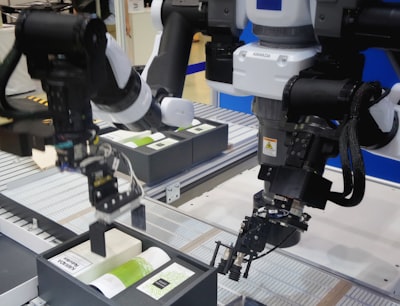
In a world where robotics and artificial intelligence are advancing by leaps and bounds, task planning in shared environments has become a critical challenge. Imagine a smart home where several robots must collaborate to keep the house clean, prepare meals, and assist family members. Or an automated restaurant where robot waiters, chefs, and stockers work together. In these scenarios, traditional planners solve each task in isolation, without considering how their actions will affect future tasks, either their own or others'. The result: accumulated costs, inefficiencies, and terminal states that complicate operations. This is where the concept of 'courteous anticipation' emerges, a revolutionary strategy that allows agents to anticipate the impact of their decisions on collective well-being.
Courteous anticipation is inspired by principles of cooperation and foresight. Instead of acting selfishly or myopically, a courteous robot evaluates not only the immediate cost of its plan, but also the expected future cost for all robots sharing the environment. To do this, it uses independently learned estimators that predict the additional cost its actions will generate in subsequent tasks. This avoids the need for combinatorial joint simulations, facilitating scalability when new agents are added. Essentially, it is anticipatory planning that prioritizes global balance.
This philosophy has a direct parallel in the business and technology world. Organizations adopting artificial intelligence and intelligent agents face similar challenges: how to allocate computational resources, how to prioritize tasks in an ecosystem of interconnected applications, or how to minimize the impact of local decisions on global performance. Courteous anticipation becomes a conceptual model for designing software systems that learn to cooperate, reducing operational costs and improving efficiency.
At Q2BSTUDIO, we understand that technology should be a facilitator of collaboration, not a generator of conflicts. That is why we develop custom software that integrates principles of anticipatory planning and algorithmic courtesy. Our teams implement AI agents capable of predicting future scenarios, using cloud infrastructure such as AWS or Azure to scale dynamically, and applying cybersecurity layers to protect sensitive data. Additionally, we incorporate Business Intelligence tools like Power BI to monitor process performance in real time, enabling proactive adjustments.
The concept of courteous anticipation is not just a robotic theory; it is a guide for building more responsible intelligent systems. When a robot in a restaurant decides not to move a chair because it knows that another robot with less mobility will have to pass through there, it is practicing anticipatory courtesy. Similarly, a company deploying an AI agent to manage orders can design it to avoid overloading an AWS server during peak hours, knowing that other services depend on that same resource. This type of decision, based on predictive models, reduces costs and improves user experience.
Practical implementation of this strategy requires a robust technological ecosystem. For example, a courteous planning system can rely on cloud services from AWS or Azure to run parallel simulations and store estimation models. Cybersecurity plays a fundamental role, as training data and predictions must be protected against unauthorized access. Likewise, BI/Power BI tools allow visualization of key performance indicators (KPIs) of the agents, facilitating strategic decision-making. At Q2BSTUDIO, we combine all these capabilities to offer comprehensive solutions that go beyond simple automation.
An illustrative case study is a smart home with two robots: a cleaning robot and a personal assistant robot. The cleaning robot, when planning its route, might choose not to block the path of the assistant robot that needs to quickly reach a room. If it acts myopically, it would leave the vacuum cleaner in the middle of the hallway, causing a blockage. With courteous anticipation, the cleaning robot calculates the future cost of that action (delaying the other robot) and chooses an alternative. This principle transfers to business software: an inventory management application can delay a heavy update if it knows that another critical module needs network bandwidth. Algorithmic courtesy minimizes bottlenecks.
From a technical perspective, the model presented in the reference article uses independent future cost estimators per robot, trained with historical task data. This allows that when adding a new robot, only its estimator needs to be trained, without retraining the entire system. This modularity is key in business environments where needs change rapidly. At Q2BSTUDIO, we apply this modular approach in the development of process automation and multi-agent systems, ensuring scalability and ease of maintenance.
Experimental results on PDDL (Planning Domain Definition Language) domains show significant reductions in total cost over long task sequences: up to 10.43% compared to myopic planners and 4.03% compared to selfish planners in two-robot environments. In more complex scenarios with three robots (such as a restaurant), the improvement reaches 17.41% and 13.24%, respectively. These data demonstrate that courteous anticipation is not a utopia but a quantifiable reality that can be applied to multiplatform software systems.
The integration of AI agents with courteous anticipation capabilities opens new possibilities in fields such as logistics, intelligent manufacturing, and service robotics. Companies that still rely on static or reactive planning can make the leap toward autonomous and cooperative systems. At Q2BSTUDIO, we offer consulting and development to implement these solutions, combining AI, cloud AWS/Azure, cybersecurity, and BI/Power BI into a coherent ecosystem. Our experience in custom software allows us to adapt these concepts to specific industries, maximizing return on investment.
In conclusion, courteous anticipation represents a paradigm shift in shared task planning. By considering not only the immediate cost but also the future impact on other agents, superior global efficiency is achieved. This approach, supported by AI and machine learning techniques, is perfectly applicable to enterprise software development. At Q2BSTUDIO, we are committed to providing technological solutions that incorporate these principles, helping organizations operate more intelligently, collaboratively, and profitably. Courtesy is not just a human virtue; it is a winning strategy in the digital world.