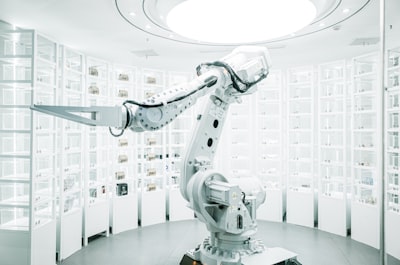
The robotics industry lives a double life. On one hand, headlines and tech fairs show us humanoids that dance, jump, and even mimic facial expressions. On the other, in warehouses, fields, and homes, the robots that truly transform the economy have forms nothing like ours. They are rolling boxes, articulated arms, disc-shaped vacuums, and wheeled machines that travel miles without tiring. This article analyzes why function is defeating form in machine design, and how this trend redefines the global competition between the United States, China, and Japan. Additionally, we explore how companies can integrate these technologies with custom software solutions to optimize their processes.
The promise of a human-like robot has fascinated popular culture for decades. From sci-fi androids to the latest prototypes from Tesla or Boston Dynamics, the idea of a machine that walks, talks, and thinks like us has been the holy grail of robotics. However, economic and technical reality has taken a different path. The most useful robots on Earth do not need legs or a face. What they need is energy efficiency, low cost, and the ability to perform repetitive tasks without failure. That is why Amazon and Symbotic warehouses are full of autonomous platforms moving at 20 mph, farms use laser weeders mounted on 4-ton gantries, and our homes have disc-shaped vacuum cleaners that map every corner.
This divergence between what is sold and what actually works has profound implications for industry. While headlines focus on humanoids, the real revolution is happening in physical intelligence: foundation models that allow any machine—on wheels, tracks, or legs—to understand the world and act upon it. Companies like Physical Intelligence and Skild AI have developed artificial brains that can be installed in any robotic body, decoupling intelligence from hardware. This opens the door for businesses to adopt specialized robots and connect them with advanced AI systems to automate complex processes.
In this context, cloud and cybersecurity play a crucial role. Robots generate massive amounts of data that must be processed in real time. Platforms like AWS or Azure provide the scalability needed to manage fleets of geographically distributed robots. Q2BSTUDIO, as a software and technology development company, helps organizations implement cloud AWS/Azure solutions that ensure the availability and security of these systems. Furthermore, cybersecurity is vital to protect sensitive data and prevent attacks that could paralyze robotic operations. Cybersecurity services like ours allow auditing infrastructures and ensuring that robots and their networks are resilient to threats.
Business intelligence also benefits from this revolution. Data collected by robots in warehouses, factories, or fields can be analyzed using BI / Power BI tools to identify patterns, optimize routes, and predict maintenance. For example, an agricultural robot that records the growth of each plant allows farmers to make data-driven decisions, reducing costs and increasing yields. Similarly, warehouse robots generate productivity metrics that, integrated into Power BI dashboards, offer real-time visibility across the entire supply chain.
Process automation, moreover, is not limited to physical robots. AI agents—programs that act autonomously—can manage inventories, respond to customer inquiries, or coordinate robot fleets. These agents, combined with process automation, allow companies to scale operations without increasing headcount. Q2BSTUDIO develops custom solutions that integrate AI agents with existing systems, creating intelligent ecosystems where machines and humans collaborate seamlessly.
Returning to geopolitics, the race to dominate robotics has become a tug-of-war between the United States, China, and Japan. The US leads in software and AI models, with companies like NVIDIA, Google DeepMind, and Figure AI developing the most advanced brains. China, for its part, dominates volume manufacturing: it produces 90% of the world's humanoid robots and has an integrated supply chain in the Yangtze River Delta. Japan, the veteran of industrial robotics, bets on specialized arms and control systems, with companies like FANUC and Yaskawa supplying 60% of the world's industrial robots. But in all three cases, the common denominator is that the robots actually deployed have no face: they are tools optimized for the task, not imitations of humans.
For companies looking to ride this wave, the key is to adopt a pragmatic approach. It is not about buying the most spectacular robot, but the one that best solves a specific problem. And to integrate those machines into existing workflows, custom software is needed to connect sensors, databases, cloud platforms, and BI dashboards. That is where Q2BSTUDIO adds value: we develop multi-platform applications, cloud services, business intelligence dashboards, and AI agents that allow organizations to get the most out of robotics without compromising security or scalability.
The future is not humanoid. It is diverse, efficient, and above all, functional. The robots that will change the world have no face, but they do have a clear purpose: to make businesses more productive, fields more sustainable, and homes more comfortable. And behind each one, there is a software ecosystem—developed by companies like ours—that makes them possible. If your organization is considering taking the leap into intelligent automation, we invite you to contact Q2BSTUDIO to explore how we can help you design and implement custom solutions, from cloud to artificial intelligence, through cybersecurity and data analysis.