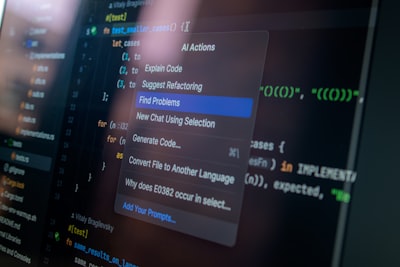
When my AI demands poetry, I just write Python. It's not a metaphor, but a daily reality for those of us working at the intersection of software development and artificial intelligence. Receiving a whimsical request —like a model wanting to compose sonnets— and responding with functional code is an exercise that combines technical pragmatism with a pinch of irony. At its core, AI is neither a poet nor a programmer: it's a tool that needs a human script to translate its desires into executable instructions. And that's the essence of our work: transforming ambiguity into logic, poetry into Python.
Behind that seemingly friendly scene hides a complex ecosystem. Companies looking to integrate artificial intelligence into their processes cannot afford to treat models as literary companions. They need robust AI agents, trained on quality data and deployed on infrastructures that guarantee availability and security. At Q2BSTUDIO we have been building that bridge between technological imagination and business reality for years. It's not about AI writing poems, but about automating tasks, analyzing patterns, and suggesting decisions with the precision of a well-debugged script.
Creating custom software that incorporates artificial intelligence is a process that requires first understanding the business, then the technology. We usually start with a detailed analysis of workflows, identifying points where a predictive model or a conversational assistant can generate real value. Then we design the architecture, select the appropriate algorithms —sometimes neural networks, sometimes lighter models— and program the integration. All of this relies on cloud platforms like AWS or Azure, which offer the scalability and elasticity that modern systems demand. Because an AI that works in local tests can collapse when it receives a thousand requests per minute; that's why we always recommend cloud AWS/Azure services in any professional deployment.
But technology is not enough if it is not accompanied by a solid cybersecurity strategy. Every interaction with an AI agent, every query to a database, every request to an endpoint exposes information that must be protected. At Q2BSTUDIO we integrate cybersecurity practices from the design phase, perform periodic audits, and apply encryption both in transit and at rest. An error in input validation can turn a useful tool into an open door for attacks; that's why our developers review every line of code as if it were a verse of a poem that admits no typos.
Another dimension gaining increasing relevance is data analysis. A company may have millions of records, but without proper treatment they are noise. This is where Business Intelligence with Power BI comes in, a tool we transform into an intelligent control panel. Combined with AI agents, a dashboard not only shows what happened, but predicts trends, detects anomalies, and suggests actions. For example, a client in the logistics sector uses a model we trained that anticipates delivery delays based on weather and traffic data; the information is visualized in Power BI and the system sends automatic alerts to the operations team. That's functional poetry.
However, the real qualitative leap comes when those AI agents start interacting with each other, forming autonomous ecosystems that manage complete processes without human intervention. Imagine an assistant that negotiates with other systems, adjusts inventories, and reschedules shipments in real time. For that to work, each component must be perfectly coupled: from the Python backend to the cloud persistence layer. At Q2BSTUDIO we have developed several success stories where process automation, driven by AI agents, has reduced operational costs by over 40%. And it all starts with a line of code, with a 'print('Hello world')' that later becomes a microservice.
Going back to the beginning: when my AI demands poetry, I just write Python. But deep down, I know that demand is a symptom that technology is advancing. Models are becoming more expressive, more capable of imitating human language, but they still need a guiding hand. Our mission is to provide that hand, not so they write sonnets, but so they solve real problems. And if along the way we learn something about ourselves —about how we translate creativity into code— so much the better. In the end, true poetry lies in well-constructed logic, in the loop that doesn't overflow, in the database that responds in milliseconds. That's what we do at Q2BSTUDIO: turn impossible requests into working software solutions, no matter if the prompt asked for verses or vectors.