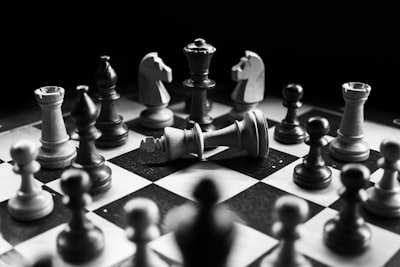
Chess has been the perfect battlefield for studying strategic decision-making for centuries. Every game forces a balance between immediate opportunities and long-term goals, a tension that defines not only the game but also the business environment. A recent study based on network metrics that quantify piece-to-piece interactions reveals that elite artificial intelligence (AI) systems maintain significantly higher levels of strategic tension for longer periods than top human grandmasters. This finding not only transforms our understanding of chess but also offers profound lessons for the corporate world, where the ability to sustain complexity without collapsing is a decisive competitive advantage.
Strategic tension, measured as the density of connections between pieces that balance attack and defense, is an indicator of the depth of positional thinking. Human players, even the top-ranked ones, naturally tend to reduce this tension. The human brain has cognitive limits: processing highly interconnected networks of interactions over dozens of moves requires mental effort that few can sustain. That is why grandmasters often simplify positions, exchanging pieces or closing structures to avoid errors. In contrast, AI algorithms—such as those powering modern engines or agents trained with deep learning—do not suffer from that exhaustion. They can explore millions of variations and maintain densely connected positions throughout the game, maximizing uncertainty for the opponent.
The study also shows that cumulative tension scales with algorithmic complexity in AI systems and increases linearly with skill level (Elo rating) in human play. In games with longer time controls, humans can approach those tension levels because they have more minutes to analyze. But even then, AI still surpasses those peaks. This suggests a fundamental barrier: the biological mind is optimized for heuristic shortcuts, while artificial intelligence can navigate much denser decision spaces without degrading performance.
What implications does this have for a company competing in global markets? The metaphor is direct: an organization's strategic management requires balancing short-term pressures (sales, costs, reaction to competition) with long-term investments (R&D, talent, positioning). Sustaining that tension without taking simplistic shortcuts is what differentiates resilient companies. This is where technology becomes an indispensable ally. Artificial intelligence solutions enable businesses to process complex data, anticipate scenarios, and maintain consistent strategies that a human team could only manage with enormous cognitive cost.
At Q2BSTUDIO, we understand that every business has its own chessboard. As a software development and technology company, we help build the pieces that sustain that strategic tension. From custom software applications that automate critical processes to cybersecurity systems that protect digital assets, and cloud infrastructures (AWS/Azure) that scale under pressure. Our team integrates AI agents capable of monitoring the business pulse in real time, generating dashboards with Business Intelligence (Power BI) that reveal hidden patterns. Because, just like in chess, a company that does not manage strategic tension ends up losing the game.
The difference between a grandmaster and a chess engine is not just speed but nature. The former applies intuition and experience; the latter, optimization and consistency. In the corporate realm, this duality translates into human teams supported by intelligent tools that amplify their analytical capacity. AI does not replace the strategist but allows them to sustain tension longer, explore combinations that would otherwise go unnoticed, and execute plans with millimeter precision. Companies that adopt this approach—combining human talent with advanced software—will be better prepared to face volatile environments.
Furthermore, cybersecurity becomes a critical factor when high strategic tension is sustained. The more digitalized an organization is, the more exposed it is to threats that can break the balance. That is why at Q2BSTUDIO we integrate security measures at every layer of development, from cloud architecture to user interfaces. Our pentesting and auditing services ensure that systems are not only powerful but also robust against attacks. Likewise, the cloud offers the elasticity needed to absorb demand spikes without losing performance, essential when handling large volumes of real-time data.
Another lesson from the study is that reflection time influences decision quality. In chess, longer time controls allow humans to approach higher tension levels. In business, this translates into the need for processes that provide room for analysis without hindering agility. The BI and automation platforms we develop at Q2BSTUDIO help reduce friction: they collect data, process it with predictive models, and present actionable recommendations. Thus, executives can devote their cognitive energy to the most impactful strategic decisions, supported by AI agents that manage operational complexity.
In conclusion, the superiority of AI in chess is not a mere technological anecdote: it is a mirror of what will happen in business. Companies that learn to sustain strategic tension through custom software, artificial intelligence, cloud, and cybersecurity will be in the pole position of the market. At Q2BSTUDIO, we work so that every organization can move its pieces with the same depth as an elite engine, without losing the human vision that gives meaning to the game.