
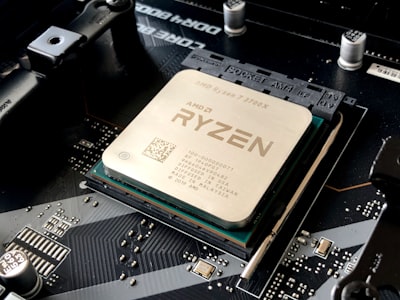
AMD has once again marked a milestone in the semiconductor industry by announcing its next processor architectures: Zen 6, codenamed Venice; Zen 7, codenamed Florence; and Zen 8, codenamed Ravenna. These new generations not only represent an evolution in performance and energy efficiency but also redefine the capabilities of modern computing, especially in enterprise environments where the demand for massive processing, artificial intelligence, and data analysis grows exponentially. For companies like Q2BSTUDIO, specialized in custom software development, this technological leap opens unique opportunities to design solutions that fully leverage the potential of these CPUs.
The Zen 6 Venice architecture is poised to be the first to adopt a 2nm manufacturing node, promising unprecedented transistor density and a drastic reduction in power consumption. Venice introduces fundamental changes in the cache hierarchy and the Infinity interconnection bus, enabling faster communication between cores and memory. This is critical for applications requiring low latency, such as algorithmic trading systems or scientific simulations. Additionally, Zen 6 is expected to incorporate AVX-1024 instructions, doubling the vector bandwidth compared to AVX-512, which will directly benefit artificial intelligence and machine learning workloads. Companies like Q2BSTUDIO already integrate AI agents into their platforms, and with Venice they will be able to run more complex models without dedicated GPUs, reducing operational costs.
Meanwhile, Zen 7 Florence takes efficiency a step further by using an advanced chiplet design that combines high-performance cores (Zen 7c) with high-efficiency cores (Zen 7e). This heterogeneity allows tasks to be assigned based on criticality: for example, batch data analysis processes or cybersecurity system updates can run on efficient cores, while real-time calculations for AI agents are dispatched to performance cores. Florence will also debut with native support for CXL 3.0 memory, facilitating the creation of shared memory clusters between servers. From Q2BSTUDIO's perspective, this architecture is ideal for deploying hybrid cloud solutions, as it allows dynamic scaling of processing resources without compromising data security, a key aspect in their cybersecurity and migration services to AWS or Azure.
Zen 8 Ravenna represents a revolutionary advancement: it will be the first architecture specifically designed for neuromorphic and hybrid quantum computing. Although technical details are still scarce, it is known that Ravenna will integrate tensor processing units (TPUs) directly on the die, eliminating data transfer bottlenecks. This will enable training large language models (LLMs) in real-time, something that previously required GPU clusters. For the enterprise ecosystem, Ravenna will change the game in areas like Business Intelligence (BI) and predictive analytics. Power BI tools, for example, will be able to execute complex queries on petabytes of data with millisecond latency. Q2BSTUDIO, with its experience in BI and cloud integration, is already preparing reference architectures that combine Ravenna with in-memory databases to offer real-time dashboards to corporate clients.
The impact of these architectures transcends hardware: it forces software companies to rethink their applications. For instance, a traditional ERP can hardly exploit the massive parallelism of Venice if not redesigned from scratch. This is where the value of developing custom applications comes in: Q2BSTUDIO offers custom software services that adapt business logic, workflows, and data models to leverage the unique features of each AMD generation. Moreover, integration with cloud platforms like AWS or Azure becomes smoother thanks to Zen 6 and Zen 7's compatibility with optimized bare-metal instances and containers. Cybersecurity also benefits: the new instruction sets enable faster homomorphic encryption, and Q2BSTUDIO implements these mechanisms in its pentesting and data protection solutions.
From the perspective of AI agents, these architectures allow running deep learning models directly on edge servers, reducing reliance on the cloud. For example, a real-time recommendation system for e-commerce can run on a server based on Zen 7 Florence with 128 cores, processing millions of transactions per second without sending sensitive data to the cloud. Q2BSTUDIO is already developing frameworks that orchestrate AI agents on these architectures, combining local processing with cloud services to balance cost and privacy.
In the field of automation, the new architectures facilitate the orchestration of complex data pipelines. For instance, an ETL process that combines data from multiple sources (databases, APIs, streams) can be efficiently parallelized thanks to higher memory bandwidth and improved interconnects. This is crucial for companies relying on BI and analytics. Q2BSTUDIO, in its digital transformation projects, uses these capabilities to design real-time reporting systems that feed Power BI dashboards, helping executives make informed decisions instantly.
Finally, it is worth noting that AMD's roadmap through 2027 shows a commitment to backward compatibility, allowing companies to migrate gradually without rewriting their entire software stack. However, to truly capitalize on the performance leap, it is advisable to have a technology partner like Q2BSTUDIO, which thoroughly understands the specifics of each architecture and offers consulting, development, and integration services. From migrating to cloud AWS/Azure to implementing advanced cybersecurity systems, and from creating custom applications with integrated artificial intelligence to deploying automation pipelines, the AMD-Zen ecosystem provides the perfect substrate to drive the next generation of enterprise solutions.
In conclusion, Zen 6 Venice, Zen 7 Florence, and Zen 8 Ravenna are not mere product updates; they redefine the boundaries of what is possible in enterprise computing. With the right combination of hardware and custom software, companies across all sectors can automate processes, extract deeper insights from their data, and protect their digital assets more efficiently. Q2BSTUDIO, with its focus on cross-platform application development, artificial intelligence, cybersecurity, and cloud, is perfectly positioned to accompany its clients in this new era of massive processing.

