
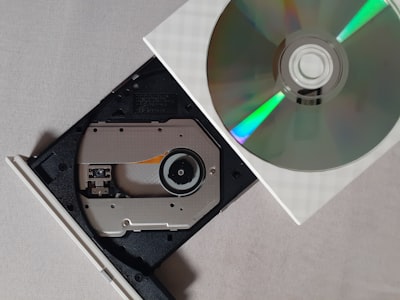
In a market where modern laptops increasingly sacrifice internal optical drives for lightness and battery life, having access to an external CD/DVD reader has become a necessity for both home users and professional environments. The external USB CD/DVD drive allows reading optical discs on computers that lack a built-in reader, facilitating tasks ranging from recovering old data to installing legacy software. But beyond being a simple accessory, this type of device opens the door to deeper technological reflections on compatibility, data security, and process automation—key areas where companies like Q2BSTUDIO offer high-value solutions.
The USB connector, in its 3.0, 2.0, and even 1.0 versions, provides the power and data transfer needed for the drive to operate without an external power supply. This makes it a truly plug-and-play tool, ideal for professionals working on the go. Compatibility with Windows, macOS, and Linux systems ensures that almost any computer can benefit from its use. Additionally, the inclusion of a USB-C adapter allows connecting the drive to both traditional USB-A ports and modern USB-C ports on laptops like the MacBook Air or Windows ultrabooks.
When it comes to supported formats, these external drives usually read and burn CD-R, DVD-R, DVD-RW, DVD-R DL, and DVD-RAM, covering most discs still found in homes and offices. Transfer speeds of up to 5 Gbps ensure a smooth experience when playing movies or making backups. However, not everything is perfect: some users report recognition issues when connecting the drive through a USB hub, a situation solved by connecting it directly to the computer's port, as most manufacturers recommend.
From a business perspective, the need to read optical discs is not a whim of the past. Many companies keep critical files on CD or DVD, either for legal reasons, archiving, or because their legacy systems still rely on this medium. Integrating an external drive into a modern workflow may seem simple, but behind it lie greater challenges: digitizing that data, storing it securely, and automating the copying process. This is where the technical expertise and solutions from Q2BSTUDIO make a difference. For example, a custom software development company can design a system that automates the extraction of information from physical discs, converts it to digital formats, and stores it in the cloud using AWS or Azure cloud to ensure high availability and security.
Speaking of security, when working with physical discs that may contain sensitive information, cybersecurity becomes a critical factor. An external reader can be the gateway to corporate data, so any digitization process must include access controls, encryption, and auditing. Q2BSTUDIO offers specialized cybersecurity services that evaluate and protect these flows, from disc reading to final cloud storage.
Furthermore, artificial intelligence (AI) can play a transformative role. Imagine a system that, upon inserting a CD, uses AI agents to automatically classify the content, extract metadata, and generate business reports. The AI agents developed by Q2BSTUDIO can integrate with Business Intelligence (Power BI) tools to visualize usage patterns of old discs, helping companies decide which data to keep and which to migrate to the cloud. This combination of simple hardware and intelligent software allows optimizing resources that would otherwise become obsolete.
In the context of digital transformation, many SMEs are migrating their legacy applications to the cloud. However, before that migration, they need to extract data from optical discs. The external USB CD/DVD drive is the first tangible step. Then, with BI/Power BI solutions and process automation, companies can create dashboards that monitor the status of their historical files. Q2BSTUDIO accompanies this journey by offering cloud AWS/Azure services, as well as custom software development to integrate optical readers into document management systems.
Another relevant aspect is sustainability. Instead of buying a new laptop with a built-in reader, which consumes more resources and generates e-waste, an external drive extends the life of existing equipment. From a business standpoint, this translates into cost savings and a lower environmental impact. Companies adopting this approach often combine it with automation and digitization strategies, an area where Q2BSTUDIO is a reference in process automation development.
For an individual user, the external drive is an economical and practical solution. Reviews highlight its good price-performance ratio and ease of use. With a size of just 14x14 cm and a thickness of 1.7 cm, it fits in any backpack. And while it is true that some computers may have USB power issues, most of the time simply avoiding hubs solves the problem. For those who occasionally need to read CD or DVD, it is a minimal investment that avoids the frustration of discovering their new ultrabook lacks a reader.
From a technical point of view, these devices use standard chipsets that guarantee broad compatibility. However, for intensive or corporate use, it is advisable to have software support that manages reading, backups, and indexing. This is where custom application development makes sense. Q2BSTUDIO designs systems that communicate directly with the optical drive, automate file copying, verify data integrity, and upload to an Azure or AWS bucket, all with encryption and logging protocols to meet compliance regulations.
In summary, the external USB CD/DVD drive is much more than a nostalgic accessory. It represents a bridge between the physical world of optical discs and the digital cloud. For companies and professionals, integrating it with AI, cybersecurity, cloud, and BI services allows transforming obsolete data into strategic assets. And for that, having a technology partner like Q2BSTUDIO ensures that every step—from reading to analysis—is optimized, secure, and aligned with business goals.
If you are considering purchasing an external drive for your laptop, do not hesitate to evaluate your long-term needs. A simple $20 reader may solve your immediate problem, but if your company needs to digitize a full archive of discs, the smart move is to plan a comprehensive solution that combines basic hardware with artificial intelligence and automation. That way, that small USB device becomes the key to digital transformation.

