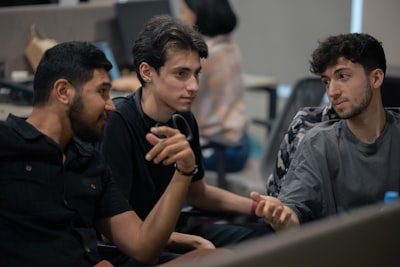
It all started with a seemingly simple question, posed on an ordinary afternoon between two university friends. Daniel and Santiago shared a bench in the computer engineering faculty, but they also shared a growing frustration: artificial intelligence was advancing at a dizzying pace, yet using it remained a constant exercise in fragmentation. Jumping from ChatGPT to Claude, from Claude to Perplexity, copying contexts, rewriting prompts, comparing results... The promise of a unified AI seemed increasingly distant. That conversation, which at the time seemed like just another complaint, became the seed of a project that would change their lives.
For months, Daniel and Santiago spent nights and weekends sketching what they called an 'agent orchestrator.' The idea was simple in theory but complex in execution: build a system capable of interpreting a human objective, breaking it down into tasks, selecting the appropriate AI model for each step, coordinating executions, and returning a complete result without the user having to intervene. They did not want to compete with OpenAI or Anthropic; they wanted to be the layer that made all those models work together intelligently. This required not only AI expertise but also a deep understanding of custom software, cloud architectures, and data security.
The first prototype was chaos. Written in Python, with improvised integrations via APIs, it worked sporadically. But it proved the idea had merit. A user could ask 'analyze the latest market trends and write an executive report' and, after a few seconds, the system would return a document with charts, references, and recommendations. The magic happened behind the scenes: the orchestrator called a reasoning model to structure the analysis, another to fetch real-time data, a third to write, and a visualization engine to generate charts. All without the user lifting a finger.
What started as a university project soon hit reality: they needed robust infrastructure, scalability, and above all, cybersecurity. The data they handled was sensitive; any leak would be catastrophic. That was when they contacted Q2BSTUDIO, a company specialized in software development and technology that had already worked on similar projects. The Q2BSTUDIO team helped them migrate the architecture to cloud AWS/Azure, implement enterprise-grade cybersecurity measures, and optimize continuous integration processes. They also incorporated business intelligence modules with BI/Power BI so clients could visualize the performance of their AI agents.
The collaboration with Q2BSTUDIO was a turning point. Not only because they brought technical expertise, but because they transformed a garage idea into a viable product. The AI agents that Daniel and Santiago had designed on whiteboards began running on Kubernetes clusters managed in Azure, with secure data pipelines and Power BI dashboards. The company also guided them in creating an automation platform that allowed users to define complex workflows without writing a single line of code, using only natural language.
Today, that initial conversation has become a startup serving dozens of companies. But the most valuable thing for Daniel and Santiago is not commercial success; it is the journey. They learned that a brilliant idea without consistent execution is worthless. That perseverance, lost weekends, and sleepless nights are the true engine of innovation. And that sometimes, the best way to move forward is to surround yourself with a team that understands both AI and custom software, cloud, and cybersecurity.
The final project does not resemble the first sketch. It has evolved with every iteration, every user feedback, every new API that appeared in the ecosystem. But the core remains the same: eliminate the friction between humans and artificial intelligence. So that the user only has to worry about what they want to achieve, not which tool to use. That is the legacy of a conversation that changed a life, and continues to inspire other students to ask: why not?