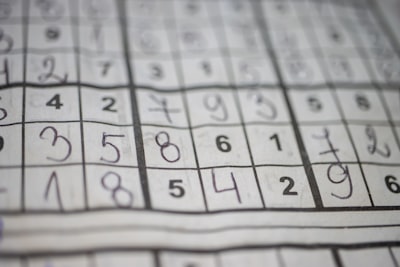
Solving a Sudoku is not just a pastime; it is a combinatorial optimization problem that has fascinated mathematicians and computer scientists for decades. In essence, it involves assigning numbers from 1 to 9 to a 9x9 grid while respecting row, column, and region constraints. Its NP-complete complexity makes it an ideal testbed for new computational architectures. Recently, a novel approach has captured attention: Oscillatory Neural Networks (ONNs) applied through graph coloring techniques. This article explores how this synergy enables solving Sudokus with near-perfect accuracy, and how companies like Q2BSTUDIO can translate these principles into custom software solutions.
Graph coloring is a classic problem in graph theory: assign colors to vertices so that no two adjacent vertices share the same color. To model a Sudoku, each cell becomes a vertex, and constraints (same row, same column, same region) are represented by edges. Digits from 1 to N (where N is 4 or 9) become colors. Thus, solving the Sudoku is equivalent to finding a valid coloring of the graph. However, graph coloring is also NP-complete, so heuristic or physics-inspired methods are needed to scale.
Oscillatory Neural Networks (ONNs) offer a promising alternative. They are based on a set of coupled nonlinear oscillators that evolve by minimizing a global energy function. Each oscillator represents a graph vertex, and its phase or frequency encodes the assigned color. The system dynamics seek a low-energy state that satisfies adjacency constraints. Unlike Hopfield Neural Networks (HNNs), ONNs work in continuous time and exploit synchronization and desynchronization phenomena, allowing them to explore the solution space more efficiently.
Recent work on ONN solvers for Sudoku introduces two key improvements over previous proposals. First, the oscillator model is simplified to reduce computational complexity while preserving its ability to represent coloring. Second, an extra term is added to the energy function that specifically penalizes violations of Sudoku's own rules, such as repeated digits in the same region. This dual adjustment enables the system to converge to valid solutions with over 99% accuracy on 4x4 Sudokus and above 90% on 9x9 puzzles, even when many initial digits are missing.
Constructing the Sudoku graph involves connecting each cell with all cells in its same row, column, and region. For a 9x9 Sudoku, this yields around 810 edges. Each ONN oscillator is assigned to a vertex, and its phase represents a color (digit). The total energy function includes a coupling term between adjacent oscillators that favors different phases, plus a penalty term to prevent non-adjacent oscillators from having the same phase when required by the Sudoku (e.g., cells with a fixed number). The key modification of the proposed solver is to simplify the oscillator dynamics, reducing the number of required interactions without sacrificing accuracy, and incorporating an additional constraint term that enforces the fulfillment of Sudoku-specific conditions, such as digit uniqueness in each subgrid.
From an implementation perspective, simulating an ONN requires solving a system of ordinary differential equations, which can be done efficiently with numerical libraries in Python or C++. However, for large-scale business applications, Q2BSTUDIO offers custom software development services that adapt these algorithms to cloud AWS/Azure environments, enabling hundreds of parallel simulations. Furthermore, integration with AI agents allows real-time adjustment of oscillatory network parameters, improving convergence rates. Cybersecurity, meanwhile, protects input data and results, especially when handling sensitive client or industrial process information.
The combination of ONNs, graph coloring, and cloud computing opens the door to hybrid systems where heavy computations run on specialized hardware (such as FPGAs or ASICs) while orchestration takes place in the cloud. Q2BSTUDIO offers consulting services to design such architectures, leveraging its expertise in software process automation. Intelligent AI agents can monitor oscillator states and dynamically readjust parameters, ensuring convergence to optimal solutions even under changing conditions.
From a business perspective, the ability to solve constrained assignment problems with efficient hardware has direct applications in logistics, resource planning, and network design. The artificial intelligence underlying these models combines with AI agents to automate complex processes, from task assignment to inventory management, all on cloud AWS/Azure infrastructures that guarantee scalability and security. Business Intelligence (BI) solutions with Power BI enable real-time visualization of optimization algorithm results, providing executives with interactive dashboards that facilitate strategic decision-making. For example, a logistics company could use an ONN solver to plan delivery routes and, via Power BI, analyze the impact on costs and times.
Ultimately, solving Sudoku with oscillatory neural networks through graph coloring is not just an academic exercise; it is a tangible example of how principles from physics and mathematics can become powerful business tools. Q2BSTUDIO helps organizations make that leap by developing custom software that integrates AI, cloud, cybersecurity, and BI to solve real-world optimization problems. If your company faces assignment or planning challenges, an ONN-based approach could be the key to achieving near-perfect results, much like those attained in the most complex Sudokus.