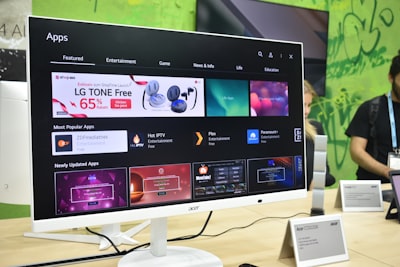
The recent controversy surrounding LG UltraGear monitors has brought to the forefront a practice many users consider invasive: the automatic installation of applications and advertisements without explicit consent. According to an investigation by Gamers Nexus, when connecting an LG 34GX900A-B monitor to a Windows 11 PC, the operating system silently downloads and installs LG drivers along with the LG Monitor App Installer via Windows Update. This app, far from providing useful functions, redirects users to other LG tools and, more annoyingly, displays pop-up ads for McAfee and LG itself in the bottom right corner of the screen. Reports date back to 2024, but have recently gained traction on Reddit, where numerous users complain about large advertising windows appearing without any prior permission request.
This incident is not isolated; it reflects a worrying trend in the hardware and software industry where manufacturers prioritize promoting their own or third-party services over user experience and security. Forced installation of applications without notification or cancellation options violates fundamental principles of consent and control that should govern any modern operating system. Windows Update, designed to keep the system secure and updated, becomes a distribution vector for unwanted software, raising debates about Microsoft's responsibility in allowing signed drivers to include additional installers.
Beyond the annoyance of seeing antivirus ads on a machine that likely already has protection, the issue underscores the need for companies to adopt ethical and transparent development practices. In an environment where cybersecurity and data protection are critical, any non-consensual installation can be considered a potential risk. Users lose trust when they discover that a basic peripheral like a monitor behaves as an advertising vector.
Against this backdrop, the work of software development companies that focus on responsible, user-centric solutions becomes especially relevant. Q2BSTUDIO is a prominent example: as a firm specialized in technology and software, it understands that every user interaction must be based on transparency and respect. The company offers custom software services that ensure no hidden elements or intrusive practices are included. Instead of forcing installations, Q2BSTUDIO’s solutions prioritize personalization and user control, adapting to the real needs of each business or individual.
The LG case also highlights the importance of a robust security architecture in the Windows ecosystem. Integrating cloud services such as AWS or Azure can provide additional protection layers, but only if implemented with transparency. Q2BSTUDIO, for instance, has an expert team in cloud AWS/Azure that designs secure and scalable infrastructures, where process automation does not compromise user privacy. Likewise, in the field of cybersecurity, the company conducts audits and penetration tests to identify vulnerabilities before they are exploited by malicious actors or by questionable practices like unauthorized software installation.
Unwanted advertising on a monitor is just the tip of the iceberg. Behind it lies a chain of technical decisions affecting user experience: from driver signing to update management. To avoid similar situations, many organizations are turning to artificial intelligence solutions that monitor system changes and alert about unauthorized installations. AI agents can act as automatic watchdogs, but they require careful implementation to avoid falling into the same intrusive errors. Q2BSTUDIO integrates AI agents into its developments to offer proactive systems capable of detecting anomalies and blocking suspicious behavior, always under the end user's control.
Another relevant aspect is data analysis and business intelligence. When a manufacturer like LG installs applications without permission, it is also collecting information about user behavior without explicit consent. The BI / Power BI solutions offered by Q2BSTUDIO allow companies to make data-driven decisions while respecting privacy regulations and ensuring ethical data handling. The difference between legitimate data use and invasive practice lies in transparency and the user's ability to opt out.
For developers and technology companies, the LG case should serve as a lesson on the importance of designing software that respects the user. Process automation, when done correctly, can improve productivity without sacrificing trust. Q2BSTUDIO offers automation services that optimize workflows, but always with consent and control mechanisms. The same philosophy should apply to the distribution of drivers and complementary applications.
In conclusion, the silent installation of McAfee ads through LG monitors is not just an annoyance; it is a symptom of a culture that prioritizes monetization over user experience. Faced with this, the industry needs to shift toward models where software is developed with quality, ethics, and transparency. Companies like Q2BSTUDIO demonstrate that it is possible to deliver advanced technological solutions —from custom software to artificial intelligence and cybersecurity— without deceiving the user. The next time you connect a peripheral, remember that control of your device should be in your hands, not in the advertising algorithms of a manufacturer.