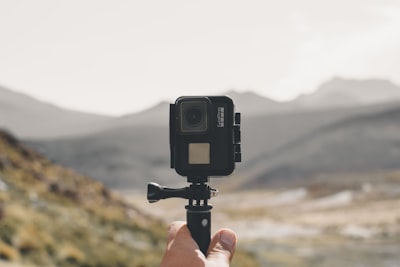
The GoPro camera has been the gold standard for years among those seeking to capture extreme adventures with maximum quality. But in 2026, the market demands more: lightness, an adjusted price, and an accessory ecosystem that truly multiplies possibilities. This year, the GoPro family is renewed with models that bet on compactness without sacrificing key features, while integrating smart connectivity and compatibility with software tools that transform the way we edit, share, and protect content. We analyze which is the best option for each user profile, from the occasional creator to the professional who needs automated workflows.
The 2026 lineup includes the GoPro Hero Compact, the Hero Eco, and the Hero Pro Lite. The Hero Compact is the bet on reduced size: it weighs only 80 grams, records in 5.3K at 60 fps, and features HyperSmooth 6.0 stabilization. Its built-in battery lasts up to 2 hours in 4K, ideal for a day of sports without worrying about recharging. On the other hand, the Hero Eco is positioned as the economical one: it sacrifices 8K resolution (stays at 4K/120 fps) but includes a front touch screen, resistance up to 10 meters without housing, and an AI-enhanced time-lapse mode. Finally, the Hero Pro Lite is a special edition that combines the best of both: a compact body with a 1/1.7-inch sensor, dual processor, and external microphone input, perfect for vloggers who want cinema quality without bulky equipment.
Official and third-party accessories have multiplied. The new universal magnetic mount (compatible with GoPro, DJI, and Insta360) allows you to attach the camera to any metal surface, while the 4-section extendable arm with built-in tripod is perfect for group selfies or subjective shots. For underwater use, the Dive+ housing reaches 60 meters and has Bluetooth connectivity for remote control. In audio, the WindShield Pro microphone eliminates wind noise even at 100 km/h, and the rechargeable LED lighting module offers three color temperatures. But the real leap is in software: the GoPro Quik 2026 app includes AI-powered automatic editing, scene-based highlight generation, and music suggestions synced with the action's rhythm.
From a technical and business perspective, this ecosystem opens enormous opportunities. Integrating the camera with cloud services like AWS or Azure allows storing terabytes of footage without local costs, accessing from any device, and applying distributed processing to transcode videos in real time. Cybersecurity becomes critical when recordings contain sensitive client data or strategic locations; therefore, companies working with GoPro for vehicle fleets or industrial surveillance must implement end-to-end encryption protocols and vulnerability analysis. This is where cybersecurity services like those offered by Q2BSTUDIO become an indispensable ally to protect both hardware and associated software.
Moreover, artificial intelligence is not only in the consumer app. AI agents can autonomously analyze hours of footage to detect events (goals, jumps, accidents) and automatically generate highlight clips ready for social media. Combined with Power BI dashboards, a sports director can visualize performance metrics extracted from the videos: average speed, recording angle, high-activity zones. This is possible thanks to Business Intelligence platforms that integrate data from multiple cameras. And when it comes to customization, custom software development allows creating anything from a control panel to manage a fleet of GoPros to a facial recognition system that triggers recording only when an authorized person appears. Companies like Q2BSTUDIO, specialized in custom software, already work with clients who use GoPro as an IoT sensor in harsh environments.
The cloud also plays a central role. Storing videos on cloud AWS or Azure not only frees up physical space but also allows scaling processing according to demand. A production company shooting a documentary in Patagonia can upload footage via satellite to AWS S3, where an AI agent transcodes it into multiple formats and automatically distributes it to editors in different time zones. Process automation through scripts and serverless functions (Lambda, Azure Functions) orchestrates the entire flow without human intervention. Q2BSTUDIO offers complete automation and cloud computing solutions, helping companies migrate their video workflows to agile and secure environments.
Of course, not everything is big business. An individual creator can also benefit from these technologies. For example, using free or low-cost AI agents to automatically tag clips by sport type, location, or emotion detected in faces. Then, with free Power BI, they can generate visual reports of their weekly production. And if they need a custom app for their YouTube channel, custom software development allows integrating the camera with their monetization, statistics, and community management tools.
Regarding camera choice, our recommendation for 2026 depends on the profile:
· Casual user (travel, family, light sports): Hero Eco. It offers the best value for money, with basic accessories like a silicone case and a tripod adapter.
· Content creator (vlogs, social media, livestreams): Hero Pro Lite. External audio input and front screen are unbeatable; add a WindShield microphone and an extendable arm.
· Extreme sports enthusiast or professional (surf, motocross, diving): Hero Compact with Dive+ housing and magnetic mount. 5.3K recording allows cropping in post-production without losing detail, and stabilization is unmatched.
· Enterprise or fleet (logistics, inspection, security): Hero Compact with industrial housing, GPS module, and GoPro Cloud Plus subscription. Here, backend software integration is key; Q2BSTUDIO can develop a control panel that monitors battery, storage, and status of each camera in real time.
Smart accessories also evolve. The Smart Grip with wireless charging and integrated SSD storage (512 GB) is ideal for long sessions without swapping cards. The variable ND filter allows controlling exposure in changing light conditions without carrying multiple filters. And for virtual reality lovers, the 360-degree mount with programmable rotation motor enables smooth motion time-lapses.
In short, the best GoPro 2026 is not just a device: it is an ecosystem where the camera, accessories, and software converse. The bet on compactness has not sacrificed power, and prices have been adjusted so that more people can access high-quality recordings. The real innovation is in how companies and creators leverage AI, cloud, and cybersecurity to extract maximum value from every clip. And there, having a technology partner like Q2BSTUDIO, which understands custom software development, artificial intelligence, and automation, makes the difference between owning a camera and having a complete production studio in your backpack.