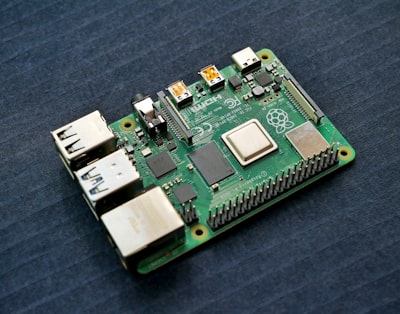
A few days ago, a close friend, a homelab builder and single-board computer enthusiast, remarked: 'Nobody wants a Raspberry Pi anymore.' The statement, said without drama, echoed a silent shift. For fifteen years, the Raspberry Pi has been the symbol of accessible computing, the workhorse of makers, educators, and small businesses. But times change, and what seemed like an unstoppable reign fades without fanfare. This article analyzes the causes of this decline and how the tech ecosystem is evolving toward more powerful, integrated, and professional solutions, where companies like Q2BSTUDIO set the pace with custom software, AI, and cloud AWS/Azure services.
The initial success of the Raspberry Pi was revolutionary. For under $40, it offered a complete computer capable of running Linux, programming, controlling hardware, and serving as a media center. The Raspberry Pi Foundation sold over 50 million units, creating a global community. However, the magic has worn off. The semiconductor supply crisis (2020-2023) hit hard: prices skyrocketed, lead times stretched to months, and many projects were stranded. Moreover, scalper speculation turned a $35 board into a $100 luxury. The low-cost promise was broken.
Meanwhile, competition did not sleep. Manufacturers like Rockchip, Allwinner, and Amlogic launched boards with more powerful ARM processors, better GPUs, and support for NVMe, USB 3.0, and up to 16 GB of RAM. The Orange Pi 5, Banana Pi M7, or Radxa Rock 5 offer performance that doubles or triples that of the Raspberry Pi 4 and 5, often at a similar price. Even Intel NUC and x86-based mini PCs have invaded the space of home servers and industrial automation. The Raspberry Pi is no longer the obvious choice.
Another key factor has been the shift in workloads. Previously, a small web server, a smart irrigation system, or a retro game emulator fit on an ARM Cortex-A72. Today, projects demand more: artificial intelligence at the edge, real-time video analytics, containerized databases, lightweight Kubernetes orchestration. The Raspberry Pi 5, with its 4 Cortex-A76 cores and 8 GB of RAM, remains limited for these purposes. Cybersecurity has also become critical: poorly configured boards on home or corporate networks are attack vectors. Firmware updates and security patches do not always arrive as quickly as a professional environment requires.
In this scenario, many organizations are migrating their solutions from low-cost proprietary hardware toward cloud platforms or more robust embedded systems. For example, instead of deploying a Raspberry Pi to monitor sensors, they opt for AI agents that process data on AWS or Azure, with automatic scalability and high availability. The cloud solutions from Q2BSTUDIO allow designing hybrid architectures that combine edge devices with cloud backends, reducing operational costs and improving security. Business Intelligence with Power BI connects directly to these flows, offering real-time dashboards that previously required setting up a home server.
The silent end of the Raspberry Pi reign does not mean the end of single-board computing, but its transformation. Manufacturers are shifting their offerings toward more specific products: AI boards with NPUs, industrial devices with certifications, or modular systems. But the end user, especially the professional needing reliable and maintainable solutions, increasingly seeks custom software ecosystems and managed services. This is where the experience of a development company like Q2BSTUDIO brings real value. It is not about replacing a board, but about building software that runs on the right infrastructure, whether physical or virtual.
The keys to the immediate future lie in process automation, integration of generative AI into workflows, and using containers and orchestrators to manage heterogeneous environments. The Raspberry Pi may remain useful as an educational tool or for rapid prototyping, but as a production-scale solution, its time has passed. Companies that want to stay competitive must rethink their technology architectures. For instance, a quality control system based on computer vision traditionally mounted on a Raspberry Pi with a camera is now implemented with AI agents in the cloud that process images from any device, with lower latency and higher accuracy.
In conclusion, the 15-year reign of the Raspberry Pi ends in silence, not because of a resounding failure, but due to the natural evolution of the market. The democratization it started continues, but with more mature tools: the cloud, AI, and customized software. For those who need robust and scalable solutions, the answer is no longer a €35 board, but an ecosystem of professional services. Q2BSTUDIO, with its focus on custom software development, cybersecurity, cloud, and BI, represents this new paradigm. The Pi's legacy was to plant the seed; now the harvest is reaped by companies that know how to turn ideas into applications that work, from the edge to the cloud.