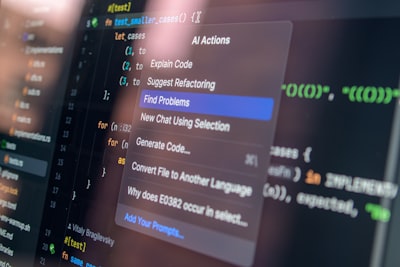
For years, discipline in software development rested on an unquestioned premise: writing code was expensive. Every line represented time, testing, risk, and future maintenance. That is why teams became experts at saying 'no' to any request that seemed small but could hide complexity. However, the arrival of artificial intelligence is redefining that equation. The cost of producing code has dropped dramatically, but the cost of understanding, reviewing, and owning it has not dropped at the same pace. This forces a rethinking of how we evaluate change requests: we can no longer rely solely on implementation effort; we must measure the real cost of saying 'yes' and also the cost of saying 'no'.
At Q2BSTUDIO, a company specialized in developing custom software applications, we have observed how this transformation impacts decision-making. Before, a simple feature —like displaying an existing field in an interface— required a forty-minute meeting to debate whether it was worth it, followed by two days of uncertainty. Now, with AI assistants, that first draft can be ready in the time the debate takes. But the real change is not in writing speed, but in how we manage uncertainty. AI allows us to get a 'price' almost instantly: a small patch, with tests, bounded to a precise scope. That patch is not the final product; it is a probe that reveals whether the request is truly small or if it brings along changes in authentication, persistence, or API contracts.
The main risk, and where many organizations stumble, is confusing 'cheap to write' with 'cheap to own'. A change can be trivial in code, but if it modifies data retention semantics, affects privacy, or alters the billing model, its ownership cost remains very high. AI does not reduce that cost; it only shifts it to the review phase. Therefore, the criterion for approving a request should no longer be 'can an agent write this?', but 'can a human validate it and take responsibility for it?' This implies that certain decisions still need a firm 'no', even if the generated code looks flawless. At Q2BSTUDIO we apply this principle: when integrating AI agents into our workflows, the boundary between permitted and rejected is defined by review cost, not generation cost.
How does this affect services like cloud AWS/Azure or cybersecurity? In cloud environments, a seemingly minor change —like exposing a new endpoint— can have security implications and operational costs. AI can generate the code, but human review must verify that no unwanted doors are opened and no data leaks occur. Similarly, in BI/Power BI projects, a small tweak in a query may seem harmless, but if it alters the aggregations used by dozens of reports, the ownership cost skyrockets. That is why at Q2BSTUDIO we encourage teams to use AI for rapid prototyping, but always under a strict review framework that includes security checklists, compliance, and maintainability.
The new skill engineers must develop is the ability to 'price uncertainty' within minutes. Instead of debating for hours whether a request falls within scope, one can ask an agent to generate the smallest possible patch under clear constraints: no public contract changes, with tests, and behind a feature flag. If the result is clean and bounded, the cost of saying 'yes' reduces to review. If the agent produces a diff that touches five packages and requires changes in the persistence layer, then we know the request was not small and we can reject it with evidence. This approach changes the dynamic: from 'is this necessary?' to 'here is the real cost, do we pay it?'.
In short, the cost of saying 'yes' has changed, but it has not disappeared. What has disappeared is the excuse that 'any new code is too expensive.' The true filter now is review capacity and long-term responsibility. At Q2BSTUDIO we understand that technology —whether process automation, AI, or cloud— should serve to make better decisions, not to avoid them. That is why our advice is simple: before saying 'no' by default, try requesting a patch. And before automatically saying 'yes', review the cost of owning it. The balance between speed and quality remains the key to software development.