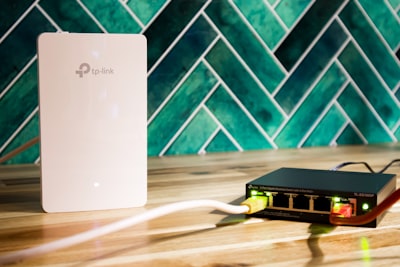
In a world where connectivity defines business productivity, having a stable, high-speed network in every corner of the office or home is no longer a luxury but a necessity. The TP-Link AV1000 Powerline Adapter Kit presents itself as an elegant solution to extend the Ethernet network using existing electrical wiring. But beyond a simple gadget, this device represents the convergence between physical infrastructure and digital solutions that companies like Q2BSTUDIO implement for their clients: a solid network is the foundation upon which custom applications, AI systems, cybersecurity platforms, and cloud environments are built.
The working principle of powerline adapters is simple yet ingenious: they turn any electrical outlet into a local network access point, eliminating the need to run Ethernet cables through walls or floors. The TP-Link AV1000, in particular, offers a theoretical speed of up to 1,000 Mbps under the HomePlug AV2 standard, though in real-world conditions — depending on the building's wiring and router quality — it usually achieves between 300 and 500 Mbps. That is still more than enough for 4K streaming, video conferencing, online gaming, or heavy file transfers between servers and development workstations.
From the technical perspective we handle at Q2BSTUDIO, where we design cloud infrastructures on AWS and Azure for our clients, we understand that the local network layer is critical. A well-configured powerline can be the piece that connects an IoT edge device to the data center, or that allows a BI (Business Intelligence) team to work with Power BI dashboards without latency. Moreover, the absence of WiFi in these adapters is not a flaw but an advantage: being wired, they offer a more secure and predictable connection, ideal for environments handling sensitive data under strict cybersecurity policies.
The kit includes two adapters: one plugs in near the router and connects to it via the included Ethernet cable; the other is placed in the destination room. Both have a Gigabit Ethernet port and a pass-through outlet so you don't lose the use of the wall socket. They also incorporate a noise filter that mitigates interference from household appliances or other connected devices. Installation is plug-and-play: within minutes any professional, even without advanced networking knowledge, can have a stable network extension. However, performance may degrade if connected to power strips or if the electrical installation is very old; in those cases, mesh systems remain an alternative, though more expensive and with less dedicated bandwidth.
Now, what does all this have to do with software development and emerging technologies? At Q2BSTUDIO, when we work on digital transformation projects for companies, we don't just handle code: we analyze the entire ecosystem. A custom application for inventory management, for example, may depend on IoT sensors sending data over the local network. If that network is unstable, the software, no matter how well designed, will not function correctly. That is why we recommend robust connectivity solutions like the TP-Link AV1000, especially when bandwidth requirements are moderate but reliability is critical.
On the other hand, artificial intelligence and AI agents (virtual assistants, image recognition systems, chatbots) greatly benefit from a low-latency network. In an office where multiple departments use AI models trained in the cloud, having a wired connection at key workstations avoids bottlenecks. The powerline acts as a silent bridge between the development team and cloud resources (AWS or Azure), allowing machine learning experiments to flow without interruptions.
Cybersecurity also gains from these devices. Being a purely Ethernet connection, it emits no radio frequency signals that could be intercepted, unlike WiFi. In environments handling financial data, medical records, or intellectual property, a powerline adapter can add an extra layer of physical security to the network. At Q2BSTUDIO we integrate these considerations into our cybersecurity services, evaluating the complete network topology to ensure no weak points exist.
We cannot forget data analysis and business intelligence. A BI team needs fast access to databases or Power BI servers. If the analyst works in a room far from the router, a powerline provides the same bandwidth as a direct cable, without the typical WiFi fluctuations. Thus, dashboards load instantly and decision-making becomes more agile. In projects where we have implemented BI solutions for clients, we always evaluate the underlying network infrastructure; the TP-Link AV1000 has been a recurring choice due to its cost-performance ratio.
On a practical level, the TP-Link AV1000 is currently available on Amazon for $53.97, a deal that lasts only one day. Although not its all-time lowest price, it is the best price of the year and has over 11,000 reviews, predominantly positive. Users highlight the ease of installation, connection stability, and the absence of additional cables. Criticism focuses on real-world speed, which as explained depends on the electrical installation, but this is inherent to powerline technology in general.
In conclusion, the TP-Link AV1000 Powerline Adapter Kit is a valuable tool not only for the home but also for small and medium enterprises looking to extend their network economically and reliably. In a context where digitalization is unstoppable, having a well-designed network infrastructure is as important as the software running on it. At Q2BSTUDIO, as a software and technology development company, we understand that connectivity is the first link of any digital solution, whether it's a custom application, an AI system, a cloud service, or a BI dashboard. That's why we analyze every detail, from the powerline adapter to the cloud architecture, to offer our clients comprehensive solutions that truly work.