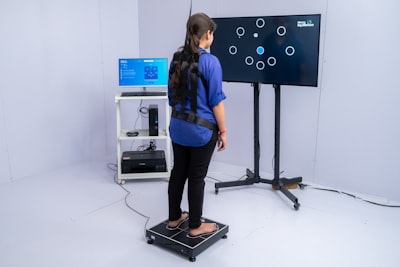
In the field of human activity recognition, a recent study has revealed a fascinating dissociation: the static posture of the body is sufficient to classify which activity is being performed, but the temporal dynamics of movement are essential to reconstruct how it unfolds. This distinction, derived from analyzing 16 daily activities from the MoVi dataset, has deep implications not only for computer vision but also for enterprise software development, applied artificial intelligence, and industrial process optimization. At Q2BSTUDIO, as a company specialized in software development and technology, we understand that such scientific findings can be translated into practical solutions that improve efficiency and security in corporate environments.
The study compared three movement analysis strategies: Temporal Movement Primitives (TMPs), Legendre polynomial coefficients, and autoencoders. Results showed that both Legendre coefficients and TMPs achieved the highest classification accuracy, while autoencoders lagged slightly behind. However, when reconstructing movements, TMPs preserved temporal dynamics and generated natural motion, whereas Legendre coefficients only retained the average posture, resulting in 'frozen' movements. This suggests that the human visual system may rely on static configuration for rapid recognition, but needs temporal information to understand the full sequence.
From a technical and business perspective, this discovery opens opportunities to develop custom software applications that classify activities in real time with reduced computational requirements. For example, in workplace safety environments, a posture-only system could detect whether a worker is performing a dangerous task without processing full video, reducing infrastructure costs. Artificial intelligence, specifically AI agents, can integrate these lightweight classifiers into edge devices, while AWS or Azure cloud handles training of more complex models and storage of historical data.
Q2BSTUDIO offers artificial intelligence services that enable designing predictive models combining posture and dynamics according to client needs. For instance, in the healthcare sector, a rehabilitation system could classify exercises using static postures for immediate feedback, then use temporal dynamics to adjust program difficulty. Cybersecurity is also critical when processing video or body sensor data. Our cybersecurity services ensure that activity recognition systems comply with regulations like GDPR, especially when handling biometric data. Additionally, the cloud infrastructure (AWS or Azure) we provide allows scaling processing of large movement data volumes, with secure environments and high availability.
Business intelligence also benefits from these discoveries. With BI tools such as Power BI, activity patterns can be visualized on production floors, identifying bottlenecks or ergonomic risks. AI agents can automatically alert about incorrect postures that cause injuries, integrating artificial intelligence with business intelligence. At Q2BSTUDIO, we develop custom dashboards that connect motion sensors with cloud databases, offering actionable insights in real time.
The research also highlights the importance of selecting the appropriate representation strategy based on the goal. For pure classification, Legendre coefficients (capturing average posture) are efficient and accurate. For movement generation or animation, TMPs are superior. This guides the development of applications like virtual fitness assistants, interactive games, or training simulations. In a virtual reality project, for example, we could use a hybrid model: classify the user's activity with a lightweight posture-based classifier and then generate the corresponding animation with a TMP-based generator.
From a process automation standpoint, the ability to classify activities without reconstructing full movement reduces computational load, enabling deployment on low-cost devices. Our automation services integrate these classifiers into industrial workflows, for example to monitor compliance with safety protocols in real time. The combination of cloud, AI, and automation creates intelligent ecosystems that optimize production and reduce human errors.
In conclusion, the study on posture vs movement reminds us that not all information is equally relevant for each task. In the business world, applying this principle allows designing more efficient, economical, and accurate systems. At Q2BSTUDIO, we are committed to technological innovation and offer comprehensive solutions ranging from custom application development to AI agent implementation, cybersecurity, cloud, and BI. If your organization seeks to leverage these advances to improve activity classification and reconstruction, contact us to explore how we can help transform movement data into business value.