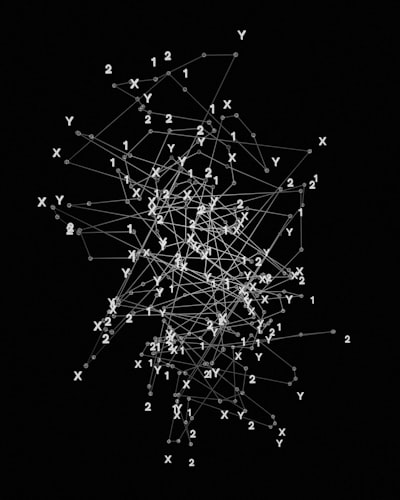
Chaos in machine learning systems is not a barrier, but a window into new ways of predicting behavior. Recent research in game theory shows that algorithms like Multiplicative Weights Update (MWU) can generate chaotic dynamics, unpredictable point by point, yet hiding solid statistical structures. This finding, far from being a mere academic curiosity, has profound implications for developing custom software applications and multi-agent systems, where the interaction between intelligent agents — such as AI agents — can lead to emergent and chaotic behaviors. Understanding these dynamics allows companies like Q2BSTUDIO to design more robust software solutions capable of extracting order from apparent disorder.
Invariant measure theory, drawn from ergodicity, offers a rigorous framework to describe the long-term behavior of such chaotic systems. Instead of seeking a fixed point or a predictable cycle, it studies probability distributions that remain stable under the dynamics. This is analogous to how in financial markets one cannot predict the exact price of a stock tomorrow, but can forecast its long-term statistical distribution. In the business world, this same philosophy applies to massive data analysis using BI / Power BI tools, where the chaos of millions of transactions is ordered into predictable indicators and dynamic dashboards.
The cited study demonstrates that even in simple two-strategy games, chaotic dynamics can coexist with periodic behaviors and strange attractors. For a technology company, this resonates with the challenges of cybersecurity: cyberattacks are chaotic in origin, but through statistical models and invariant measures it is possible to anticipate threat patterns. Q2BSTUDIO integrates these principles into its cloud AWS/Azure services, where scalability and resilience against unpredictable traffic spikes are managed with algorithms that do not seek an exact solution but a stable distribution of resources.
Artificial intelligence and AI agents are another fertile field. When multiple agents learn and compete, they can fall into chaotic cycles. But again, invariant measures allow computing time averages of key metrics such as social cost or regret. This is crucial for developing custom applications that require reliable predictive models. At Q2BSTUDIO, we approach these problems by combining game theory and dynamical systems with cutting-edge software engineering, offering solutions that, even when operating in chaotic environments, deliver statistically predictable results.
The connection between chaos and order is not just philosophical; it is practical. Companies that adopt this approach can optimize their processes through automation based on intelligent agents, deploying cloud architectures that dynamically adapt to demand. Ergodic statistics thus become a design tool for systems that, far from fearing chaos, harness it to extract valuable information. As the arXiv:2607.21805 article demonstrates, game chaos is not the end of predictability, but the beginning of a deeper understanding of complex systems.
In summary, research on invariant measures in chaotic game dynamics provides a conceptual framework that transcends academia. For Q2BSTUDIO, this perspective inspires the development of custom software that integrates AI, cybersecurity, and cloud computing, enabling companies to turn uncertainty into competitive advantage. The key is not to seek the elimination of chaos, but to measure and model it statistically. With this philosophy, and supported by platforms like Power BI to visualize those distributions, any organization can find order in the chaotic dynamics of markets, systems, or algorithms.