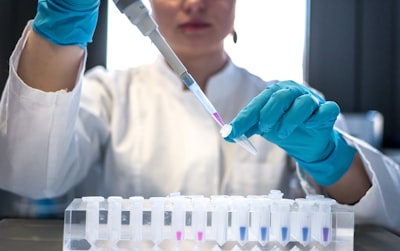
Artificial intelligence is reshaping drug discovery timelines, and China has become an ideal laboratory for this transformation. While conventional methods require four to five years to reach preclinical candidate selection, companies like Insilico Medicine have reduced that to just over a year by combining generative algorithms with automated laboratory infrastructure. This progress not only accelerates research but also allows more innovative molecules to enter clinical trials faster.
The typical discovery process begins with identifying biological targets, followed by designing candidate molecules and experimental validation. Generative AI enables exploration of a vast chemical space, proposing compounds with high binding and activity potential. However, the real leap comes when those designs integrate with robotic workstations and high-throughput screening systems. At this point, collaboration with specialized technology companies becomes key. For instance, Q2BSTUDIO develops custom software platforms that connect predictive models with physical laboratories, enabling continuous data flow and feedback.
China offers structural advantages that enhance this synergy. Its research infrastructure is extensive, and operating costs are significantly lower than in the West. Additionally, regulatory agility — such as the 30-working-day review window for innovative drug applications — allows clinical trials to start faster. According to industry executives, clinical development in China can be conducted three times faster and at half the cost of Europe. This has motivated international pharmaceutical companies to establish partnerships with local laboratories and contract research organizations.
Beyond timelines, the quality of AI-generated candidates is also under scrutiny. Early-stage data show promising success rates (80-90% in Phase I), while Phase II remains around 40%, in line with historical averages. It is still too early to confirm that AI significantly improves late-stage odds, but the time reduction already represents considerable resource savings. To manage these workflows, companies adopt artificial intelligence solutions that not only design molecules but also optimize screening and data analysis processes.
Cybersecurity becomes a fundamental pillar when handling sensitive intellectual property and clinical trial data. Cloud platforms, whether AWS or Azure, allow AI models to scale and store large volumes of information securely. Furthermore, Business Intelligence tools like Power BI help visualize experimental results and make informed decisions. Q2BSTUDIO offers services in these areas, including consulting in cloud AWS/Azure and BI/Power BI, facilitating technological integration in pharmaceutical organizations.
Automation is also transforming job roles. It is estimated that up to 40% of positions in software teams could be replaced or redefined by AI and robotics systems. This does not necessarily imply mass layoffs, but rather a shift toward supervision, validation, and model improvement. Scientists and engineers are being retrained to manage AI evaluations and automated equipment. In this context, training in AI agents — systems capable of performing tasks autonomously — becomes increasingly relevant.
The case of Insilico Medicine illustrates this evolution well. The company has produced 31 preclinical candidates since 2021 and secured 13 investigational new drug clearances. Its first Phase III program, for idiopathic pulmonary fibrosis, is advancing with 320 patients across 47 Chinese sites. However, no drug designed entirely by AI has yet received commercial approval, underscoring that discovery is only the first step in a long path that includes clinical trials, manufacturing, and regulatory review.
Cooperation between pharmaceutical and technology companies is intensifying. Insilico has signed agreements with Eli Lilly and Takeda, and a strategic alliance with Bora Pharmaceuticals could exceed $2.5 billion. Interestingly, more than 90% of its revenue comes from Western companies, due to more favorable reimbursement systems in those markets. This reflects a paradox: while China offers speed and cost advantages, final profitability remains higher in the West.
From a business perspective, software companies like Q2BSTUDIO are well positioned to accompany this transformation. With expertise in process automation and cybersecurity, they help build the platforms that integrate AI, cloud, and data analytics. Demand for custom applications grows as each laboratory seeks to optimize its own workflows, moving away from generic solutions.
In conclusion, the combination of artificial intelligence, Chinese infrastructure, and technological collaboration is drastically compressing drug discovery timelines. Although challenges remain — such as proving long-term efficacy of AI-generated candidates — the trend is clear: the future of pharmaceutical discovery will be faster, cheaper, and smarter. And in that future, companies like Q2BSTUDIO play an essential role by providing the custom software, cybersecurity, and cloud solutions that make this revolution possible.