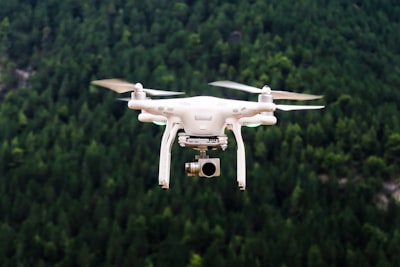
Drone navigation in urban environments is increasingly limited by the degradation of GNSS (Global Navigation Satellite Systems) signals. Phenomena such as multipath reflection, signal blockage by buildings, or intentional interference compromise the integrity of the position and velocity reported by these systems. To ensure safe separation between multiple drones, learning-based separation policies usually assume perfect data, which does not hold in dense cities. This raises a fundamental architectural question: should real-time safety mechanisms filter the policy's actions or its observations? This technical analysis examines both approaches and proposes a business-oriented approach to integrate these solutions into real products.
The action filtering architecture uses discrete-time control barrier functions to restrict the flight policy's outputs. First, a pessimistic traffic state consistent with bounded observation uncertainty is estimated, and then the barrier function is evaluated to limit commands such as speed or direction. In contrast, observation filtering directly presents that pessimistic state as corrected input to the policy, allowing the learning system to decide with cleaned information without external restrictions on its outputs. Experiments show compelling results: action filtering provides negligible safety improvement, while observation filtering reduces near mid-air collisions by 90% and remains robust to the tradeoff between separation distance and closing rate introduced by the barrier function.
These findings suggest that, for policies with learned safety behaviors, preserving the policy's decision authority outperforms overriding its actions with hand-designed constraints. In other words, it is more effective to clean the input data than to force external limits on the output. For a software development company like Q2BSTUDIO, this conclusion has direct practical implications in the design of autonomous systems. Building a robust separation system requires not only learning algorithms but also careful orchestration of safety architecture, cloud infrastructure, and cybersecurity of communication links.
At Q2BSTUDIO we tackle projects of this kind by combining various technological capabilities. On one hand, we develop custom software for drone systems, integrating computer vision and control modules. On the other, we deploy AI agents that make real-time decisions based on cleaned data; these agents can run on cloud AWS or Azure environments to scale horizontally. Cloud infrastructure is also essential for storing and processing large volumes of telemetry, while Business Intelligence (Power BI) solutions allow monitoring the performance of separation policies and detecting deviations. Finally, cybersecurity protects both the integrity of GNSS signals and communication channels between drones and base stations.
A concrete application example is the implementation of a real-time observation filtering system for a fleet of urban delivery drones. The system receives corrupted GNSS data, corrects it using a pessimistic uncertainty model, and feeds the separation policy with that clean information. To guarantee low latencies, it is necessary to optimize estimation algorithms and use low-latency cloud services such as AWS Lambda or Azure Functions. Q2BSTUDIO offers consulting and development services both in cloud AWS/Azure and in artificial intelligence, helping companies design these hybrid architectures.
The robustness of observation filtering against the barrier function also indicates that safety systems must be adaptive. Instead of imposing fixed separation rules, the policy learns to handle dynamic margins based on observation quality. This aligns with the philosophy of modern AI agents, which adjust their behavior according to context. At Q2BSTUDIO we integrate these patterns into process automation solutions, where an AI agent can supervise multiple drones and react to GNSS degradations without human intervention.
In conclusion, GNSS degradation does not have to be an insurmountable obstacle for safe drone separation. Adopting an observation filtering approach, backed by a solid technological infrastructure (cloud, cybersecurity, BI) and custom software development, allows reaching near-ideal safety levels. Companies like Q2BSTUDIO are prepared to accompany organizations on this path, providing from conceptual design to implementation and maintenance of these critical systems.