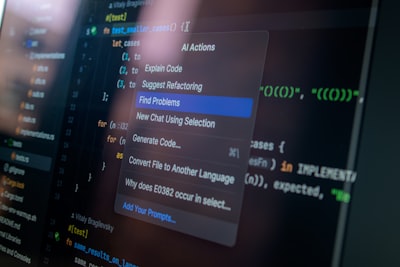
Lexicography, traditionally considered a craft of linguistic documentation, is undergoing a radical transformation driven by generative artificial intelligence. However, the real challenge is not technological, but human: how to integrate AI without stripping lexicographers of their critical and cultural judgment? The human-centered approach (HCAI) offers a conceptual framework that prioritizes collaboration between machine and professional, rather than substitution. This perspective is vital for preserving linguistic diversity and ensuring that digital tools serve speaker communities, not just efficiency metrics. At Q2BSTUDIO, a company specialized in software development and technology, we understand that the key is to design systems that augment human capabilities while keeping control in the hands of experts.
The HCAI framework proposes four interrelated dimensions that guide AI integration in lexicography: the augmented lexicographer, the sociotechnical context, bias, and tool design. The first dimension points out that AI should enhance the lexicographer's skills — such as the ability to analyze large corpora or detect semantic patterns — without eliminating their judgment. The second recognizes that technology does not operate in a vacuum: organizational, cultural, and ethical factors determine its success. The third warns about biases inherent in AI models, which can perpetuate linguistic inequalities or ignore minority varieties. The fourth demands tools designed from the real needs of the professional, not from the technical capabilities of the algorithm. To address these dimensions, many companies turn to custom software that adapts to specific workflows, ensuring usability and cultural relevance.
Automation must be high, but always with meaningful human control. A clear example is AI agents that process millions of word usage examples, identify senses, and generate draft lexicographic entries. However, the final decision on what to include or how to write the definition must rest with the lexicographer. This balance prevents the AI from imposing biased interpretations or excessive simplifications. In the business realm, Q2BSTUDIO develops AI agents that assist in similar tasks, combining natural language processing with expert supervision. The key is that the system learns from human feedback, not the other way around.
Bias is perhaps the most complex challenge. Language models are usually trained on data mostly from dominant varieties (standard English, Spanish from Spain, etc.), marginalizing dialects, minority languages, or colloquial registers. To mitigate this, it is necessary to integrate cybersecurity techniques that protect the integrity of training data and prevent manipulation. Additionally, cloud infrastructure on AWS or Azure allows storing and processing corpora in a scalable way, respecting privacy regulations. Q2BSTUDIO offers cybersecurity services and cloud solutions that guarantee linguistic data is handled with the highest ethical and technical standards.
Tool design centered on the lexicographer implies intuitive interfaces, personalized flows, and advanced analytical capabilities. Here, business intelligence (BI) and tools like Power BI become allies to visualize lexical patterns, usage frequencies, or semantic evolutions over time. Lexicographers can thus make informed decisions based on data, without needing to program. Q2BSTUDIO implements custom BI dashboards that integrate data from corpora, collaborative dictionaries, and social media analysis, offering a holistic view of a language's state.
A concrete case: a team of lexicographers working on a historical dictionary needs to process digitized old documents. Through custom software developed by Q2BSTUDIO, AI agents are integrated to recognize texts, extract words, and suggest etymologies, while the cloud infrastructure on AWS guarantees secure access and scalability. Data is visualized in Power BI, allowing detection of usage trends across different epochs. All under a cybersecurity framework that protects original documents and prevents the introduction of bias. This approach demonstrates that AI-assisted lexicography is not only possible but can be more precise and culturally richer when centered on the human.
In conclusion, the future of lexicography is neither fully manual nor fully automated; it is collaborative. Adopting a human-centered approach means putting lexicographers and linguistic communities at the core of technological design. Companies like Q2BSTUDIO, with experience in custom software development, AI, cybersecurity, cloud, and BI, are ready to accompany this transition. The invitation is to rethink tools not as substitutes, but as extensions of human intelligence, capable of preserving diversity and improving the quality of lexicographic work.