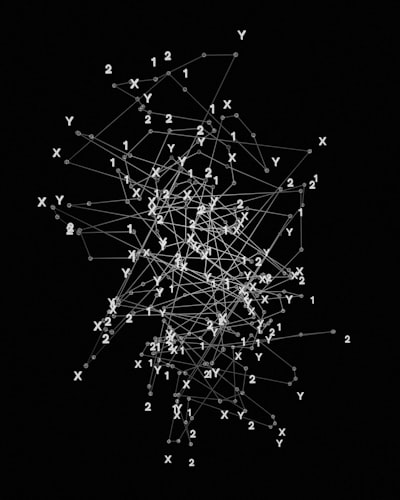
In today's technological development landscape, efficiently representing complex data structures is a recurring challenge. Hypergraphs, generalizations of traditional graphs where edges can connect multiple nodes, have become a fundamental tool for modeling complex relationships in fields such as artificial intelligence, cybersecurity, and data analysis. However, their manipulation and serialization present unique problems. A recent theoretical advance proposes a compact language and instruction set to represent any finite connected hypergraph as a string, using a small virtual machine that manages a doubly linked list and traversal pointers. This approach, reminiscent of low-level programming languages, opens new possibilities for developing custom applications that need to handle large volumes of interconnected information.
Imagine an artificial intelligence system that needs to explore vast knowledge represented as a hypergraph: each node can be a concept, and each hyperedge a relationship among several concepts. Encoding that structure into an instruction string facilitates its storage, transmission, and isomorphism verification. This mechanism is especially relevant when working with AI agents that must navigate semantic networks or graph databases. At Q2BSTUDIO we understand that the ability to model and process complex data efficiently is the foundation of any robust and scalable custom software solution. Our team integrates advanced graph theory concepts into concrete developments, whether for cybersecurity platforms that detect attack patterns or for Business Intelligence engines that analyze business relationships.
The proposed language, which we might call HIL (Hypergraph Instruction Language), consists of a closed alphabet and a virtual machine with three elements: a sparse hypergraph, a circular doubly linked list of node references, and several traversal pointers. Instructions allow moving pointers or inserting hyperedges, optionally with new nodes. This resembles how a CPU executes a program: each instruction modifies the machine state, and at the end a valid hypergraph is obtained. The resulting encoding is reversible, which is critical for applications where data integrity is paramount, such as cybersecurity systems auditing network configurations or cloud environments where complex structures need to be replicated across AWS or Azure regions.
From a business perspective, the ability to serialize hypergraphs using a compact language has direct implications for performance and portability. For example, an AI-based recommendation system can use this representation to exchange trained models between servers efficiently. At Q2BSTUDIO we develop solutions that leverage these ideas to optimize data flow in artificial intelligence platforms, while also integrating cloud services like AWS or Azure to ensure scalability. Our BI experts also use hypergraph representations to build Power BI dashboards that reflect multidimensional relationships, enabling clients to discover hidden patterns in their data.
One of the most interesting aspects of the language is its ability to decide hypergraph isomorphism through canonical string comparison. This avoids the traditional reduction to the Levi graph and subsequent graph isomorphism engines, speeding up verification processes. In cybersecurity applications, where detecting equivalent malicious structures is crucial, this property can accelerate analyses. Likewise, in developing AI agents that learn from hypergraphs, having a unique identifier for each structure facilitates memorization and experience comparison.
Practical implementation of this language requires careful design of the underlying virtual machine. Although the original article describes a greedy algorithm and a backtracking variant to generate the canonical string, the truly transformative part is the possibility of a closed alphabet: any string over that alphabet decodes into a valid hypergraph. This is similar to how well-formed machine code always produces an executable instruction. For a development team like Q2BSTUDIO, this feature allows building compilers or translators that convert high-level descriptions into hypergraph representations, and vice versa.
In the realm of AI agents, instruction-based representation opens the door for agents themselves to generate strings as part of their reasoning. For example, an agent exploring an environment can encode its observations into a hypergraph string, then compare it with others to detect similarities. This capability is fundamental in planning and reinforcement learning tasks. At Q2BSTUDIO we have explored these techniques in process automation projects, where agents need to manipulate complex data structures autonomously.
From a cloud perspective, compact hypergraph serialization facilitates data migration between cloud services. A trained model representing knowledge as a hypergraph can be stored as a string in an AWS S3 bucket or Azure Blob Storage, then loaded into a compute instance for inference. The encoding efficiency reduces storage and bandwidth costs. Our engineers at Q2BSTUDIO integrate these solutions into native cloud architectures, ensuring that AI and BI applications run with maximum efficiency.
Cybersecurity also benefits from this approach. Hypergraphs can model device networks, trust relationships, or attack patterns. By using a canonical language, detection systems can quickly compare the structure of a known attack with a new threat, without resorting to expensive isomorphism algorithms. At Q2BSTUDIO we develop pentesting and vulnerability analysis tools that incorporate these representations, offering our clients an additional layer of protection.
In the field of Business Intelligence, Power BI can benefit from loading hypergraph data as if they were relational tables, while preserving the richness of multiple connections. Our consultants create semantic models that leverage these structures to generate more accurate and insightful reports. The combination of hypergraphs with BI tools allows companies to visualize complex relationships that would otherwise go unnoticed.
In conclusion, the language and instruction set for hypergraphs represents a conceptual advance with multiple practical applications. From artificial intelligence to cybersecurity, cloud computing, and BI, this technique offers an elegant and efficient way to handle interconnected data. Q2BSTUDIO is at the forefront of adopting these ideas, transforming them into custom software solutions that help our clients solve real problems. If your organization needs to represent and process complex structures, do not hesitate to contact us; our team of experts is ready to turn theory into results.