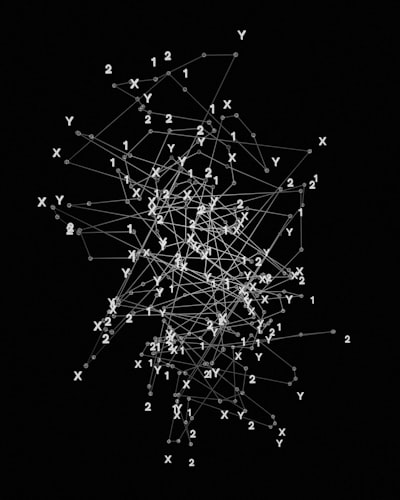
The computational treatment of idiomatic expressions has historically been a challenge for natural language processing (NLP) systems. In contrast to purely statistical approaches based on embeddings, a new line of research proposes multilingual conceptual networks that represent figurative meaning through weighted graphs. This paradigm not only captures unique semantic information but also offers interpretability absent in black-box models. From a technical and business perspective, this architecture opens opportunities to develop custom applications that integrate multilingual artificial intelligence, something that companies like Q2BSTUDIO are already exploring in their custom software solutions.
The core of the approach lies in annotating each idiomatic expression with binary conceptual features —containment, concealment, emotional, social, etc.— derived from cognitive linguistics. From these labels, Jaccard similarity is calculated between pairs of expressions, building a graph where nodes are idioms and edges represent their conceptual proximity. Community detection algorithms reveal that these idioms cluster by conceptual schemas cross-cutting languages, not by native tongue. This has direct implications for tasks such as machine translation, idiom detection in text, or building multilingual recommendation systems.
For a technology company, implementing a system based on these conceptual networks involves combining different capabilities. On one hand, artificial intelligence allows automatic labeling of new expressions via large language models (LLMs), scaling the graph without manual intervention. On the other, cloud infrastructure AWS or Azure —such as the one offered by Q2BSTUDIO in its cloud services— ensures distributed processing of large volumes of linguistic data. Cybersecurity also plays a critical role when these systems handle sensitive corporate information or multilingual content in regulated environments.
Cross-lingual transfer experiments demonstrate that conceptual proximity in the graph predicts acceptable translation equivalents better than embedding-based baselines. This is especially relevant for global companies that need to maintain terminological consistency across multiple languages. A Business Intelligence (BI) department can leverage these conceptual graphs to enrich Power BI dashboards with cultural sentiment metrics or figurative meaning patterns, improving decision-making. Q2BSTUDIO integrates these capabilities into its BI and Power BI projects, offering contextualized dashboards that reflect idiomatic nuances of each market.
Furthermore, ablation studies indicate that all model dimensions —schemas, roles, and valence— contribute non-redundantly to graph organization and performance in idiom detection. This means that custom applications implementing this architecture must maintain the richness of these features. AI agents, for example, can leverage graph community membership to choose the most appropriate paraphrase in a multilingual dialogue, avoiding literal translations that would be nonsensical.
In process automation, these conceptual networks enable workflows that automatically identify metaphors or idioms in emails, contracts, or support interactions. Companies like Q2BSTUDIO already develop process automation with advanced NLP components, and incorporating multilingual conceptual graphs elevates the precision of these tools. The combination of all these technologies —AI, cloud, cybersecurity, BI, and AI agents— positions organizations to handle the real linguistic complexity of the global market.
In conclusion, the conceptual network approach for multilingual idioms is not just an academic advance but a practical tool for custom software development. The ability to represent figurative meaning in an interpretable and cross-lingually stable manner offers a competitive advantage in sentiment analysis, machine translation, and conversational systems. Q2BSTUDIO, with its expertise in multiplatform application development, AI, and cloud, is well-equipped to implement these solutions, helping companies navigate linguistic diversity with cutting-edge technology.