In the fast-paced ecosystem of software development, artificial intelligence has evolved from a futuristic promise into an everyday tool. However, most public debate focuses on topics like automatic code generation or the possibility of machines replacing programmers. But if we look closely at the real use of AI in production environments, we discover that its true value lies not in writing lines of code for us, but in something much more subtle and transformative: the ability to free the human mind from repetitive, low-level tasks, allowing developers to concentrate on what really matters—architecture, business logic, and innovation.
At Q2BSTUDIO, a company specialized in software development and technology, we have integrated AI solutions into many projects, from custom applications to complex cybersecurity and cloud systems. And the most important lesson we have learned is that AI should not be seen as a substitute for human talent, but as a high-performance assistant that amplifies our capabilities. This article explores, from a technical and business perspective, what AI really does well in programming, and how this approach can transform the way we build software.
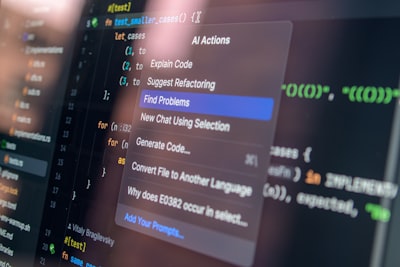
One of the most powerful uses of AI in development is test automation and early error detection. Tools based on language models trained on millions of repositories can identify anomalous patterns, suggest fixes, and even generate complete test cases. This not only accelerates development cycles but also drastically reduces technical debt. Instead of spending hours writing manual unit tests, teams can dedicate that time to designing better APIs, optimizing databases, or improving user experience. AI becomes a silent guardian that watches over code quality while developers focus on the product's differentiating value.
Another area where AI demonstrates its true strength is in requirements analysis and technical documentation generation. Many developers consider documentation tedious and error-prone. However, with AI assistants trained in natural and technical languages, it is possible to transform informal conversations into formal specifications or summarize code changes into coherent release notes. This is especially valuable in agile environments where iteration speed is critical. At Q2BSTUDIO, we apply these techniques in process automation projects and cloud integrations with AWS and Azure, enabling teams to reduce time spent on administrative tasks and focus on creating features that truly impact the business.
Cybersecurity is another front where AI is making a notable difference, though not always in the expected way. It is not just about detecting intruders through machine learning algorithms, but about analyzing source code for vulnerabilities before they reach production. AI tools can examine dependencies, review cloud configurations, and flag potential backdoors. In our daily practice at Q2BSTUDIO, we use these capabilities to strengthen cybersecurity services and provide our clients with an additional layer of protection that the human eye could hardly achieve. AI does not replace the security expert, but provides them with a high-precision radar.
It is also important to highlight the role of AI in performance optimization and scalability. When a system grows, identifying bottlenecks in code or cloud infrastructure can be like finding a needle in a haystack. AI algorithms can analyze logs, usage metrics, and traffic patterns to suggest changes in server configuration, database indexing, or query structure. This is especially relevant in cloud environments like AWS and Azure, where cost is directly tied to efficiency. At Q2BSTUDIO, we have implemented business intelligence solutions with Power BI that, combined with AI agents, allow companies to visualize the status of their applications in real time and make informed decisions about horizontal or vertical scaling.
But perhaps the most unknown and transformative use of AI in programming is its ability to facilitate collaboration among multidisciplinary teams. AI assistants can translate technical concepts into business language and vice versa, helping stakeholders understand the implications of certain architectural decisions. This reduces friction between developers, designers, and product leaders, accelerating approval cycles and aligning objectives. In AI agent projects, we have seen how these tools act as semantic bridges, improving communication and avoiding misunderstandings that often lead to costly rework.
A common mistake is to think that AI only serves large projects or elite teams. The reality is that small and medium-sized enterprises can also benefit enormously. With low-code and no-code platforms powered by AI, anyone with basic knowledge can create functional prototypes, automate workflows, or generate BI reports without writing a single line of code. This democratizes development and allows human resources to focus on tasks of higher strategic value. At Q2BSTUDIO, we support our clients in adopting these tools, always with a personalized approach that ensures technology adapts to the business, not the other way around.
Of course, AI is not perfect. It still makes mistakes, hallucinates answers, or generates code that seems correct but hides logical flaws. That is why it is essential to maintain qualified human supervision. AI should be seen as a co-pilot that speeds up the journey, but the pilot remains the developer. The key is understanding which tasks to delegate and which to retain. And that is where the true art of modern software engineering lies: knowing how to combine human intuition with the computational power of artificial intelligence.
At Q2BSTUDIO, we believe that the future of development will not be fully autonomous, but collaborative. AI allows us to do more with less time, but creativity, ethics, and strategic vision will remain the exclusive heritage of people. Therefore, when designing cloud AWS/Azure, cybersecurity, or business intelligence solutions, we always integrate AI as one component within an ecosystem where the human factor makes the difference. The question is not whether AI can program better than us, but how we can use it to program better together.
In short, what AI really does well in programming is not writing code faster, but freeing our minds so we can think big, solve complex problems, and build software that truly transforms organizations. And that, undoubtedly, is a paradigm shift worth exploring deeply.