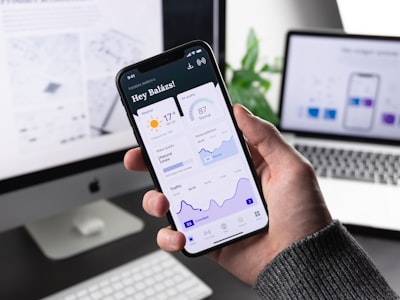
In today's business ecosystem, where mobility defines productivity, having an expense management app with mobile compatibility is not a luxury but a strategic necessity. Organizations still relying on manual processes or desktop-only systems fall behind competitors that allow their teams to capture, approve, and audit expenses from anywhere. This article explores the technical and business keys that turn an expense application into a truly mobile tool, with an original approach that goes beyond the obvious.
Digital transformation has focused on the end-user experience, and employees expect to be able to log a receipt, review an approval flow, or check an expense report as easily as they check their email. Behind this apparent simplicity lies engineering work combining cloud architecture, adaptive interfaces, perimeter security, and increasingly, artificial intelligence. At Q2BSTUDIO, as a software development and technology company, we build custom applications that integrate these components coherently, ensuring mobility does not compromise control or data integrity.
One of the first challenges is offline synchronization. An employee may be in a no-coverage area after a client meeting and need to save a dinner receipt or train ticket. A robust mobile app must allow offline capture, storing information on the device and syncing automatically when connectivity is restored. This seemingly simple approach requires careful handling of data conflicts and business logic that validates expense policies even offline. In our projects we implement sync queues with retry and audit mechanisms, all supported on AWS or Azure cloud infrastructure, depending on client needs.
Another key aspect is the user experience adapted to the mobile context. It is not just about scaling a desktop form to a 6-inch screen, but rethinking interaction: touch gestures, camera to scan receipts, geolocation to assign expenses to projects or clients, and push notifications to alert pending approvals. Additionally, the app must offer executive dashboards that, from a mobile device, allow the CFO to view spending trends, detect anomalies, or access Business Intelligence (BI) reports using tools like Power BI, all without losing performance. At Q2BSTUDIO we have developed BI and Power BI solutions integrated with expense apps, giving executives real-time insights from their personal device.
Cybersecurity is another pillar that cannot be an afterthought. A mobile expense management app handles sensitive data: corporate card numbers, supplier information, scanned documents. Any vulnerability can expose the company to fraud or leaks. Therefore, in every project we apply security-by-design practices: multi-factor authentication (MFA) adapted for mobile, end-to-end encryption, secure token and session storage, and periodic penetration testing. Additionally, we use AWS or Azure cloud services with granular access policies. For clients requiring extra protection, we offer cybersecurity and pentesting services that validate the app's resilience against real attacks.
Artificial intelligence (AI) is redefining how companies manage expenses. Virtual assistants based on AI agents can automatically classify expenses by category, detect duplicates, predict budgets, or even suggest savings actions. In the mobile environment, an integrated conversational agent lets the employee ask 'How much did I spend on travel this month?' or 'Approve this €200 expense' without navigating menus. These capabilities rely on language models trained on anonymized data and serverless architectures on AWS or Azure for efficient scaling. At Q2BSTUDIO we design custom applications with AI modules that adapt to each company's specific policies, offering a predictive and proactive experience.
Mobile compatibility also implies performance and adaptability. The app must load quickly even on slow connections, consume little battery, and use minimal storage. To achieve this, we opt for hybrid development with frameworks like React Native or Flutter, which share logic between iOS and Android, or Progressive Web Apps (PWA) offering a near-native experience without installation. In both cases, the backend is deployed in the cloud with load balancing and smart caching, ensuring availability even during peak usage, such as month-end closes or training campaigns.
We cannot forget integration with corporate systems. A mobile expense app must connect seamlessly with ERP, HR systems, travel platforms, and corporate credit cards. This requires a well-designed API layer with OAuth2 authentication, webhooks, and message queues. In our developments, we implement middleware that orchestrates these connections, allowing the mobile app to consume data from multiple sources in real time. Additionally, we offer process automation to eliminate repetitive tasks, such as automatic reconciliation of expenses with bank statements.
From a business perspective, an expense management app with mobile compatibility significantly reduces reimbursement cycles, improves accounting accuracy, and empowers employees. Finance teams gain real-time visibility, and auditors can access detailed audit trails from any device. But the real differentiating value appears when mobility is combined with advanced analytics: detecting anomalous spending patterns, forecasting budget deviations, or identifying supplier negotiation opportunities. This is made possible by integrating cloud solutions on AWS or Azure that provide computing power to process large volumes of data without sacrificing the mobile experience.
In short, mobile compatibility in an expense management application is not just a technical feature but a business enabler. Q2BSTUDIO, as a technology partner, helps companies design and build these custom solutions, incorporating the latest trends in AI, cybersecurity, cloud, and BI, ensuring that mobile users have a seamless, secure experience aligned with corporate strategy. If your organization seeks to transform how it manages expenses, mobility is the first step toward total efficiency.