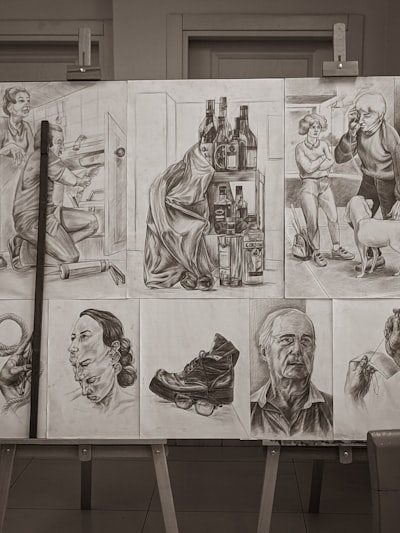
A recent study published in Nature has shaken the worlds of design and technology by revealing that sketches of everyday objects, such as a house or a tree, vary significantly across cultures. Analyzing billions of drawings made by users worldwide, researchers discovered that our way of conceptualizing our surroundings is deeply shaped by cultural context. For example, while in the West a house is drawn with a gabled roof and a central door, in Southeast Asian regions it may be depicted as a structure raised on stilts. These findings are not only fascinating from an anthropological perspective but also open new opportunities for software development and artificial intelligence.
Behind this massive analysis of sketches lies the ability to process millions of images using convolutional neural networks and deep learning techniques. Artificial intelligence has made it possible to identify patterns that would be invisible to a human observer, classifying cultural variations with astounding precision. For technology companies, this represents a goldmine of information: knowing that a user from the Middle East draws a clock differently than a European can influence the design of interfaces, visual search systems, and augmented reality applications. In this context, cultural personalization becomes a key differentiating factor.
From a business perspective, adapting products and services to these cultural differences is no longer an option but a necessity. Companies that ignore these subtleties risk offering user experiences that are unintuitive or even offensive. This is where Q2BSTUDIO comes into play, a software and technology development company that understands the importance of building inclusive and adaptable solutions. Our team specialized in custom software can design platforms that integrate culturally sensitive sketch recognition systems, using AI algorithms trained on diverse datasets. Additionally, we host these solutions on robust cloud infrastructure, whether AWS or Azure, ensuring global scalability and performance.
Imagine an online shopping app that lets users search for products by drawing them. If the app does not account for cultural variations in the stroke of a chair, a user from Japan might draw a floor cushion and get no relevant results. With the right technology, it is possible to implement an AI model that recognizes multiple representations of the same concept, improving accuracy and user satisfaction. At Q2BSTUDIO we develop this type of AI agents that learn from cultural differences and adapt dynamically. We also integrate Business Intelligence tools (Power BI) so that companies can analyze how users from different regions interact with interfaces, enabling continuous adjustments.
Cybersecurity is another critical aspect when handling sketch data and cultural preferences. The information can be sensitive if linked to identities or locations. Therefore, in our projects we implement advanced security measures, including encryption, multi-factor authentication, and penetration testing audits. A comprehensive cybersecurity approach protects both users and the company's reputation. Likewise, the cloud infrastructure (AWS/Azure) we use has compliance certifications that guarantee data privacy on a global scale.
The sketch study also has implications for process automation. For example, AI-assisted drawing systems that help designers create culturally appropriate icons, or educational apps that teach children from different cultures to draw common objects respecting their own visual traditions. At Q2BSTUDIO we offer process automation services through software that can integrate these concepts. The key is flexibility: building modular solutions that allow new cultural variations to be incorporated as they are discovered.
In addition to visual search, cultural variations in sketches have applications in the design of logos, emojis, and digital signage. A global company launching a product in multiple markets needs to ensure that its graphic representations are understood the same way. This seemingly simple task becomes complex when a simple drawing of an arrow can be interpreted differently across cultures. Here, analyzing large volumes of sketch data, supported by BI tools like Power BI, allows identifying trends and validating design hypotheses objectively. At Q2BSTUDIO we integrate customized dashboards that monitor in real time how users from different regions draw and search, providing actionable insights for product teams.
Another emerging field is intercultural education. Learning platforms that use drawing recognition can personalize content according to the student's cultural background. For example, when teaching vocabulary, a system could display a sketch of a 'house' that matches the student's typical representation, facilitating mental association. Developing these capabilities requires custom software that combines computer vision, language models, and efficient cloud storage. Our experience in AWS and Azure allows us to deploy serverless architectures that scale automatically according to demand, keeping operational costs low.
Finally, ethics in collecting and using cultural data is fundamental. Companies must be transparent about how they use sketches and offer consent options. At Q2BSTUDIO we implement data governance policies aligned with regulations such as GDPR, and we conduct impact assessments on AI models to avoid biases. Cybersecurity is not an add-on but a pillar of every solution we build. We work with penetration testing teams to identify vulnerabilities before a product reaches the market, ensuring the trust of global users.
In conclusion, the research on billions of sketches reminds us that cultural diversity is not just a social issue but a strategic factor in technological development. Companies that leverage these variations to personalize their products will gain a significant competitive advantage. From Q2BSTUDIO, we invite organizations to explore how artificial intelligence, the cloud, and custom software can transform these scientific findings into practical solutions. It is not just about drawing, but about deeply understanding how each user thinks and perceives. And in that journey, technology is the best ally.