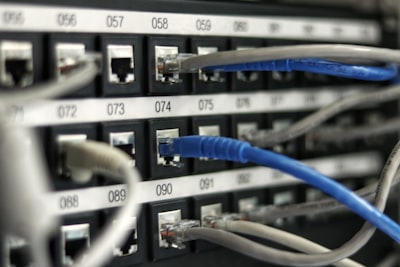
If you are still using Cat5 cables in your home or office, you are losing performance and limiting your network's potential. Although Ethernet cable has been a standard for decades — from its invention in the 1970s to its commercialization in the early 1980s — technology has evolved. Cat5 cables, designed for 100 Mbps networks, simply cannot keep up with modern fiber optic connections, cloud applications, and artificial intelligence systems. The solution is not complicated: replace those outdated cables with Category 6 or higher cabling. But beyond the physical change, this upgrade is an opportunity to rethink your entire technological infrastructure.
Imagine you sign up for a 1 Gbps connection, but it drops to 100 Mbps because the final stretch is a Cat5 cable. It's like having a sports car with a 1980s carburetor. The same happens in business environments: cloud services like AWS or Azure, Business Intelligence platforms like Power BI, and cybersecurity solutions depend on fast and stable data transfer. Poor cabling introduces latency, packet loss, and bottlenecks that ruin user experience and operational efficiency.
What should you do instead of using Cat5? First, identify what type of cable you have. Original Cat5 is recognized by its limited 100 MHz frequency and inability to reliably support Gigabit Ethernet. Cat5e improved slightly, but the real leap comes with Cat6 and Cat6a. Cat6 handles frequencies up to 250 MHz and can transmit 10 Gbps over distances up to 55 meters; Cat6a reaches 500 MHz and maintains 10 Gbps up to 100 meters. For new installations, Cat6a is the most balanced option in terms of price, performance, and future-proofing. If you need longer distances or total immunity to electromagnetic interference, consider fiber optics. In any case, get rid of Cat5.
Now, changing cabling is not just about speed. It is the foundation for advanced technologies such as artificial intelligence agents, which require low latency to make real-time decisions. It is also key for cybersecurity: a slow or unstable network can be vulnerable to attacks or hinder the implementation of security protocols like end-to-end encryption. Companies developing custom software need predictable bandwidth for testing and production environments. At Q2BSTUDIO, as a software and technology development company, we understand this interdependence. That is why we offer services ranging from creating custom software to migrating to cloud AWS/Azure, all on an optimized network infrastructure.
But don't stop at the cable. Take advantage of the renewal to review other components: switches must be Gigabit or higher, patch panels of good quality, and RJ45 connectors properly crimped. A common mistake is using flat or low-quality cables that do not meet specifications. It is also advisable to perform a certification test with a cable tester to ensure each segment meets the desired category.
From a business perspective, a modern network is a productivity enabler. Business Intelligence solutions like Power BI feed on real-time data; if the network cannot transport that data smoothly, reports take longer to load and decisions are delayed. Similarly, the implementation of AI agents to automate processes requires constant communication between servers and devices. Cybersecurity also benefits: shielded cabling (STP) reduces signal leakage and interference, protecting data integrity.
Moreover, cabling affects the efficiency of Power over Ethernet (PoE). Devices such as IP cameras, WiFi access points, and IoT sensors receive power and communicate over the same cable. A low-quality Cat5 can cause voltage drops or overheating, while Cat6a with thicker conductors handles power delivery better. This is crucial for modern security and automation installations.
Another consideration is scalability. If you plan to expand your network in the coming years, Cat5 will quickly become obsolete. In contrast, an infrastructure with Cat6a or fiber optics will allow you to add more devices, increase bandwidth, and adopt new technologies without rewiring. Q2BSTUDIO, with its expertise in cybersecurity and BI/Power BI, knows that a solid network is the backbone of any digital strategy. Not surprisingly, our artificial intelligence and AI agent solutions are deployed on high-performance networks to guarantee immediate results.
In terms of cost, the investment is minimal compared to the benefit. A 100-meter roll of Cat6a cable costs between 30 and 50 euros, and connectors are equally cheap. If you hire a professional, labor may be the larger expense, but it is worth it to ensure correct installation. Moreover, many companies offer turnkey services that include certification and warranty.
In summary, stop using Cat5 cables is the first step toward a faster, more secure, and future-ready network. Whether you are a home user with multiple devices or a company managing large amounts of data, the upgrade is simple and the benefits immediate. Change the cable, optimize your infrastructure, and boost your technology with the support of experts like Q2BSTUDIO, who integrate software development, cloud, AI, and cybersecurity into a coherent ecosystem.