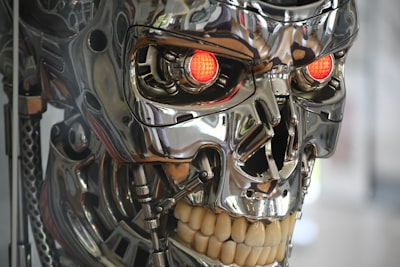
When James Cameron released Terminator 2: Judgment Day in 1991, the world of cinema was forever changed. The film not only redefined science fiction but set a new benchmark for visual effects. Behind those groundbreaking images — the liquid metal T-1000, the truck chase, the fusion of practical and digital — lies a fascinating oral history that reveals how a team of visionaries pushed technological boundaries. Today, those same lessons of innovation, rapid iteration, and tool integration are directly applicable to enterprise software development. Companies like Q2BSTUDIO have learned from that philosophy to offer technology solutions that transform businesses.
The best-kept secret of Terminator 2 was not its million-dollar budget, but how it integrated disparate techniques: animatronics, miniatures, digital painting, and motion capture. Stan Winston and his team built scale models with a level of detail that today would be achieved with 3D printing and software like Blender or Maya. Yet the real magic happened when they combined those physical models with early CGI systems, such as the Quantel Paintbox, which allowed frame-by-frame retouching. That blend of tangible and digital is exactly what modern companies seek when developing custom software: a balance between proven processes and cutting-edge technology.
Motion capture — with suits full of markers — was another leap forward. For the scene where the T-1000 walks through bars, actors performed precise movements that were later translated into digital animations. Today, that technology has evolved into inertial sensors and depth cameras, but the principle remains the same: transforming data into realistic behaviors. In the corporate world, AI agents work analogously: they receive data from sensors (such as transactions, logs, or user interactions) and learn to make autonomous decisions. Q2BSTUDIO integrates these intelligent agents into business processes, from customer service to logistics, replicating that same 'capture and execute' logic that made the film famous.
Another little-known aspect of the production was the use of miniatures for the tanker truck sequence. Rather than digitizing everything, Cameron preferred to build physical models and then add CGI only to enhance details like explosions or reflections. This hybrid methodology saved time and created an organic texture that pure CGI could not achieve. In software development, something similar occurs: not everything has to be new code. Smart companies reuse existing modules, integrate cloud platforms like AWS or Azure through cloud services, and apply low-code logic to accelerate delivery. The key is knowing when the practical (a library, a proven service) is better than building from scratch.
The oral history of Terminator 2 also reveals last-minute decisions that saved the shoot. For example, for the famous scene where the T-1000 emerges from a tiled floor, the effects team designed a pneumatic mechanism that raised the actor. That kind of on-the-fly innovation is comparable to what happens in a cybersecurity project when a real-time attack forces a defense redesign. Q2BSTUDIO offers cybersecurity and pentesting services built on that same adaptability: assess vulnerabilities and react with robust solutions before the 'attack' materializes.
The film was also a pioneer in using digital effects to simulate liquids, a huge computational challenge at the time. Today, fluid simulation is used in video games, surgical training, and industrial digital twins. And behind those simulations are AI models trained on massive data. Companies adopting Business Intelligence with tools like Power BI can leverage that same predictive logic: analyze historical data flows to anticipate trends. Q2BSTUDIO develops dashboards with BI and Power BI that turn data into decisions, just as the T-1000 transformed its shape according to the environment.
If there is a lasting lesson from Terminator 2, it is that innovation does not come from a single technology but from the intelligent integration of several. Cameron's team used CGI, miniatures, animatronics, and motion capture as pieces of the same puzzle. In today's business ecosystem, successful companies are those that combine custom software, AI, cybersecurity, cloud, and BI into a coherent architecture. Q2BSTUDIO acts as that conductor: it understands each tool, knows when to apply it, and makes them all work together toward a single goal. Whether automating processes with AI agents or migrating infrastructures to AWS, the philosophy is the same that took cinema to a new level: dare to experiment, combine the best of each world, and learn from past mistakes.
The oral history of Terminator 2 is not just about cables, servos, and pixels; it is about people who dared to dream big with limited resources. That same spirit drives software development companies today. If you want your business to have the impact of a blockbuster, you need a team that understands both the whiteboard and the code. At Q2BSTUDIO, every project is approached like a tech blockbuster: with planning, creativity, and the certainty that the best way to predict the future is to invent it.