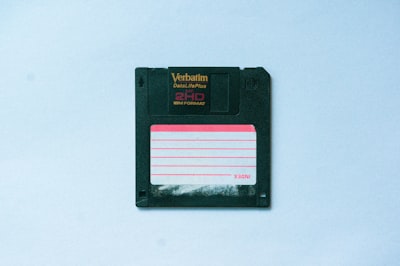
The Future Nostalgia project is born from a technological paradox: dedicating cutting-edge resources to rescue data from floppy disks, a medium that already seemed obsolete in the 90s. What could be a mere retrocomputing exercise becomes an ironic critique of our relationship with digital memory. While cloud storage promises eternity, floppy disks physically degrade; while artificial intelligence algorithms generate new content, old files are lost due to magnetic decay. In this context, archiving floppy disks is not just about preserving 80s photos or BASIC programs, but about questioning what deserves to be saved and with what tools.
The irony is evident: to read a 3.5-inch disk with a capacity of 1.44 MB we need obsolete hardware (a USB floppy drive), operating systems that no longer support native drivers, and often emulated or reconstructed software. But once data is extracted, the real work begins: cataloging, digitizing, extracting metadata, and deciding whether to preserve the original format or convert to modern standards. That is where current business technology comes in.
Companies like Q2BSTUDIO have developed custom software applications that automate the ingestion of data from old media, applying error correction algorithms and recognition of proprietary formats. This is not a small niche: museums, historical archives, and large corporations storing decades of documentation on floppy disks need robust and scalable solutions. The cloud plays a central role: once digitized, files can be migrated to AWS or Azure, ensuring redundancy, encryption, and global accessibility. Q2BSTUDIO offers precisely this orchestration between legacy hardware and modern cloud, combining extraction scripts with cloud storage APIs.
Artificial intelligence also adds its ironic touch. AI models trained to recognize fonts, logos, or handwritten text can automatically tag images extracted from floppy disks. Even AI agents can be used to classify documents by content, dates, or keywords, without human intervention. This accelerates processes that previously required weeks of manual work. Of course, cybersecurity cannot be ignored: old floppy disks may contain malware that, when run in emulators, could infect modern systems. That is why cybersecurity solutions include sandboxed environments and behavioral analysis before allowing any rescued binary to execute.
The Future Nostalgia project also examines the human aspect: why spend time and money archiving floppy disks when we can search for anything on the internet? The answer lies in the uniqueness of the data. Many floppy disks contain academic papers, private correspondence, shareware software, or demos that were never uploaded to the web. They are unique pieces of our digital culture. By digitizing them, we not only preserve them but also open the door to historical analysis using Business Intelligence tools. A Power BI dashboard could show the evolution of software prices in the 80s, the frequency of certain viruses, or the geographic distribution of users of a particular program. Q2BSTUDIO, with its experience in BI and Power BI, helps build those dashboards that transform chaotic data into structured knowledge.
But beyond the technical, Future Nostalgia is an exercise in self-awareness. We store terabytes of photos in the cloud that we never look at again, while letting floppy disks containing the only records of a doctoral thesis rot in a drawer. The irony forces us to ask: what are we doing wrong with digital preservation? Tech companies have a responsibility to design systems that not only store but allow continuous migration. Q2BSTUDIO addresses this challenge with process automation solutions that detect obsolete formats and suggest automatic conversions before hardware fails.
The project has gained notoriety in retrocomputing and archivist circles, but has also sparked interest in IT departments of large companies that discover they still have boxes of floppy disks in basements. Future Nostalgia's methodology includes creating forensic images of each disk (bit by bit), documenting metadata (manufacturer, date, handwritten label), and publishing to open repositories when copyright allows. All with an ironic tone that often translates into memes and viral videos: 'I waited 30 years to see what was on this floppy and it turned out to be a shopping list.' That combination of technical rigor and humor is what makes the project unique.
From a business perspective, Future Nostalgia shows that demand for legacy data migration services is growing. Banks, insurance companies, and public administrations still operate mainframe systems that read magnetic tapes or floppy disks. Q2BSTUDIO has capitalized on this need by offering an integrated service ranging from physical extraction to cloud platform integration, including the application of artificial intelligence for content indexing. AI agents, for example, can search for text patterns in thousands of floppy disk documents and generate automatic summaries, saving hours of manual review.
In short, archiving floppy disks with irony is much more than a nostalgic hobby: it is a reminder that technology is not eternal and that preservation requires strategy, investment, and sometimes a sense of humor. Projects like Future Nostalgia help us rethink how we manage digital heritage, while companies like Q2BSTUDIO provide the technical tools to make that management viable, secure, and scalable. Next time you find a dusty floppy disk, think about the irony of using artificial intelligence to read it, or uploading its content to a cloud that might also become obsolete someday. That contradiction is the heart of Future Nostalgia.