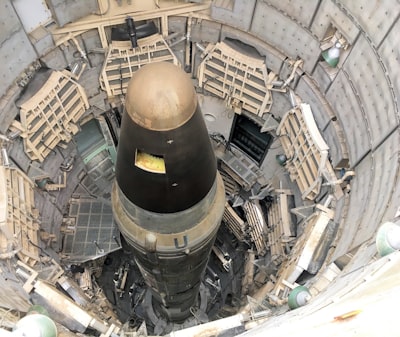
The increasing militarization of space poses a global challenge: ensuring that no country or non-state actor deploys nuclear weapons in Earth orbit. Although the 1966 Outer Space Treaty explicitly bans such weapons, verifying compliance remains a technical and political problem. Recently, a model developed at MIT proposes a method based on “inspector” satellites capable of detecting neutron signals emitted by fissile materials in the presence of high-energy protons trapped in Earth’s magnetic field. This approach, published in Nature, opens new avenues for space security but also raises questions about the technology needed for operational implementation.
The model, created by Areg Danagoulian, simulates the interaction between gigaelectronvolt (GeV) protons and heavy nuclei such as uranium or plutonium. When these particles collide, a nuclear spallation process occurs, generating neutrons, gamma rays, and other secondary particles. A CubeSat equipped with commercial detectors, weighing less than 18 kg, could identify a thermonuclear weapon at a distance of 4 km after approximately one week of observations. However, the study acknowledges that additional proof-of-concept tests are required to validate practical feasibility.
From a technical perspective, nuclear verification in space depends not only on particle physics but also on advanced software systems for signal processing, noise filtering, and data interpretation. This is where custom software development solutions come into play. Companies like Q2BSTUDIO, specialized in high-complexity software, could design analysis platforms that integrate artificial intelligence algorithms to discriminate between genuine signals and false positives caused by cosmic rays or environmental radiation.
Implementing a constellation of inspector satellites would require a robust data infrastructure. The volume of information generated by neutron detectors would be enormous, and real-time processing would demand cloud computing capabilities. Services such as AWS and Azure offer scalability and security, two critical factors for an international verification mission. Additionally, cybersecurity becomes a fundamental pillar: inspector satellites could be targets of cyberattacks to hide or manipulate evidence. Therefore, cybersecurity solutions, such as those Q2BSTUDIO integrates into its projects, are essential to protect data integrity and communications.
Another key aspect is the analysis of large historical datasets to identify orbital behavior patterns. Business Intelligence tools, like Power BI, enable trend visualization and anomaly alerting. A BI and Power BI system could consolidate data from multiple sources —satellites, ground stations, sensors— and generate automated reports for international bodies. Likewise, AI agents could take on continuous monitoring tasks, automating the detection of suspicious signals without direct human intervention.
Process automation is another field where technology can make a difference. From deploying CubeSats to managing their orbits, through data collection and analysis, each stage can be optimized with custom software. Q2BSTUDIO offers process automation services that reduce costs and times, improving the efficiency of complex space missions.
Danagoulian’s model represents a step forward in treaty verification, but its feasibility depends on a technological ecosystem that includes advanced sensors, secure communications, and, above all, intelligence to interpret the data. Artificial intelligence and machine learning allow training models capable of distinguishing between nuclear emissions and other radiation sources, minimizing false positives. In a context of geopolitical tensions, having reliable and transparent AI systems is crucial for trust between nations.
From a business perspective, developing these capabilities opens a niche market for software companies and technology consulting. Q2BSTUDIO already works on projects related to AI agents, cloud computing, and cybersecurity, areas that converge in space verification. The company could collaborate with space agencies or international consortia in creating modular verification platforms, adapting its expertise in artificial intelligence to a highly demanding field.
In conclusion, the model for verifying the nuclear ban in space is a reminder that technology must advance not only in hardware but also in the software that controls it. Collaboration between physicists, engineers, and software developers is essential to turn a promising theory into an operational reality. With companies like Q2BSTUDIO providing custom software solutions, artificial intelligence, and cybersecurity, the path toward a space free of nuclear weapons seems more attainable.