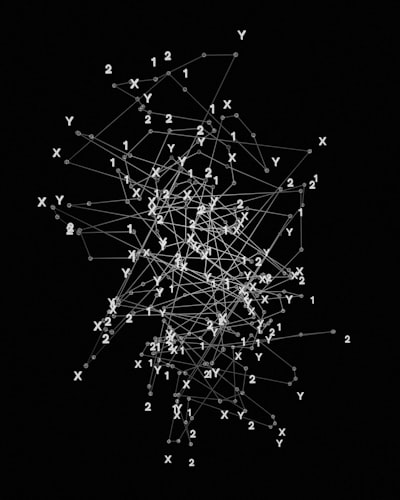
In the field of transformer-based language models, Rotary Position Embeddings (RoPE) have proven to be an effective technique for encoding positional information. However, a fascinating aspect that has recently emerged is that the frequencies of these embeddings are not used uniformly by trained models. Instead, the training data seems to shape frequency selection, creating a deep link between the relative-dependency structure of the corpus and how the model generalizes to longer context lengths. This phenomenon not only has theoretical implications but also opens practical opportunities for companies seeking to optimize their artificial intelligence systems.
The core idea is that each frequency in RoPE acts as a positional lens: high frequencies capture fine details but with a reduced field of view, while low frequencies offer a global view but with lower resolution. Thus, there is a trade-off between field and resolution. Recent studies demonstrate that the optimal frequency for a given dependency scales inversely with the width of the data-induced dependency window. This frequency-matching principle explains why language models tend to use mid-low frequency bands: natural language exhibits a multi-scale dependency structure, with patterns repeating at different relative distances.
From a business perspective, understanding this mechanism is key to improving the ability of AI models to handle long contexts, a recurring challenge in applications such as analyzing lengthy documents, customer service chatbots with full history, or recommendation systems processing long interaction sequences. At Q2BSTUDIO, as a software development and technology company, we help organizations integrate these innovations into their AI solutions, tailoring models to each business's specific needs through custom software applications. For example, a legal contract analysis system can benefit from a RoPE frequency configuration that maximizes precision in long-range dependencies without sacrificing resolution in nearby fragments.
Length generalization through test-time frequency scaling is another practical consequence. When dependencies in long contexts are an approximate dilation of those seen during training (as occurs in natural language, which shows self-similarity across scales), reducing frequencies expands the effective field. This allows a model trained on, say, 512-token chunks to extrapolate to 4096 tokens without retraining. However, this technique fails if the relevant dependencies do not scale with context length, for instance, in tasks where crucial information is concentrated in a fixed window regardless of total context.
For companies deploying language models in production, this distinction is critical. A customer service system that uses AI to summarize lengthy conversations needs to ensure that the RoPE frequencies align with the actual dependency structure of dialogues. This is where cloud AWS/Azure and cybersecurity services offered by Q2BSTUDIO enable secure and efficient infrastructure scaling, ensuring models can process long contexts without compromising performance or data privacy.
Another relevant point is the connection with business intelligence tools. The dependency patterns that emerge in training data can also be analyzed using BI/Power BI to identify how different context scales influence prediction accuracy. By integrating these metrics into dashboards, data teams can make informed decisions about hyperparameter tuning such as RoPE frequencies. Additionally, AI agents (agentes IA) operating in multi-step environments benefit from a clear understanding of the field-resolution trade-off, optimizing their ability to recall past information while maintaining agility in short interactions.
Ultimately, research on how data shapes RoPE frequency usage reveals that length generalization is not merely an architecture problem but is deeply rooted in the statistical structure of the data. For companies aiming to lead in advanced AI adoption, partnering with a technology partner like Q2BSTUDIO, specialized in custom software, cloud, cybersecurity, and automation, provides a competitive advantage. It is not only about implementing the latest model but about understanding how data conditions its behavior and adapting infrastructure accordingly. Scale matching—between learned frequencies and training dependencies, and between frequency scaling and context extension—is the principle guiding the future of length-efficient transformers, and mastering it is the next step for any organization wanting to extract maximum value from its data.