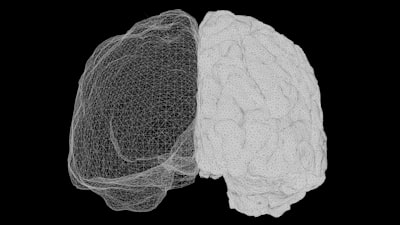
At the intersection of computational neuroscience and artificial intelligence, a crucial question arises: how to model the complex hierarchy of the human brain to diagnose disorders with greater accuracy? Traditional brain graph analysis methods often flatten the multi-level structure—from regions of interest (ROIs) to functional communities and the global network—losing fundamental information about cross-scale interactions. Recently, hyperbolic learning has proven to be a powerful tool for capturing hierarchies in complex data, and its application to brain graphs promises to revolutionize the diagnosis of disorders such as autism or depression. In this context, companies like Q2BSTUDIO are leading the development of AI solutions that integrate these advanced techniques to offer more accurate and scalable clinical tools.
The brain is not a flat network. ROIs cluster into functional communities that coordinate for specific tasks, and these communities, in turn, integrate into a global network that sustains cognition. Modeling this hierarchy has been challenging because traditional Euclidean representations cannot capture the inclusion and nesting relationships that occur naturally. Hyperbolic space, with its negative curvature, offers an ideal geometry for representing hierarchies: the distance between nodes reflects their hierarchical level, allowing a model to learn that a community contains its ROIs and that the global network contains the communities. The HLBG (Hyperbolic Learning on Brain Graphs) framework is a paradigmatic example: it projects ROI, community, and whole-brain representations into a Lorentz space, and imposes geometric entailment constraints to enforce hierarchies. This allows the model to learn discriminative representations that significantly improve disorder classification.
From a business perspective, implementing these models requires robust technological infrastructure. Q2BSTUDIO offers cloud services on AWS and Azure that enable deploying large-scale hyperbolic deep learning models, handling massive volumes of neuroimaging data without compromising performance. Furthermore, cybersecurity is critical when processing sensitive medical data; the company integrates advanced security protocols to comply with regulations such as HIPAA or GDPR. On the other hand, results analytics is enhanced with BI / Power BI, transforming learned representations into interactive dashboards that neurologists can easily interpret. All of this is supported by the development of custom software, adapting each solution to the specific needs of hospitals and research centers.
An innovative aspect within HLBG is the use of Graph-aware Mamba (GaMamba), a model that captures long-range dependencies in brain graphs without losing topology. Unlike traditional graph convolutional networks, GaMamba incorporates structural prompts derived from graph topology into a Mamba-style architecture (an efficient alternative to transformers). This allows modeling connections between distant ROIs that belong to the same community, improving the detection of functional biomarkers associated with disorders such as autism spectrum disorder (ASD) or major depressive disorder (MDD). Experiments on datasets like ABIDE-I and REST-MDD show that HLBG outperforms state-of-the-art methods, identifying patterns that previously went unnoticed.
The commercial potential of this technology is enormous. Custom software developed by Q2BSTUDIO allows clinics to integrate these models into their daily workflows—from fMRI image acquisition to automatic generation of diagnostic reports. The AI behind HLBG not only classifies disorders but also reveals which regions and communities are most relevant for each patient, facilitating personalized medicine. Additionally, AI agents can be trained to monitor patient evolution over time, adjusting the model with new data and alerting clinicians to significant changes. This represents a step toward precision psychiatry, where treatment dynamically adapts to the functional architecture of each individual's brain.
From a technical standpoint, deploying hyperbolic models in production requires handling negative curvature in gradient computations and optimization in non-Euclidean spaces. Q2BSTUDIO has a specialized team in cloud computing (AWS/Azure) that configures GPU clusters to train these models in hours instead of days. Parallelization techniques and data lake storage are used to manage neuroimaging datasets that can reach several terabytes. Cybersecurity is addressed through end-to-end encryption and access audits, ensuring patient data is never exposed. Moreover, integration with Power BI allows researchers to visualize the learned hierarchies: for example, a hyperbolic graph where each point is an ROI and concentric rings represent communities, facilitating result interpretation.
The future of brain disorder diagnosis lies in models that respect the brain's hierarchical organization. Hyperbolic learning on brain graphs is not just an academic curiosity; it is a practical tool already yielding results in clinical trials. Companies like Q2BSTUDIO are at the forefront, combining this innovation with AI, cloud, cybersecurity, and BI services to build end-to-end platforms. If your organization is interested in exploring how these techniques can be applied to your data, the Q2BSTUDIO team can design a custom solution that integrates everything from data capture to production deployment. The revolution of hyperbolic graph-based diagnosis is here, and the opportunities to improve global mental health are immense.