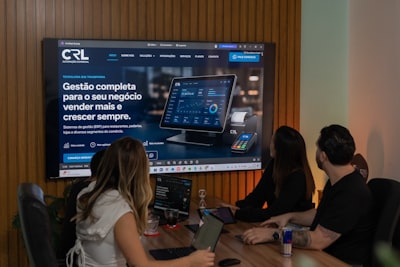
The transformation of remote and hybrid work has turned the corporate intranet into more than just a document repository. For distributed teams, the intranet with integrated chat is the organization's nervous system: it connects people, processes and knowledge in a single digital space. In Alicante, 2026 brings a concrete challenge: moving intranet pilots toward stable, scalable and secure production environments. Q2BSTUDIO approaches this challenge from a technical and business perspective, with a practical combination of custom software, artificial intelligence, cybersecurity and analytics.
The concept of the intranet has evolved quickly. For years, companies used the intranet as a static place to publish policies and organizational charts. With the consolidation of remote work, that vision fell short. Teams need to communicate without friction, consult up-to-date information and automate repetitive tasks. Integrated chat in the intranet is not an extra: it is the starting point for a dispersed workforce to collaborate in real time. If that environment also includes AI capabilities, employees can resolve doubts, summarize documents and generate reports without waiting for a technical department.
For a company with offices in Alicante, Madrid, Valencia or with people teleworking from other countries, the challenge is not only in the tool. It is in the production strategy. Taking an intranet to production in 2026 requires planning architecture, permissions, security and observability from day one. A pilot can work with test data; a production environment must coexist with critical systems, personal data and real business processes.
Q2BSTUDIO understands that difference. As a software development and technology company, its job is to design solutions that solve real problems, not to install a generic product. Every organization has different workflows, access policies and integration needs. That is why the first phase of any intranet with chat project involves understanding how the team actually works: what tools it uses, where knowledge is generated, who needs access to what information and what decisions employees can make without manual intervention.
The first strategic decision is choosing between standard platforms and custom applications. A standard solution can cover basic needs, but it often falls short when the chat has to be integrated with the ERP, the permission structure has to be adapted to the organization, or AI has to be incorporated with internal data sources. Custom software applications allow the construction of an intranet that fits real processes, avoiding rigid formulas that force companies to change the way they work. In addition, a custom application can grow with the company: adding modules, connecting new data sources and evolving without complete rewrites.
AI is, without doubt, the great accelerator of modern intranets. A traditional search engine returns links; an assistant with generative AI answers questions, writes communications, summarizes meetings and guides employees through internal procedures. For that to work in production, AI needs access to reliable data sources and a quality control mechanism. This is achieved with techniques such as retrieval augmented generation (RAG), which combines a language model with a corporate knowledge base and limits responses to authorized content.
In this scenario, AI agents have a growing role. An agent can, for example, review vacation requests, extract relevant information from the HR system and propose a response subject to a manager's validation. Another agent can classify internal incidents and assign them to the right team. Instead of replacing people, these agents eliminate low-value administrative work and allow the team to focus on strategic activities. Their deployment requires good governance: defining limits, recording actions and establishing human supervision in the most sensitive processes.
AI adoption must also be realistic. Connecting a large language model to an intranet is not enough. Data must be prepared, permissions defined, results measured and safeguards established so the assistant does not invent information. That is where integration experience makes the difference. Q2BSTUDIO applies an incremental methodology: first build a concrete use case, then measure its impact, and only when results are validated scale it to other departments.
Security is another fundamental pillar. An intranet with chat and AI agents handles confidential information: customer data, internal strategies, employee conversations. Cybersecurity cannot be a layer added at the end; it must be at the center of the architecture. Q2BSTUDIO incorporates role-based access control, multi-factor authentication, audit logging and encrypted communications. When the intranet needs to interact with on-premises systems, secure connections such as VPN or Azure Private Link are used so traffic does not traverse the public internet.
Infrastructure plays a decisive role in 2026 production. Many companies in Alicante already use cloud environments, but they do not always know how to configure them for an intranet project. Cloud services on AWS and Azure offer scalability, high availability and managed services that reduce the operational burden. Azure AI Foundry, for example, allows AI models to be deployed with data control, Active Directory integration and advanced privacy policies. AWS, for its part, offers complementary services for storage, computing and analytics.
In this type of project, the cloud is not just a place to host the application. It is the foundation for observability. Technology teams need to know whether the intranet is responding quickly, whether an AI agent is consuming more resources than expected, or whether the chat is logging errors. Monitoring tools make it possible to detect issues before they affect end users.
Business intelligence should also be present. A productive intranet generates valuable data: which news items are read most, which departments use the chat, which processes are successfully automated and where bottlenecks exist. With BI and Power BI, executives can visualize adoption indicators, response times and employee satisfaction. This turns the intranet into a strategic source of information, not a technology expense without measurable return.
Power BI also facilitates the creation of dashboards that unify data from the intranet, the ERP and other sources. Instead of asking IT for reports, business leaders explore metrics on their own. This autonomy is key to keeping the tool aligned with company objectives over time.
Regarding the production process, Q2BSTUDIO works with phased deliveries. In the first weeks, the architecture is defined, the systems to be integrated are identified and the environment is prepared. Then a minimum viable product is developed, including the most critical flows: chat, AI search, notifications and an administration panel. After validation with real users, the production environment is opened and usage is monitored. After launch, the support team makes adjustments and optimizations based on observed behavior.
One of the most common concerns is integration with existing business software. An intranet isolated from the ERP, CRM or human resources system loses much of its value. That is why Q2BSTUDIO designs connectors and APIs so the intranet can talk to SAP, Odoo, Salesforce, HubSpot, Microsoft 365, Google Workspace and other tools. The goal is not to replace systems, but to get more value out of them.
Companies of different sizes can benefit from this approach. A small business with twenty employees needs a simple intranet to organize documentation and communicate news. A company with one hundred workers may require chat, AI agents and BI. A multinational with several subsidiaries needs advanced governance, multi-language support and high availability. The flexibility of custom applications makes it possible to scale the solution without starting from scratch.
Deployment in Alicante in 2026 has positive connotations for the local technology ecosystem. Alicante has technical talent, business incubators and a strategic location on the Mediterranean. Producing an intranet from Alicante does not mean giving up the global market; on the contrary, it enables development with competitive costs and proximity to the client. Companies that address this project now will have a clear competitive advantage over those that continue using scattered tools.
Measuring return on investment is another aspect that Q2BSTUDIO takes special care of. Before development begins, key indicators and a baseline are defined. During the project, real results are compared with that baseline. At the end, decision makers have concrete data to justify the investment to management and to decide next steps.
Benefits usually appear in specific areas: reduced time searching for information, faster onboarding processes, fewer errors in manual tasks, better internal communication and greater employee satisfaction. In addition, by using AI agents, the organization can handle repetitive requests 24 hours a day without expanding the workforce.
For companies hesitating between waiting or taking the step, the advice is to start with a small but significant use case. There is no need to transform the entire organization in one month. It is enough to choose a department or a specific process, build an intranet with chat and AI that solves that problem, measure the result and scale from there. This approach reduces risk and builds trust among teams.
In short, the intranet with chat for distributed teams is a strategic bet for 2026. Alicante is emerging as a technology production point with great potential, and companies that know how to combine custom software, AI, cybersecurity, cloud and BI will obtain a sustainable advantage. Q2BSTUDIO supports this process with a multidisciplinary team that understands both technology and business.
If your company is considering taking its intranet to production in 2026, Q2BSTUDIO offers a free initial thirty-minute meeting to explore the project, identify first steps and estimate scope. The conversation will cover objectives, current systems, security requirements and timelines. After that meeting, management can make an informed and realistic decision without initial commitments.