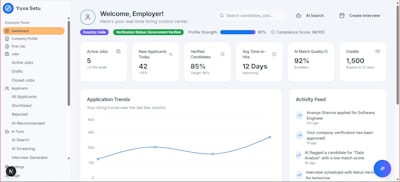
In today's business ecosystem, distributed teams are the norm, not the exception. Accelerated digitalization, remote and hybrid work, and the need to respond quickly to global markets have turned the corporate intranet into a strategic asset. However, an intranet is not simply a document repository: when it includes embedded chat, automation, and AI capabilities, it becomes the organization's central nervous system.
This article helps executives, IT managers, and project managers compare intranet for distributed teams with chat options in a structured way. It is not about choosing the tool with the most features, but about understanding what architecture, implementation model, and technology provider offer the best balance among security, integration, cost, and adaptability.
1. Compare by architecture, not only by interface. There is a common mistake in buying processes: evaluating visible features before validating the technical foundation. An intranet with chat can be attractive because of its design, but the real value appears when it integrates with existing systems, adapts to internal workflows, and is deployed with the appropriate security level. Therefore, the first question is not what options exist, but what specific problem the intranet must solve: accelerating onboarding, reducing internal email volume, centralizing knowledge, automating approvals, or making it easier for departments in different countries to collaborate.
2. Define success criteria before talking to vendors. An intranet should be measured by outcomes, not by the number of modules installed. Useful indicators include the time a new hire needs to find relevant information, the number of interruptions caused by uncoordinated channels, or the operating cost of repetitive administrative tasks. The more defined these criteria are, the easier it is to compare proposals. Q2BSTUDIO, a custom software and technology company, recommends starting with a discovery phase that maps these indicators. That exercise reveals the tools teams already use, detects process dependencies, and establishes a measurable baseline. From there, it is possible to build a minimum viable product within a few weeks and expand the platform according to what actually creates value. To get a fair comparison among vendors, ask for a discovery plan with concrete objectives and a named person accountable for the result, not only a product demo.
3. Custom software vs. generic platforms. A central decision is choosing between a standard platform and custom software development. Standard platforms offer fast implementation but often limit personalization and can create expensive vendor dependency. With custom applications, the company defines structures, permissions, chat types, and workflows based on actual needs. Q2BSTUDIO has built custom software solutions for companies that needed to cover very specific processes without changing their operating model. The expression custom software summarizes this approach well: a product that adapts to the company, not the other way around.
4. Integration with the corporate ecosystem. Another key question is how the intranet will connect to the ERP, CRM, HR system, BI platform, or Microsoft 365. An integrated chat is much more useful if it allows users to check operational data, receive alerts, or generate summaries without switching applications. Business Intelligence solutions such as Power BI help visualize scattered information and measure the intranet's impact on operations. Before deciding, ask for details about available APIs and connectors. An intranet that does not connect with what already exists often becomes a parallel system that few people use.
5. Cloud, cybersecurity, and governance. Infrastructure determines security and scalability. Many companies choose AWS or Azure to take advantage of auto-scaling and global availability. Others need to keep part of the data on their own servers. A hybrid model, with cloud applications and secure connectivity to on-premises environments through VPN or private endpoints, can satisfy both requirements. Q2BSTUDIO offers cloud services on AWS and Azure and supports the architecture decision. Cybersecurity must be part of the project from day one. In addition to authentication and encryption, penetration testing and code audits are recommended to detect vulnerabilities. Making security an acceptance criterion reduces risk and protects sensitive information.
6. AI, semantic search, and conversational agents. AI is redefining intranets. Beyond point-to-point chat, internal search engines now include direct answers, automatic summaries, and assistants that guide employees through recurring tasks. These systems can be trained on internal company documentation, connected to knowledge bases, and respond with corporate context. AI agents are the next step: software developments that not only converse but also execute actions, such as creating an incident, updating a record, or requesting an approval. When evaluating a vendor, ask how the information used by AI is protected and whether the code of the agents remains in the company's hands.
7. Budget, maintenance, and autonomy. A responsible comparison needs metrics before the project. For example, time to resolve internal requests, hours spent searching for documents, or number of approvals managed per week. With those figures, it is possible to estimate expected savings and justify the investment to financial leadership. Budget should not be based only on license prices: implementation time, integration cost, user training, and maintenance hours also matter. Ask about knowledge transfer: will the internal team be able to administer the intranet and tune AI agents without depending on the vendor for every change? Q2BSTUDIO delivers a web administration portal so business users can configure workflows and monitor metrics, something that marks the difference between a delivered project and an adopted project.
8. Pilot tests and selection criteria. Before closing a contract, try to validate the result with a pilot or proof of concept focused on a specific area. A well-defined pilot discovers integration problems, change resistance, and security gaps before large-scale investment. Also evaluate technical documentation, support response, and the provider's experience with similar projects. Asking for references in your sector helps avoid surprises. A provider's maturity shows in the quality of its questions during the discovery phase: a good technical team asks before promising.
9. Conclusion. Choosing an intranet for distributed teams with chat is not a minor decision. The difference between an isolated tool and a system connected to the business lies in architecture, security, and adaptability. Companies that combine custom software, automation, and AI gain a real competitive advantage because they make technology work for their processes and their people.