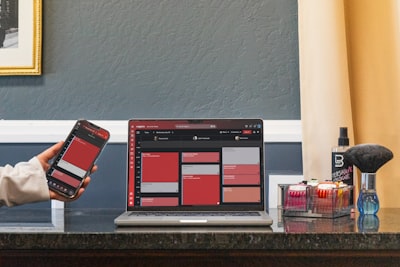
The question of whether an intranet for distributed teams with chat is truly mobile-compatible has a short answer: yes, provided it is designed with the right technical approach. The longer answer is more interesting, because it involves architecture, security, user experience and integration with AI systems. A modern intranet cannot treat mobile as an afterthought; it must be one of the main entry points. Teams need to access information, respond to chats and approve tasks from anywhere. Organizations that want to solve this challenge properly often rely on a custom software development company like Q2BSTUDIO, because designing a mobile intranet goes far beyond laying out screens.
Corporate intranets have kept evolving. A few years ago they were used to publish documents and announcements; today they operate as control centers where workflows are managed, expenses are approved, knowledge is shared, processes are automated and teams collaborate in real time. For distributed teams, mobile access is not a convenience: it is the usual way of working. If the mobile experience is limited to viewing PDFs or receiving notifications, the intranet loses its purpose. Real compatibility requires that the essential functions be available on the phone with the same quality as on the desktop.
Mobile compatibility is not just about resizing a website. It means choosing between a progressive web app and a native application. PWAs offer immediate access from the browser, push notifications and partial offline use, while native applications make better use of the hardware and operating system. Q2BSTUDIO, as a company specialized in custom applications, analyzes the context of each business and decides which combination delivers the most value. Sometimes the best option is a PWA for quick consultations and a native app for high-frequency tasks.
One of the most complex challenges is data synchronization. In a distributed environment, people may be at a construction site, at an airport or in an area with poor coverage. A mobile intranet must allow employees to work offline and automatically synchronize when the connection is recovered. To achieve this, teams use sync queues, encrypted local storage and conflict resolution rules. Without this level of detail, mobile compatibility is only theoretical and the tool creates frustration instead of productivity.
Security is the second pillar. Cybersecurity in an intranet with chat means protecting both the communication channel and corporate data. It is necessary to encrypt traffic, require multi-factor authentication and establish role-based access policies. In projects that combine artificial intelligence with internal systems, Q2BSTUDIO uses secure connections such as VPN tunneling and Azure private endpoints so that sensitive information does not travel over public networks. Regulatory compliance and access audit trails are also part of the solution.
Chat integrated into the intranet is a central element. For distributed teams, it must work in real time, maintain a persistent history and allow searches across conversations. On mobile devices, it must also send smart notifications: not every conversation needs an immediate alert. It is advisable for users to mute channels, prioritize contacts and receive daily summaries generated by AI. This combination reduces digital fatigue and ensures that relevant information arrives at the right time.
Artificial intelligence raises the level of a mobile intranet. An AI agent can answer questions about internal policies, summarize chat threads or draft responses from corporate sources. When the intranet is connected to the company's knowledge base, generative AI with retrieval-augmented generation provides answers with verifiable references. It is also possible to add human-in-the-loop mechanisms for sensitive decisions. In this way, mobile becomes a true self-service channel, not just a viewer.
For AI to be useful on mobile, it must be connected to operational data. Business Intelligence and Power BI solutions allow key indicators to be consulted from a phone. A manager can see sales trends, the status of open incidents or approval times from their device without opening a computer. That ability to make immediate decisions is one of the greatest advantages of a well-built mobile intranet, and it requires clean, updated and governed data.
Infrastructure also influences compatibility. An intranet for distributed teams needs a scalable cloud with low latency. Q2BSTUDIO deploys intranets on AWS or Azure depending on client requirements, taking advantage of managed services for databases, authentication and monitoring. The cloud not only guarantees availability, but also facilitates integration with corporate systems such as SAP, Salesforce or SharePoint. If a company wants to keep some processes on-premises, the architecture must include hybrid connectivity and encrypted tunnels.
Beyond technology, there is an organizational dimension. For a mobile intranet to be compatible with daily work, it must integrate with approval flows, notifications and task lists. If an employee receives an alert to approve an order, they should be able to approve it in three taps from their phone. If not, the tool will be perceived as a burden. The best technology is the one that disappears: the user thinks about the task, not about the system.
Measuring results matters. Companies that adopt a well-designed mobile intranet reduce response times, speed up employee onboarding and decrease dependence on email. Q2BSTUDIO projects include KPIs from the discovery phase, so every mobile feature is justified by its impact on productivity or cost reduction. Measuring actual use by device helps prioritize improvements and identify friction points.
What difficulties appear in practice? The first is integration with legacy systems. Many companies have data in local ERPs, spreadsheets or databases without APIs. The second is change management: employees need to learn how to use the mobile intranet and understand that it is an official channel. The third is information governance: defining who can publish, who can see each piece of content and how access is audited. These challenges are solved with methodology and a clear business vision.
A good intranet project must include a discovery phase to analyze current workflows, pain points and the systems involved. From there, a functional first deliverable can be built quickly. Q2BSTUDIO works with an incremental approach: an initial version is launched, its usage is measured and improvements are prioritized based on real data. This ensures that investment is focused on what truly generates value.
In environments with personal devices, BYOD adds another level of complexity. It is necessary to separate corporate data from personal data, define remote wipe policies and maintain a smooth experience. Enterprise mobility management solutions help, but the best practice is to design the intranet with secure sessions and granular access control from day one.
In short, yes, an intranet for distributed teams with chat is mobile-compatible if it is built with a mobile-first strategy. Companies looking for a robust solution should evaluate not only visible features, but also integration capability, security and the provider's experience in custom software. Q2BSTUDIO combines these three pillars with a practical approach, focused on measurable results and client autonomy in daily operations.