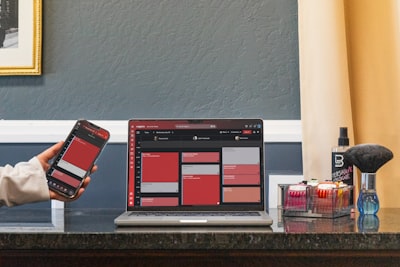
When a team is distributed, the main challenge is not technology but coordination. Information often stays isolated in emails, private chats, local documents and business applications that do not communicate with each other. An intranet for distributed teams with chat solves this by bringing instant messaging, corporate knowledge and workflows into one place. It is not just a notice board: it becomes the operational center from which people access what they need to get their work done.
Many companies make the mistake of choosing a standard solution and trying to adapt their processes to it. The result is usually a rigid platform that is adopted for a few weeks and then abandoned. The alternative is an approach based on custom software development. This way, the intranet is designed around the organization's culture, flows and priorities, not the other way around. An engineering team with experience in this type of project, such as Q2BSTUDIO, can build a solution that employees use every day because it responds to their real needs.
Chat is the element that gives life to the intranet. In distributed environments, email is too slow for operational issues and external messaging tools generate noise and fragmentation. A chat integrated into the intranet enables contextual conversations: each discussion can be linked to a project, a document, a customer or a task. Decisions stay logged next to the content that triggered them, preventing knowledge loss and making it easier to onboard new people.
For the intranet to stop being a passive repository, it needs a well-thought-out architecture. At the base is the user directory and access permissions, which determine who can see each resource. Above that, the document module organizes versions, metadata and searches. Chat adds the real-time collaboration layer, and the workflow engine connects tasks, approvals and notifications. Finally, an integration layer lets the intranet talk to the ERP, CRM and other applications already in use.
A key point is that the intranet does not necessarily have to replace all tools. In many Q2BSTUDIO projects it is designed as a unified front end that connects to existing systems, avoiding forced data migration and reducing risk. User experience is simplified because employees no longer jump from one application to another, while the backend maintains data consistency.
Artificial intelligence has completely changed what an intranet can do. A traditional search engine returns documents containing exact words; an intranet with AI understands the intent of the query and offers synthesized answers from multiple sources. For example, a new employee can ask how to request a holiday and the system finds the policy, turns it into clear language and shows a button to start the process. This same capability applies to meeting summaries, proposal analysis and report generation.
Beyond search, AI agents execute actions. Instead of just displaying information, they can create a ticket, update a record, send a reminder or prepare a draft reply. These agents operate under rules defined by the organization and include human supervision checkpoints for sensitive tasks. In this way, the intranet is no longer a knowledge base but becomes an active assistant that reduces manual work and accelerates operations.
Information visibility also improves with business intelligence. A dashboard inside the intranet lets each team see its metrics in real time: number of completed tasks, average response time, internal satisfaction level and usage trends. With BI and Power BI solutions, this data is integrated with the company's transactional systems and presented visually, helping executives identify bottlenecks and improvement opportunities.
Infrastructure matters as much as development itself. An intranet for distributed teams must be available everywhere and withstand usage spikes. Cloud platforms such as AWS or Azure provide scalability and high availability, and allow deployment close to users through regions and content distribution networks. At Q2BSTUDIO projects are designed considering the most appropriate cloud architecture for each client, whether public, private or hybrid.
Cybersecurity is not an add-on but a prerequisite. The intranet concentrates sensitive information, so it must include encryption in transit and at rest, multi-factor authentication, role-based access control and audit logging of relevant actions. AI agents and APIs that connect to other systems also need to be protected to prevent unauthorized access or data leaks. A team specialized in cybersecurity and pentesting can validate the solution before launch and periodically, reducing incident risk.
Implementation does not have to be a long process. The first step is discovery, analyzing current flows, available tools and the obstacles to be solved. From there, a minimum viable product is defined including the most critical functions: chat, document repository and basic search. With a solid base, advanced modules are added iteratively: artificial intelligence, workflows, dashboards and connectors to corporate systems.
A typical project can show results in a few weeks when an agile methodology is applied. The goal is not to deliver perfect software after a year, but to learn quickly from real usage and prioritize improvements with data. This way of working fits Q2BSTUDIO's philosophy, combining integration and AI experience with continuous delivery and business-oriented outcomes.
Impact is measured in operational and economic terms. Internal process cycle times are reduced because people find information faster and approvals move automatically through the flow. Manual and repetitive tasks decrease thanks to AI agents. Errors also decrease by minimizing manual data transfer between applications. Management gets a unified view that used to be scattered across separate reports.
Integration with the existing technology ecosystem is another success factor. The intranet is not born in a vacuum: it must coexist with the ERP, CRM, video conferencing tools, email and human resources systems. An integration layer through APIs lets actions performed in the intranet be reflected in source systems, keeping information consistent. This is one of the areas where custom development offers the most value, since no off-the-shelf product fits every scenario perfectly.
Ultimately, the intranet for distributed teams with chat is a strategic asset for building a more agile and connected organization. When designed with an artificial intelligence and automation approach, it becomes an asset that supports company growth. The question is no longer whether an intranet is needed, but what kind of digital experience the organization wants to offer employees. The answer lies in a flexible, secure and business-integrated solution that can evolve at the same pace as the organization.