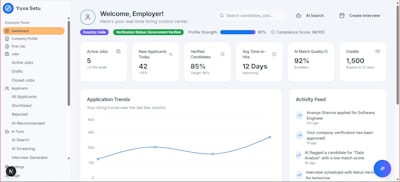
The corporate intranet has changed its meaning. It is no longer a place where documents are stored; it is the organization's digital operating system. In 2026, many European companies face a clear challenge: replacing SharePoint with a platform that combines user experience, automation, artificial intelligence, and real-time data. Q2BSTUDIO, a software development and technology company, approaches this challenge from a holistic perspective: first understanding the business and then proposing a technical solution based on custom software.
This article presents a success story developed in Europe. The client company had a mid-sized operation, with administration and operations teams relying on multiple disconnected tools. Information was scattered, processes required manual intervention, and management lacked a reliable view of what was happening. The goal was not to modernize for modernization's sake, but to solve concrete problems affecting results.
The first phase of the project consisted of analyzing real workflows. Q2BSTUDIO conducted interviews with department leaders, reviewed existing systems, and documented critical interactions. This diagnosis made it possible to identify improvement opportunities with higher impact, avoid generic solutions, and establish indicators that served as a reference throughout the project. Without this foundation, any technological implementation would have groped in the dark.
After the diagnosis, a modular intranet, built with custom applications, was designed to replace SharePoint's traditional structure with a proprietary digital ecosystem. The platform integrates the ERP, CRM, office tools, and internal systems through APIs and business events. Instead of forcing employees to change the way they work, the intranet adapts to existing processes and improves them where friction exists.
The project architecture relied on a hybrid cloud infrastructure with AWS and Azure. This choice offered the flexibility needed to scale services according to demand, keep data protected, and ensure business continuity. Environments were logically separated, automated backups were configured, and role-based access controls were implemented. In this context, the cloud is not a trend; it is the foundation for a fast, secure, and available intranet.
Cybersecurity played a central role in the design. A corporate intranet concentrates sensitive information, so any breach would have serious consequences. Q2BSTUDIO's team applied protection measures in multiple layers: encryption of data in transit and at rest, multi-factor authentication, continuous monitoring, and identity management. Penetration tests and security reviews were also carried out to validate that access was properly delimited.
The most innovative component was the integration of generative artificial intelligence with retrieval-augmented generation, or RAG. Instead of relying on a model with generic knowledge, the intranet connects AI with internal information sources: manuals, policies, minutes, contracts, and production data. Employees can ask questions in natural language and receive contextualized answers with source references. This mechanism reduces search time and prevents knowledge dispersion.
Alongside generative AI, AI agents oriented to specific tasks were incorporated. An agent can classify invoices, extract contract data, draft responses, or detect inconsistencies in records. Each agent works with supervision rules and human review checkpoints to avoid automatic decisions in complex contexts. This balance between autonomy and control is what allows automation to scale without creating risk.
Process automation was implemented through a visual orchestrator that connects the intranet with other applications. When an event occurs in a form, the system can update the corresponding record, create a task in the CRM, notify the manager, and update dashboards. All without manual intervention. In addition, the orchestrator includes retries, alerts, and execution logs, so teams can supervise each flow and fix incidents quickly.
Visibility for management arrived through a business intelligence layer built with Power BI. Data generated by the intranet, connected applications, and automated workflows were consolidated into a set of intuitive reports. Management can consult process status, resolution times, workload by team, and the impact of improvements. Information becomes a strategic asset, not just a historical record.
The migration from SharePoint was carefully planned to avoid disrupting daily work. Phases were defined by department, migration windows were established, and training spaces were created so each person understood the new functions. Q2BSTUDIO assisted users during the first weeks, answering questions and adjusting details. As a result, adoption was faster than expected and employees perceived the intranet as a real improvement.
During the first months of operation, the project team monitored the indicators agreed upon in the initial phase. Data showed a substantial reduction in manual tasks, an increase in process accuracy, and a significant improvement in internal response times. The company stopped relying on spreadsheets and emails to coordinate work. All relevant information became centralized and available to those who needed it.
The impact was not only operational. The intranet transformation generated a new collaboration dynamic. Teams began sharing information naturally, using indicators to prioritize tasks, and proposing improvements on the platform. Technology went from being a problem to becoming an enabler of change. Management, for its part, gained confidence because results could be verified with objective data.
A key lesson learned in this project is that integration with existing systems matters more than choosing a specific technology. Many organizations spend time and budget replacing tools that are still valid. Q2BSTUDIO demonstrates that it is possible to create an intelligent layer connecting current systems with new capabilities, achieving results in less time and with lower risk.
Another relevant lesson is the need to define indicators before starting to build. In this case, leaders agreed from the beginning which metrics would reflect success: cycle time, data quality, adoption rate, and reduction of administrative tasks. These indicators guided all design decisions and made it possible to demonstrate return on investment to the finance department.
The executive team realized that investing in an intelligent intranet is not an expense but an investment with measurable return. Reducing administrative hours, improving quality, and reacting quickly to market changes have a direct impact on results. Moreover, the platform can continue evolving with the business, incorporating new modules and services without starting from scratch.
For companies operating in several European countries, this solution is especially valuable. The intranet can be configured to respect languages, local regulations, and specific processes of each subsidiary while maintaining a consolidated view for headquarters. The combination of custom software, cloud, and AI agents creates a competitive advantage difficult to replicate with generic tools.
The future of intranets lies in personalization, intelligent automation, and the ability to learn from each interaction. Companies that have already made the move will not return to previous models because they have verified that a well-designed platform improves employee and customer experience. Q2BSTUDIO continues to support this type of project with a practical, results-oriented approach based on solid technology.
In conclusion, the 2026 success story shows that an intranet replacing SharePoint can generate a deep change in the way a company works. The combination of cloud architecture, cybersecurity, automation, business intelligence, and artificial intelligence allows the organization to become faster, more efficient, and more transparent. The question is not whether your company needs a modern intranet, but when it will start building one.