Smart onboarding intranet: success story in Madrid 2026
In 2026, companies in Madrid face a double challenge: attracting talent and retaining it while technology evolves. The corporate intranet is no longer a simple document repository. It is now expected to act as an intelligent environment, capable of guiding new employees from day one, answering questions, assigning tasks and measuring progress. Q2BSTUDIO, a software development company and technology consultancy, has turned this need into a real success story in Madrid: a smart onboarding intranet that shows how AI and automation can transform a company's operations.
The project began with a specific problem. A medium-sized company in Madrid managed employee onboarding through spreadsheets, emails and shared folders. Managers had to validate every task manually, new employees received scattered information, and the operations team spent many hours chasing signatures, checking document versions and repeating explanations. In addition, leadership did not have a clear view of each person's progress. This situation affected both productivity and the employee experience, which in 2026 has become a strategic priority.
The solution developed by Q2BSTUDIO was based on custom software. Instead of installing a closed application, a modular intranet was built that respects the company's processes and adapts to its culture. Each employee has a profile with a personalized onboarding plan, assigned tasks, relevant documents and a virtual assistant that answers questions immediately. The portal also allows HR to manage hires, departures and promotions from the same place. To achieve this, the development team worked closely with operations leaders and trained future system administrators.
The most innovative component was the virtual assistant based on artificial intelligence. Far from being a generic chatbot, it is connected to internal corporate documentation through a retrieval augmented generation (RAG) mechanism. In this way, answers are based on real policies, manuals and procedures. AI agents also classify documents, detect incomplete forms and suggest the next action within the onboarding flow. The system knows, for example, that a new employee cannot access the warehouse until the safety policy has been signed. That automated supervision prevents errors and frees up time for managers.
The next challenge was integration with existing systems. The company used Microsoft Teams, SharePoint, an ERP and a CRM. The new intranet could not force the client to abandon those tools. Therefore, connectors and APIs were built to synchronize users, permissions and notifications. The deployment was carried out with a cloud AWS/Azure architecture, ready to adapt to the client's infrastructure. This flexibility, common in Q2BSTUDIO projects, allows technology to adapt to each organization's policies rather than the other way around.
Cybersecurity was a cross-cutting requirement. Access to the intranet is protected by multi-factor authentication, roles and granular permissions. Every relevant action is logged to facilitate audits and comply with GDPR. When AI agents need to access sensitive information, communication goes through encrypted VPN tunnels and private cloud endpoints, preventing data from traveling over the public internet. Q2BSTUDIO applies these measures in projects that require a high level of control, without sacrificing usability or performance.
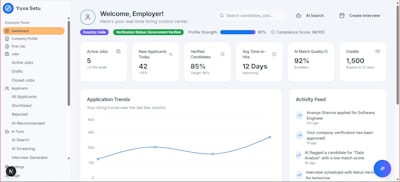
Another key dimension was measurement. A BI/Power BI dashboard was built to turn process data into a management panel. Leadership can see in real time the onboarding progress percentage, average time per task, most frequent questions and workflow bottlenecks. This visibility supports evidence-based decisions rather than intuition. For example, the data showed that a welcome guide generated many queries because its wording was confusing; once it was rewritten, queries dropped immediately.
The results were visible within the first few weeks. Onboarding time was reduced by more than 30%, manual tasks in the operations team dropped by nearly 40%, and new employee satisfaction improved significantly. Documentation errors went from being a constant to an exception. The management team was able to demonstrate return on investment with concrete data, something that does not always happen in digital transformation projects. For area leaders, the intranet stopped being an expense and became a productivity tool.
The project followed a phased methodology. During the first two weeks, Q2BSTUDIO consultants mapped workflows and defined key indicators. Then a minimum viable product was built and expanded through short delivery cycles. This approach allowed real employee feedback to be incorporated before full deployment. In addition, control points with human supervision were established for critical decisions, reducing risk and accelerating internal acceptance. Training system administrators was another essential part of making the business more autonomous.
One of the most important lessons was that technology alone does not change an organization. Change happened when HR and operations people stopped seeing the intranet as a burden and began using it as an ally. To achieve that, Q2BSTUDIO avoided imposing rigid processes. The methods that worked were respected, those that did not were digitized, and the reason behind every adjustment was clearly explained. Transparency during the project generated trust and reduced resistance to change.
The Madrid case shows that technology is most effective when designed around the business. A smart onboarding intranet is not a closed product that is simply installed. It is a living solution made of custom software, cloud connectors, artificial intelligence, process automation and a BI system that supports continuous improvement. For Q2BSTUDIO, the value lies in combining all these elements and transferring knowledge to the client. This way, the company does not only get an application, but also the ability to evolve with it.
In short, any executive who wants to improve talent onboarding in Madrid should consider a smart intranet, not as a trend but as a competitive advantage. The key is to start with a short diagnosis, define the metrics that matter, and involve teams from the beginning. Q2BSTUDIO offers exactly that: a combination of technical vision, AI and security experience, and a focus on measurable results. Companies that take this step in 2026 will be better prepared to attract and retain talent in a demanding market.