The concept of an intranet has evolved to become the digital backbone of organizations. In 2026, a company based in Bilbao with national or international reach needs more than a document repository: it needs a platform that connects people, processes and technology. The best way to achieve this is through custom software development combined with artificial intelligence and a clear business vision. An intranet with smart onboarding is one of the initiatives with the highest return because it directly affects productivity, employee experience and talent retention.
Bilbao is going through a unique moment. Its business ecosystem combines industrial tradition with emerging sectors such as energy, healthcare, tourism and advanced services. Workforces are increasingly diverse, with profiles working from the office, from home or from production plants. This reality makes onboarding a critical process: a new person must understand the culture, operations and tools in a short time. A well-designed corporate intranet with an AI-guided welcome flow enables integration to be progressive and measurable, not an obstacle course.
What exactly does smart onboarding mean? It is not just about sending a welcome email or uploading a PDF manual. It means offering each new employee a personalized plan based on their role, area and previous experience. It can include hiring tasks, access to resources, connection with mentors, team assignment, self-training and automatic milestone tracking. For this to work smoothly, the intranet must be able to query HR data, internal documents, training systems and calendars in real time. That is where artificial intelligence and AI agents provide a clear advantage.
A solution like this cannot be built with a generic off-the-shelf application alone. Every organization has its own departments, names, hierarchies and use cases. Therefore, it makes sense to approach the intranet with a custom software mindset, supported by integration with corporate systems such as ERP, CRM, productivity tools and HR platforms. At this point, Q2BSTUDIO's experience as a software development company is essential. Its team works with open architectures, APIs and microservices, preventing the intranet from becoming an island inside the IT ecosystem.
Furthermore, cloud technology is almost mandatory for a modern intranet. Using AWS or Azure cloud allows the platform to grow without friction, offer high availability and integrate with the most advanced AI services. In Bilbao, many companies are moving from local infrastructure to hybrid models in which the intranet is deployed in a private cloud or in a secure network with VPN connection to the on-premises environment. This flexibility is key when working with industrial data, financial information or human resources data.
Security is another reason not to improvise. An intranet handles sensitive information: contracts, salaries, performance reviews, customer data, internal processes. If AI is also incorporated, the data flow to language models, anonymization, access control and protection against information leaks must be considered. For this reason, Q2BSTUDIO applies cybersecurity principles from the design stage, with roles and permissions, access auditing, encryption in transit and at rest, and human supervision mechanisms in the most delicate automated processes. Trust is as important as functionality.
The user-facing part also matters. An intranet with smart onboarding must have a clear, mobile, accessible interface and support multiple languages if the company operates in international contexts. Employees should not have to read instructions in a PDF; they should find a digital assistant that guides them step by step. That assistant can be an advanced chatbot, a copilot that answers questions or a system that automatically creates support tickets. Behind this experience, custom web development, generative AI and process automation are naturally combined.
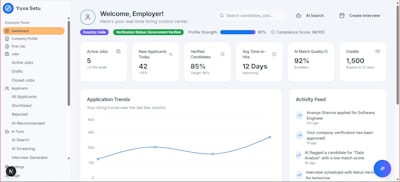
Another strategic element is measurement. Every intranet must be connected to business indicators. This is where BI/Power BI comes in as a tool for visualizing onboarding progress: time to full productivity, satisfaction of new employees, completion of training, content consumption and evolution by department. The information obtained supports data-driven decisions, not intuition. HR managers can check in a dashboard which areas need more reinforcement and which content is becoming outdated.
The cost of such an initiative is not a fixed price. It depends on variables such as the size of the organization, the digital maturity of its processes, the number of locations, the quality of master data and the desired level of automation. The support model and implementation speed also play a role. A scoped project, with a pilot in a specific area, makes it possible to validate hypotheses without committing a large budget. Afterwards, the resources generated by greater efficiency can be reinvested in expanding the intranet to other teams.
The choice of technology partner is decisive. Q2BSTUDIO has become a reference company in the development of custom digital solutions for businesses operating in Bilbao and global markets. Its approach combines senior engineering, knowledge of AWS/Azure cloud platforms and a results-oriented methodology. When commissioning an intranet project with smart onboarding, a team with experience in AI, cybersecurity, integrations and Business Intelligence can provide a complete vision from the beginning.
AI agents deserve a section of their own. We are not talking about simple bots that respond with predefined answers. In a next-generation intranet, AI agents can automate internal tasks: request time off, create reports, assign spaces, send reminders, update master data or escalate incidents. When a new employee joins, an onboarding agent can prepare their profile, request access, schedule training and answer frequent questions in the appropriate language. All of this reduces the HR workload and improves the employee experience.
To maximize profitability, it is wise to integrate the intranet with other solutions the company already uses. If an ERP exists, the intranet can display relevant operational data. If Microsoft Teams is used, the assistant can be embedded in the same work channel. If the organization has a CRM, sales onboarding can be fed with real customer and product information. The architecture must be flexible and API-based, so that new business needs are resolved without rewriting the entire platform. This is where custom software adds the most value.
In the legal and data protection field, an initiative of this type must be aligned with the GDPR and, where applicable, with sector regulations. The processing of personal data during onboarding is intensive: work history, identity documents, bank details, evaluations, etc. The intranet must record consents, allow the right of access and erasure, and maintain complete traceability of who has accessed what information and why. Security is not an extra; it is a starting requirement.
The immediate future points to AI as an integral component of any corporate tool. Companies that use multiple intelligences, autonomous agents and conversational assistants will have an advantage when adapting to a demanding market. Bilbao has the opportunity to position itself as a business transformation hub in Southern Europe, and the technology available in 2026 makes it possible to do so with robust, scalable solutions. Investing in an intranet with smart onboarding is not a minor expense: it is a commitment to efficiency, talent and competitiveness.
For companies considering this step, the recommended approach is to begin with an internal analysis of needs, identify current friction points and find a technology partner that understands both business and technology. Q2BSTUDIO offers that balance and supports the entire project lifecycle, from initial design to daily operations. The question is not whether your company needs a better intranet, but when it wants to stop losing time and talent to manual processes.