The corporate intranet has stopped being a simple document repository. In 2026, organizations that bet on an intranet with smart onboarding turn employee onboarding, knowledge management and internal automation into measurable efficiency levers. The goal is not just to digitize processes: it is to reduce waste, optimize resources and create a technology base that allows scaling without duplicating efforts.
In many companies, waste is not in machines, but in invisible processes: repetitive manual tasks, duplicated information, waiting times, corrections and knowledge that only lives in a few people's heads. A smart intranet attacks these points because it centralizes information, automates tasks and delivers visibility. When teams stop searching for data and start acting on it, the whole organization gains speed.
The key is to understand onboarding as a continuous process, not a three-day event. A well-implemented smart onboarding combines training content, automated checklists, mentor assignment and progressive access to systems. But it also records every interaction to detect bottlenecks. That telemetry lets HR and operations managers know exactly where time is lost and how to avoid it.
To achieve this, technology must be an enabler. Generic software solutions do not always fit the real workflows of each company. That is why more and more executives choose custom software that adapts to their processes, instead of forcing employees to adapt to rigid software. A custom development makes it possible to connect the intranet with ERP, CRM and productivity tools, and add exactly the functions the business needs when it needs them.
Artificial intelligence multiplies this potential. An internal search engine with semantic AI, for example, understands what the employee is asking and returns the answer extracted from the manual, the email or the resolved ticket. AI agents can solve frequent questions, create tickets or request holidays without anyone having to fill out forms. These assistants operate inside the intranet and are trained with company documentation, respecting permissions and access policies.
All this intelligence requires a solid infrastructure. A modern intranet is best deployed in cloud AWS/Azure, because it offers elasticity, high availability and managed AI services. Organizations that have already migrated to the cloud can integrate the intranet with active directories, databases and internal APIs. Those that have not can start with a hybrid environment. In any case, it is advisable to rely on Azure and AWS cloud services to keep the balance between performance and cost.
Cybersecurity is not an add-on, but a structural pillar. An intranet handles personal data, intellectual property and access credentials. If it is not well protected, it becomes an attack vector. Encryption in transit and at rest, role-based access control, session auditing and GDPR compliance are mandatory elements. In addition, when AI connects to internal systems, calls must be carried out through secure channels and the model must not expose sensitive information.
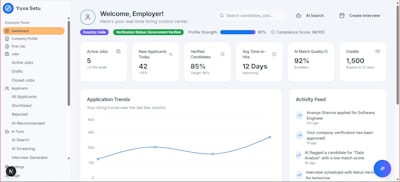
Another component that brings immediate value is the BI/Power BI layer, that is, Business Intelligence. An intranet with embedded indicators allows managers to see in one dashboard onboarding progress, new employee activity, training completion rates and business impact. Power BI facilitates this analysis without manually extracting data. When reports update themselves, decision-making stops depending on assumptions and is based on facts.
Waste reduction comes to life with early alerts and automation. Suppose a new employee has not completed mandatory training before accessing a system. The intranet can send a reminder, escalate the case to their manager or temporarily block access until the requirement is met. Or consider resource consumption: if a machine, vehicle or facility exceeds expected thresholds, the intranet detects it and launches a corrective action. This reaction capability is what separates a passive intranet from a smart one.
Q2BSTUDIO is a software and technology development company that designs these solutions with a practical approach. Instead of selling generic licenses, it builds custom intranets, integrates secure AI and automates workflows with measurable results. Its team combines cloud engineering, cybersecurity and data analysis so that the platform is not an end in itself, but a means to eliminate inefficiencies.
The working method starts with a discovery phase that maps current processes, dependencies between systems and baseline indicators. From there, a minimum viable product is defined in a few weeks. This allows the solution to be validated with real users before investing in larger developments. Integrations with SAP, Salesforce, SharePoint, Microsoft Teams or any custom API are approached incrementally, without disrupting operations.
Governance also matters. An intranet with smart onboarding must have different permission levels, activity logs and, when necessary, human supervision in critical decisions. The point is not to automate for the sake of automating, but to do it with control. Q2BSTUDIO configures dashboards so that the client can manage their own AI agents, adjust indicators and monitor costs without depending on the provider for every change.
Economic benefits appear because non-value-added work is eliminated. By reducing manual tasks, data-entry errors and search times, companies can reassign their teams to higher-impact activities. Moreover, the visibility provided by a unified dashboard makes it easier to detect cost overruns and renegotiate with suppliers. The result is a more agile operation, with less friction and a better employee experience.
For an executive evaluating this investment, the question should not be how much it costs, but how much it costs to do nothing. Manual processes are expensive: every hour spent searching for information, filling out forms or correcting errors is an hour not invested in innovation. An intranet with smart onboarding pays for itself when it reduces cycle times, avoids duplication and accelerates the productivity of new hires.
Deployment is agile. In a corporate environment, a project of this type can start in two weeks, show a first functional product in two months and finish in less than a four-month period. The cost depends on scope, integrations and level of AI, but it is usually far below the annual savings it generates. That is why financial executives understand the proposal better when they see a business case with KPIs and payback timelines.
What is more, there is no need to replace current systems. A smart intranet connects with existing infrastructure and adds a layer of experience, automation and analysis. Companies keep their investments in ERP, CRM and office tools. What changes is the way those systems talk to each other and to people.
Organizations that combine intranet, AI and automation are achieving lower operating costs, less material and energy waste, and more autonomous teams. Sustainability also benefits: by monitoring consumption in real time, schedules, inventories and production can be adjusted to use only what is necessary. Technology, when well applied, is an ally of efficiency and the planet.
In short, an intranet with smart onboarding is not a technological fad: it is a management decision. It reduces waste, optimizes resources, improves employee experience and generates actionable data. To achieve it, it is wise to work with a technology partner that understands both business and code. Q2BSTUDIO brings that combination, with a transparent and results-oriented approach. Those who take that step stop fighting fires and start building a smarter operation.